
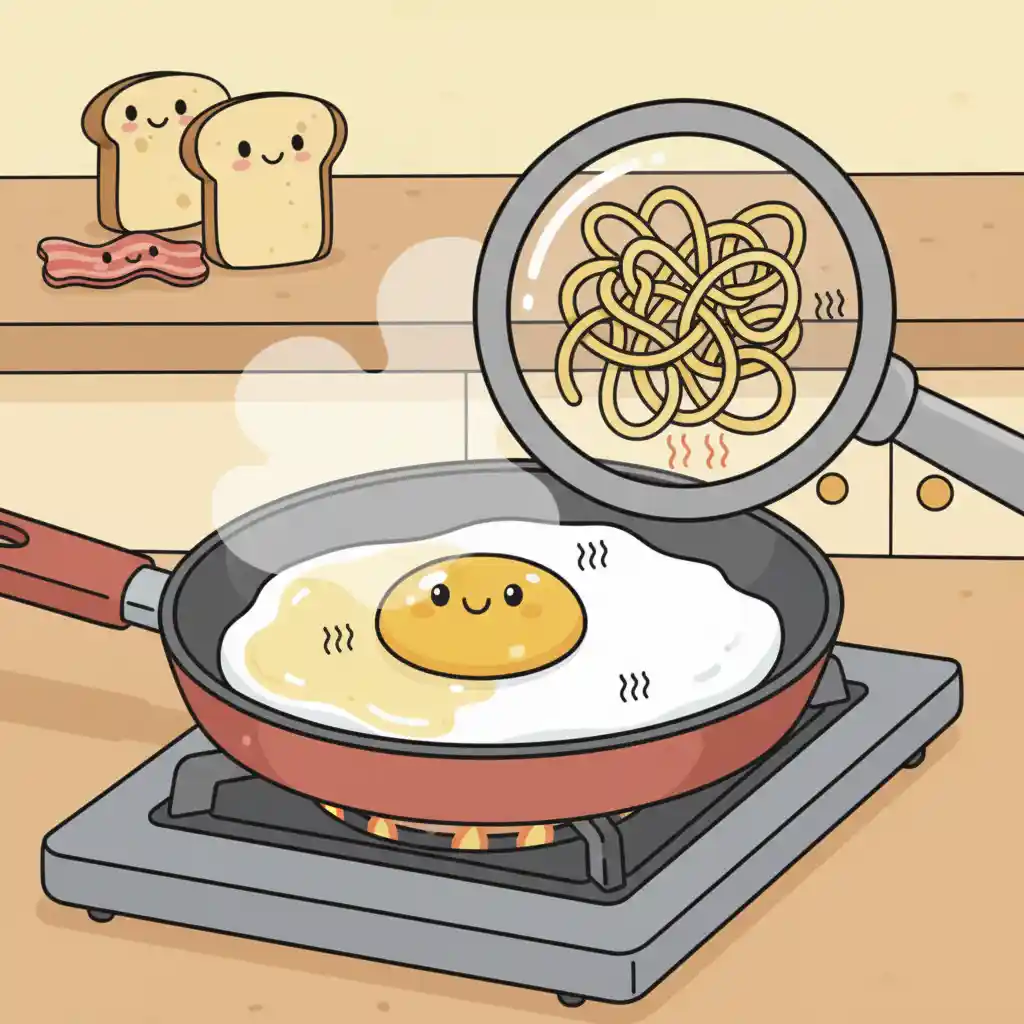
The Great Egg Mystery!
Imagine you're cracking open a fresh egg. What do you see? A clear, wobbly, almost watery white part surrounding a bright, runny yellow yolk. It's all liquid, right? But then, watch what happens when that same egg touches a sizzling hot pan. In just a few moments, the clear liquid turns into a solid, white, firm disc, and the yellow yolk becomes soft and creamy, or even hard, depending on how long it cooks. It's like a magic trick happening right before your eyes!
This isn't magic, though; it's pure kitchen science! The amazing change from a runny liquid to a yummy solid is all thanks to tiny, invisible workers inside the egg. These workers are so small you can't see them without a powerful microscope, but they do incredible things when they get a little warm.
Tiny Protein Super-Strings
So, what are these secret workers? They are called proteins! Think of the egg white as being full of millions of super-tiny, incredibly long strings. But these aren't just any strings; they're all neatly coiled up and twisted into tiny, neat little balls or knots, like a perfectly wound ball of yarn. They float around happily and freely in the watery part of the egg, minding their own business.
Because they're all tightly coiled and compact, they don't have many sticky parts showing, and they can slide past each other easily. This is why a raw egg is so runny and transparent – the proteins are happy in their little coiled-up worlds, not bothering anyone. They give the egg its liquid texture.
The Heat Dance Begins!
Now, let's turn up the heat! When the egg hits that hot pan, or goes into boiling water, something exciting happens to those coiled protein strings. Imagine turning up the music at a party, and everyone starts dancing wildly! The heat energy makes the protein molecules vibrate and wiggle with so much energy that they can't stay in their neat, coiled-up shapes anymore.
It's like unwinding a tightly wound ball of yarn very, very quickly. The proteins start to untangle and stretch out, unraveling from their compact little balls into long, wiggly, messy strands. This process, where proteins lose their original shape due to heat, is called denaturation (say: dee-nay-chur-AY-shun). Their neat little shapes are gone, and now they are long, floppy, and looking for something to do!
The Big Protein Hug
Once the proteins are untangled and stretched out, they aren't content to just float around randomly anymore. They become a bit 'sticky'! Those sticky parts that were hidden away when they were coiled up are now exposed. It's like finding Velcro on a stretched-out string!