
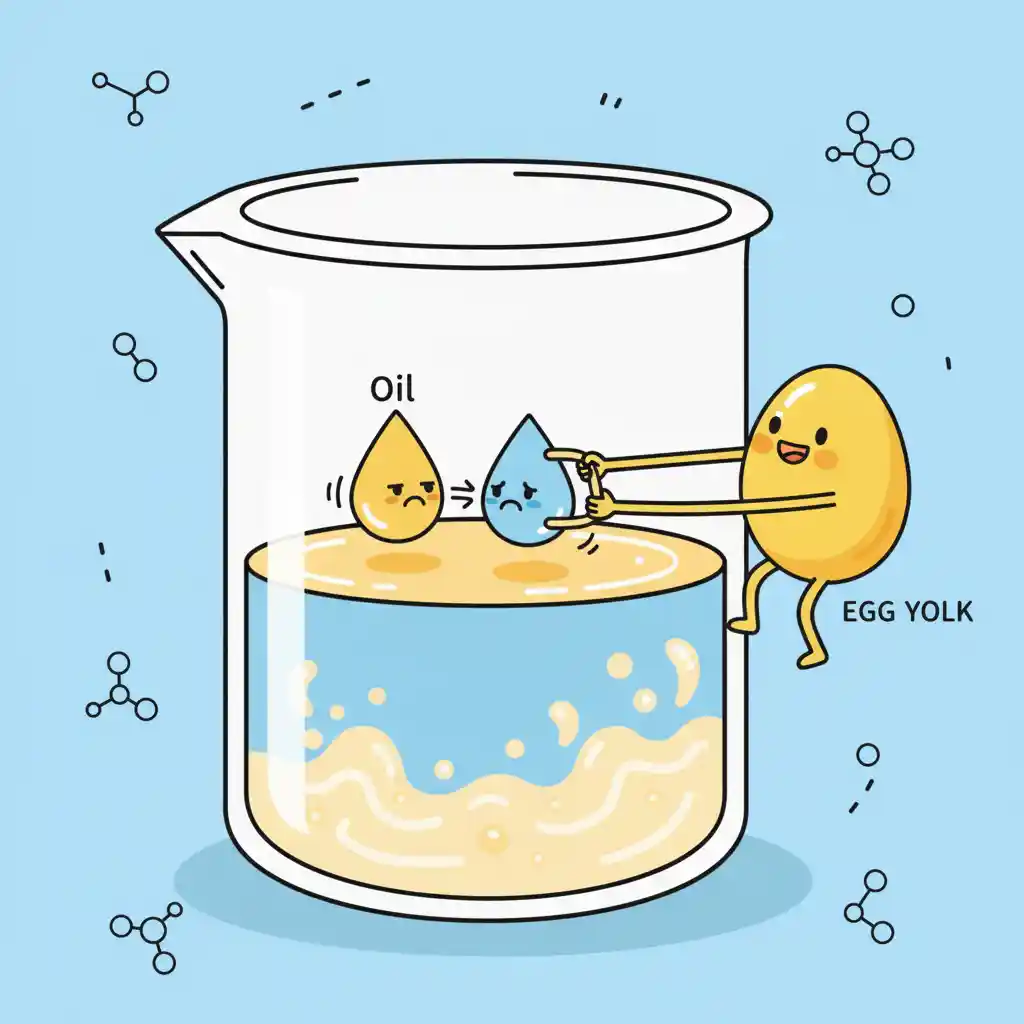
The Great Liquid Divide
Have you ever tried to mix oil and water? Maybe you've seen it in a salad dressing or when washing greasy dishes. No matter how much you stir or shake, they always seem to separate, like two friends who just can't agree on anything! Oil floats on top, and water stays at the bottom. But why do these two common liquids act like they're from different planets? Let's dive into the amazing world of molecules to solve this mystery!
Water: The Super Social Butterfly
Imagine water molecules as tiny, super-social butterflies. Each water molecule (H2O) has a slightly positive 'head' and a slightly negative 'tail,' kind of like a tiny magnet. Because they have these opposite charges, they are called 'polar' molecules. These polar molecules absolutely love to stick to each other, forming strong bonds and creating a very cohesive team.
They also love to stick to anything else that has a charge, like salt or sugar, which is why those things dissolve so well in water. We call these 'water-loving' substances 'hydrophilic' (hydro = water, philic = loving). Water molecules are always looking for other charged friends to hang out with!
Oil: The Quiet Loner
Now, let's look at oil molecules. Unlike our social water butterflies, oil molecules don't have those strong positive and negative ends. They're more balanced, without any strong charges. We call these 'non-polar' molecules. Because they don't have those 'sticky' charged parts, they don't really care for water's strong magnetic hugs.
Instead, oil molecules prefer to hang out with other oil molecules. They stick to each other in a different way, forming their own little groups, without bothering with the water. Substances that avoid water are called 'hydrophobic' (hydro = water, phobic = fearing). So, oil is a bit of a shy, hydrophobic loner when water's around!
The Big Push-Away Game
When water and oil meet, it's not really that they hate each other; it's more about how much water molecules love themselves! The water molecules are so busy hugging each other tightly that they simply push the oil molecules out of the way. Think of it like a group of close friends holding hands in a circle; if someone new (oil) tries to join, they just don't fit in the tightly packed circle and get pushed to the outside.