
When the Sky Spins Wild
Imagine a giant, invisible blender churning in the sky, suddenly dropping a swirling, roaring funnel right down to the ground! That's a tornado, one of nature's most spectacular and powerful shows. These amazing storms are columns of air that spin violently while touching both the ground and a thundercloud. They can be thin and rope-like, or wide and wedge-shaped, but one thing's for sure: they are full of energy!
Most tornadoes happen in a special part of the world called 'Tornado Alley.' This area stretches across the central United States, through states like Texas, Oklahoma, Kansas, and Nebraska. But why here? It's like a cosmic kitchen where all the right ingredients for these swirling giants come together perfectly.
The Perfect Recipe for a Twister
Creating a tornado is like baking a very wild cake, and it needs several key ingredients. First, you need lots of warm, moist air. This comes from the Gulf of Mexico, bringing humidity and warmth like a giant, steamy blanket. This air loves to rise because warm air is lighter.
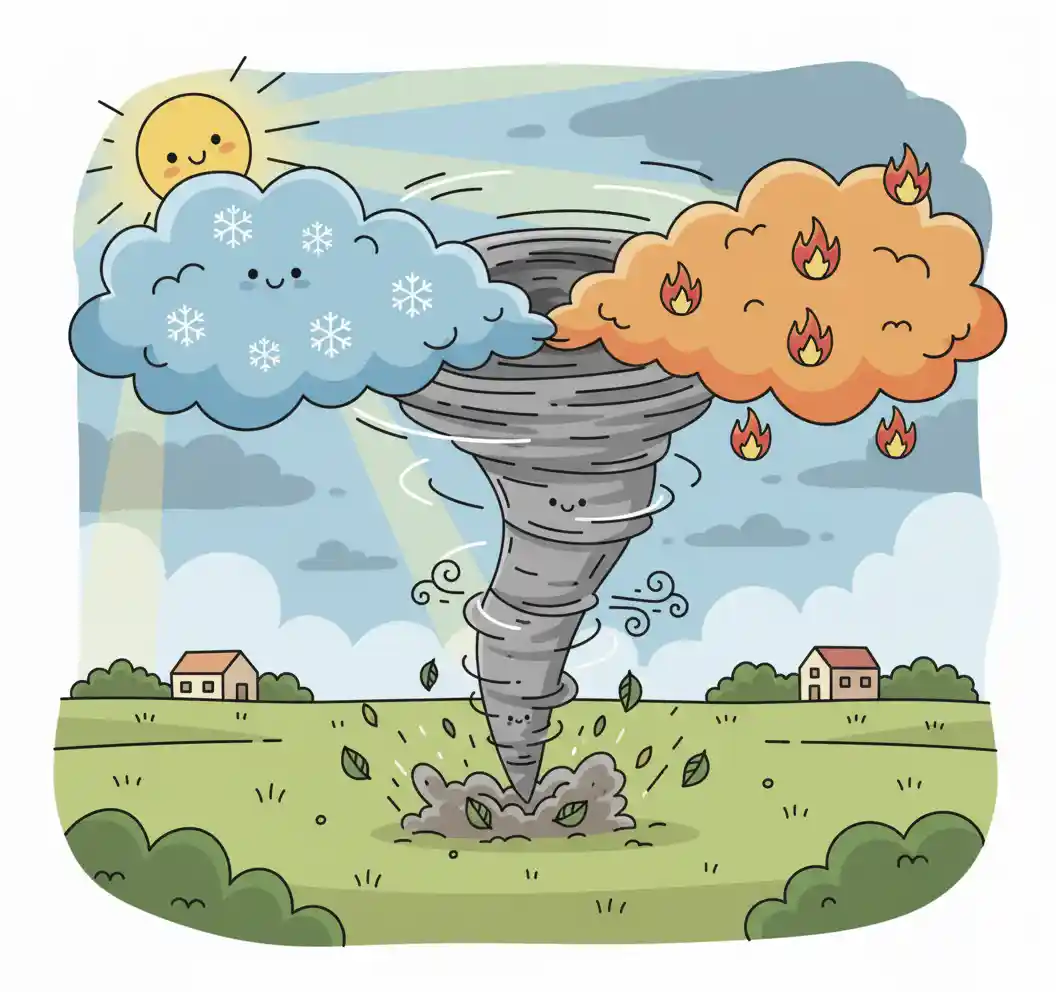
Next, you need cold, dry air. This usually blows in from the Rocky Mountains or Canada, acting like a heavy, cold lid. When this cold, dry air meets the warm, moist air, it creates a very unstable situation. Think of it like a bubbling pot of water with a lid on top – the steam wants to get out!
Finally, you need a layer of warm, dry air from the desert, sitting just above the warm, moist air. This acts like a 'cap,' trapping the warm, moist air close to the ground, allowing it to build up lots of energy. When that cap breaks, all that trapped energy explodes upwards!
The Invisible Spin: Wind Shear
Even with all those air masses, you still need one more secret ingredient: wind shear. This isn't just regular wind; it's when winds at different heights blow in different directions or at different speeds. Imagine rolling a pencil between your two hands, with one hand moving forward and the other backward – the pencil spins! That's what wind shear does to the air.
This causes the air to start spinning horizontally, like an invisible rolling pin, in the lower atmosphere. Now, remember all that warm, moist air trying to rise? When it bursts through the 'cap' and shoots upwards, it can tilt that horizontally spinning air straight up, turning it into a tall, vertical spinning column. This is the beginning of the powerful rotation that will eventually become a tornado.