
Not Just a Big Wave!
Imagine throwing a pebble into a pond. What happens? Ripples spread out, right? Now, imagine if the pond was the entire ocean and the pebble was a massive piece of Earth suddenly jumping! That's kind of like how a tsunami starts. It's not like the regular waves you see at the beach, which are made by wind. Tsunamis are much more powerful and mysterious, often starting far out in the deep blue sea.
A tsunami isn't just one giant wave; it's a series of incredibly powerful, long waves, sometimes called a 'wave train.' Think of it like a liquid wall of water that can stretch for miles and travel across entire oceans. The word 'tsunami' comes from Japanese words meaning 'harbor wave,' because they often arrive in harbors with devastating force, even if the open ocean felt calm just moments before.
The Earth's Giant Hiccup
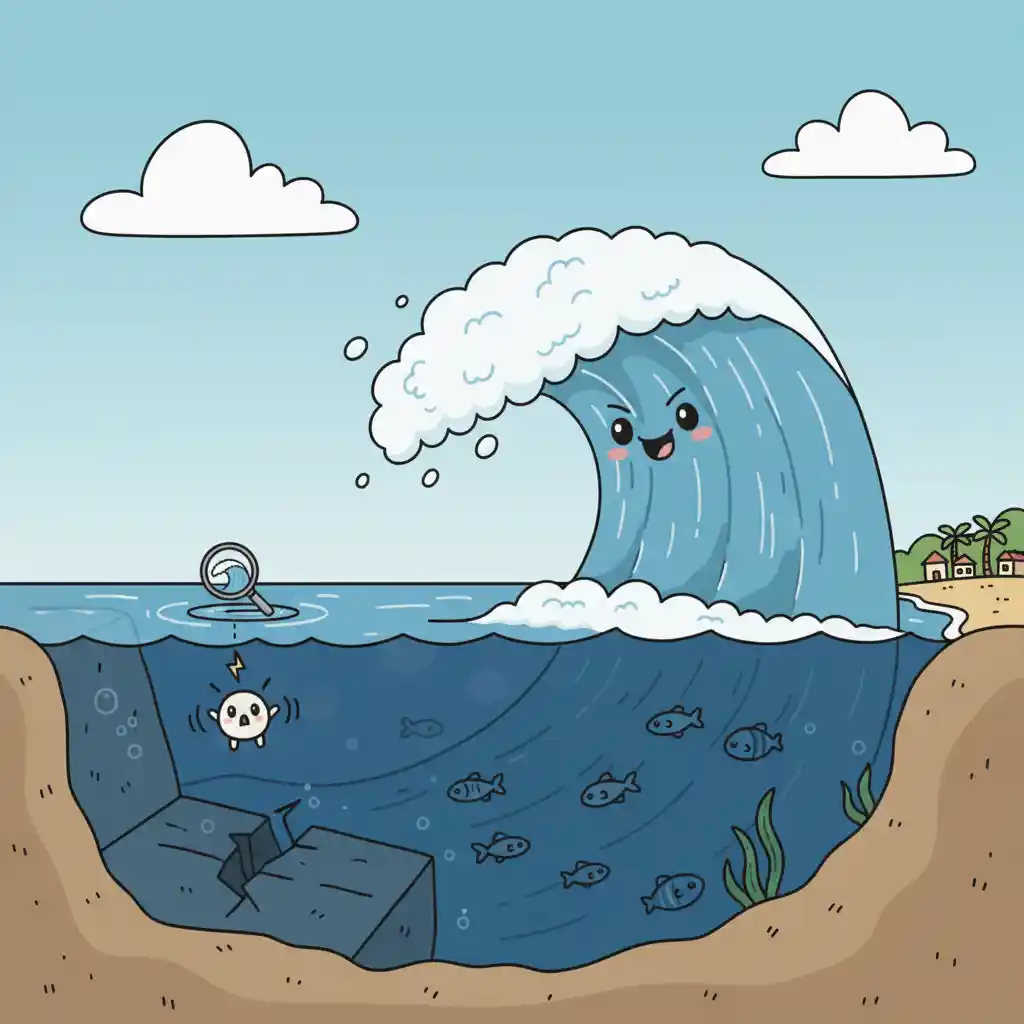
Most tsunamis begin with a massive 'hiccup' deep under the ocean—an earthquake! This usually happens in places where huge pieces of the Earth's crust, called tectonic plates, meet and grind against each other. When one plate suddenly slips or thrusts upwards, it's like a gigantic shovel pushing up the seafloor.
Imagine a giant mattress under the sea. If one part of that mattress suddenly springs up or dips down, what happens to the water resting on top of it? It gets pushed! This sudden movement of the seafloor displaces, or pushes, an enormous amount of water, from the very bottom of the ocean all the way to the surface. This is the starting gun for a tsunami.
Pushing a Liquid Mountain
Unlike a regular wave that just moves the surface water, a tsunami involves the entire water column, from the seabed to the surface. It’s like a giant invisible hand pushing the whole ocean. This means the energy of the tsunami isn't just at the top; it goes incredibly deep. Because so much water is moved, tsunamis carry a colossal amount of energy.
Think of the difference between blowing on the surface of your bathwater to make ripples, and actually pushing a big toy boat through the water. The boat pushes all the water in front of it, not just the top layer. A tsunami is like that toy boat, but on a scale so grand it’s hard to imagine, displacing trillions of gallons of water in an instant.
The Invisible Racer
Once a tsunami is born, it starts racing across the deep ocean. And when we say 'racing,' we mean super fast! In the open ocean, where the water is thousands of feet deep, a tsunami can travel at speeds of up to 500 miles per hour (800 km/h) – that's as fast as a passenger jet! If you were on a boat in the middle of the ocean, you might not even notice a tsunami passing by.