
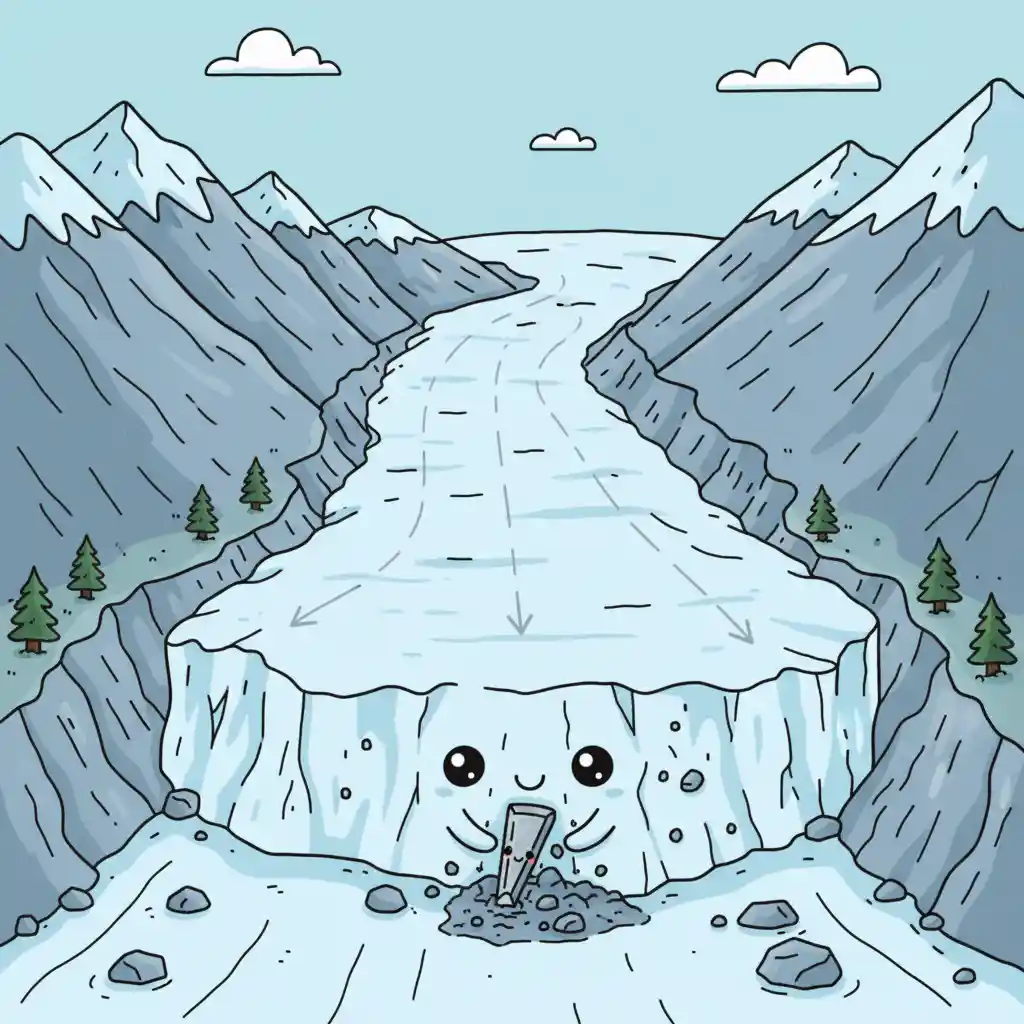
Rivers of Ice
Imagine a river, but instead of water flowing swiftly, it's made of a giant, slow-motion block of ice! That's kind of what a glacier is. It’s not just a frozen puddle or an ice cube; it’s a massive body of ice that forms on land and moves. Glaciers are incredible natural wonders, found in cold places all over the world, from towering mountain peaks to the vast polar regions.
They might seem still and quiet, but don't let their sleepy appearance fool you! Glaciers are constantly, though very slowly, on the move. They are so powerful that they can carve out entire valleys, move giant rocks, and reshape landscapes over thousands of years, like the Earth’s own super-sized, frozen bulldozers.
Born from Snow
So, how does a glacier begin? It all starts with snow! Not just any snow, but snow that falls in places where it never fully melts, even in summer. Year after year, new layers of snow fall on top of old ones. This fresh snow is light and fluffy, full of air.
As more snow piles up, the weight of the new snow squeezes the older snow beneath it. The snow crystals get squished, melt a tiny bit, and then refreeze, becoming denser and harder. This process continues for hundreds, or even thousands, of years! Eventually, the fluffy snow turns into a grainy, icy material called 'firn,' and then finally, into the dense, blue 'glacial ice' we see in a true glacier.
The Big Slide: Why Glaciers Move
Here's the big why: gravity! Just like a river flows downhill because of gravity, a glacier also moves because gravity is pulling its enormous weight down a slope. But ice isn't liquid like water, so how does it 'flow'?
There are a few amazing ways. One is 'internal deformation.' Even though ice looks solid, it's actually made of tiny ice crystals. Under immense pressure, these crystals can slide past each other, or even deform, allowing the whole mass of ice to slowly 'creep' or 'flow' like very thick syrup. Imagine a giant, stiff blanket slowly sliding off a bed—that's a bit like it!