
The Earth's Fiery Burps
Imagine a giant soda bottle, shaken and shaken, until the cap can’t hold the fizz anymore. POP! That's a bit like what happens when a volcano erupts! Volcanoes are incredible 'release valves' for our planet, letting out super-hot, melted rock, ash, and gases from deep inside the Earth.
They might seem scary, but they’re also a vital part of our planet's ever-changing story. From towering, majestic mountains that send ash sky-high to gentle, flowing rivers of fire that create new land, volcanoes come in all shapes and sizes, each with its own fiery personality.
Deep Down in Earth's Kitchen
Our Earth isn't just a solid ball; it's made of several layers, like an onion! The outermost layer, where we live, is called the 'crust'—it's surprisingly thin, like the skin of an apple. Below that is the 'mantle,' a thick layer of super-hot, gooey rock. And right at the center is the 'core,' which is hotter than the surface of the sun!
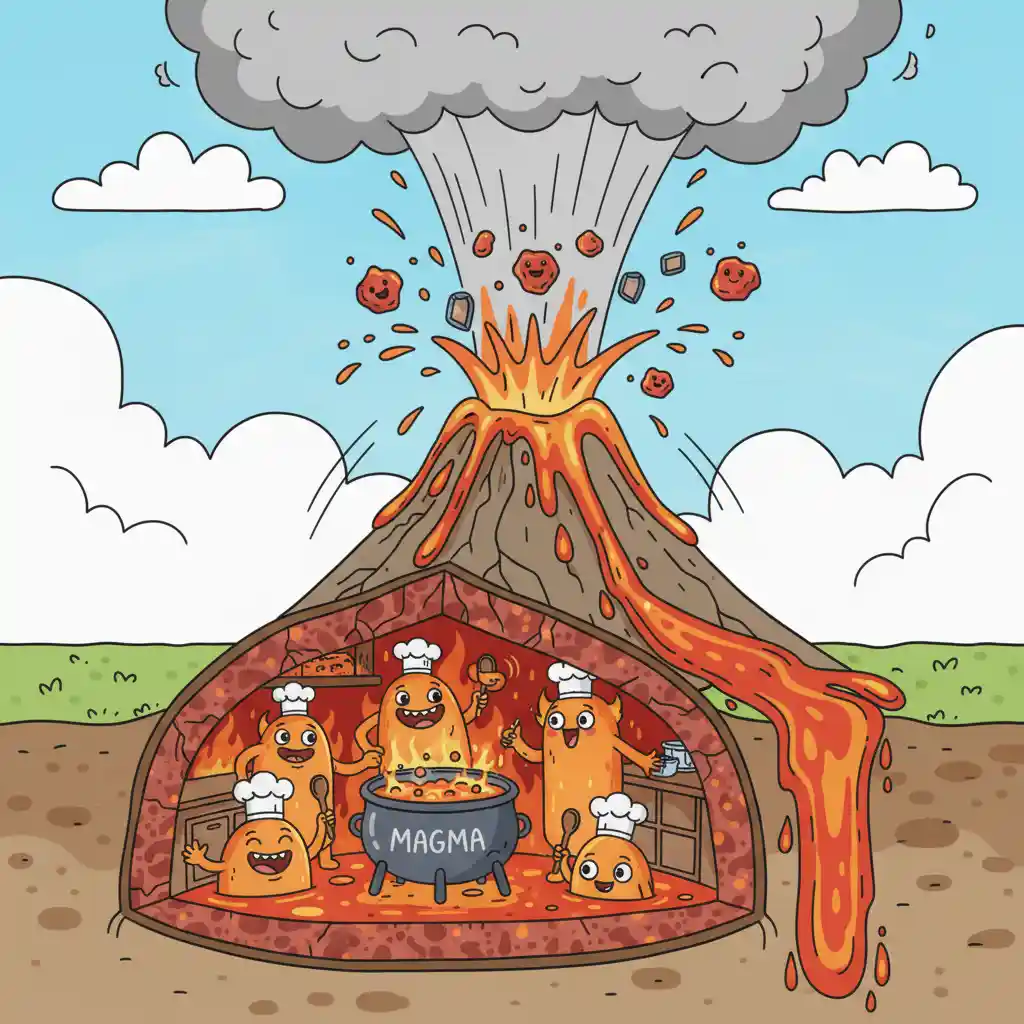
Most of the rocks in the mantle are solid, but don't let that fool you. The heat and pressure are so intense that some parts of this rock actually melt, turning into a thick, glowing, liquid goo we call 'magma.' Think of it as the Earth's own super-hot, molten soup simmering in its deep-down kitchen.
How Does Rock Melt?
You might wonder, 'How can rock melt when it's so hard?' Well, it's not like melting an ice cube! Rocks usually melt when two things happen: either the temperature gets unbelievably high, or the pressure holding the rock together decreases. Imagine squeezing a sponge underwater—if you release the squeeze, it expands!
Sometimes, water also plays a secret role! When water gets trapped in rocks and is dragged deep into the Earth, it can lower the melting point of the rock, making it easier for magma to form. So, it's a complicated recipe of heat, pressure, and even a little bit of water that creates the Earth's fiery liquid.
The Magma's Long Climb Up
Once magma forms, it doesn't just sit there. Magma is actually lighter, or less dense, than the solid rock around it. Think of a hot air balloon; it rises because the hot air inside is lighter than the cooler air outside. Magma does the same thing—it wants to rise!
It slowly pushes its way up through cracks and weaknesses in the Earth's crust, forming underground 'magma chambers'—like giant storage tanks for melted rock. If these cracks reach all the way to the surface, congratulations! You've found a volcano in the making.
The Big BOOM! Why Volcanoes Explode
Now for the exciting part: why do some volcanoes go BOOM? The secret is in the 'fizz'! Just like a can of soda has dissolved gas (carbon dioxide) that creates bubbles, magma has dissolved gases too, like water vapor and sulfur dioxide. Deep underground, immense pressure keeps these gases trapped and dissolved in the magma.
As the magma rises closer to the surface, the pressure above it decreases. This allows the gases to expand and form bubbles, just like when you open a soda can and the fizz appears. If the magma is thick and sticky, these gas bubbles get trapped, building up enormous pressure, much like shaking that soda bottle. When the pressure becomes too great, it's like uncorking a champagne bottle with super-explosive force—leading to a spectacular volcanic eruption!
However, if the magma is thin and runny, the gases can escape easily, leading to a more gentle flow of lava, like the beautiful, glowing rivers of fire seen in Hawaii. The stickiness of the magma is a huge factor in how a volcano will 'burp'!
Different Kinds of Fire Mountains
Not all volcanoes are the same! There are three main types. Stratovolcanoes (also called composite volcanoes) are the classic, cone-shaped giants like Mount Fuji or Mount Vesuvius. They have steep sides because they are built up by layers of sticky lava, ash, and rocks from explosive eruptions.
Shield volcanoes are enormous, wide mountains with gentle slopes, resembling a warrior's shield lying on the ground. These are built from very runny lava that flows easily and spreads out over vast distances, creating less explosive, but still powerful, eruptions (think of the volcanoes in Hawaii).
Cinder cones are the smallest and simplest type, usually short and steep, built from piles of volcanic rock fragments called 'cinders' that are ejected during somewhat explosive but short-lived eruptions.
Volcanoes Are Not All Bad!
While volcanoes can be destructive, they also do amazing things for our planet! Volcanic ash, though dangerous during an eruption, eventually breaks down into incredibly rich and fertile soil, perfect for growing crops. Many beautiful and lush regions around the world owe their greenness to ancient volcanoes.
Volcanoes also create new land! The Hawaiian islands, for example, were formed over millions of years by continuous volcanic eruptions building up layers of lava from the ocean floor. And finally, the Earth's heat from volcanoes can be harnessed as 'geothermal energy' to generate electricity, providing clean power for homes and cities. So, these fiery monsters are also incredible builders and providers!