
The Ocean's Hidden Highways
Imagine a world where rivers flow not just on land, but right through the middle of the ocean! That's exactly what ocean currents are. They are like giant, invisible rivers flowing through the sea, constantly moving water from one part of the world to another. Some currents are wide and slow, like a lazy stream, while others are fast and powerful, like a roaring waterfall, deep beneath the surface.
These hidden highways connect all the world's oceans, carrying warm water from the equator to the chilly poles, and cold water back again. They are truly the ocean's circulatory system, always on the move, shaping weather, distributing food for sea creatures, and even influencing how we live on land.
Sun, Wind, and Water's Dance
What makes these massive rivers start moving? Two big forces are at play: the Sun and the Wind. The Sun heats up the water near the equator, making it lighter. This warm, lighter water rises and starts to flow towards cooler areas. Meanwhile, colder, heavier water from the poles sinks and flows towards the equator. This constant exchange is like a giant conveyor belt, called thermohaline circulation (thermo for heat, haline for salt).
Then there's the wind! Powerful winds blowing across the ocean's surface push the top layer of water along. Think about blowing across a cup of hot chocolate – you create little ripples and movements. Imagine that on a gigantic scale, with winds like the 'trade winds' and 'westerlies' pushing vast amounts of ocean water across thousands of miles.
The Earth's Great Spin: The Coriolis Effect
So, we have water moving, but why does it spin? This is where the Earth's rotation comes in, creating something called the 'Coriolis Effect.' Imagine you're on a giant merry-go-round and you try to roll a ball straight to a friend across from you. The ball won't go straight; it will curve to the side because the merry-go-round is spinning under it!
The Earth is like that giant merry-go-round. As ocean currents (and winds!) try to move in a straight line, the spinning Earth deflects them. In the Northern Hemisphere, currents curve to the right, and in the Southern Hemisphere, they curve to the left. This invisible push is what makes the ocean's 'rivers' swirl into massive, slow-motion whirlpools!
Giant Swirls: Ocean Gyres
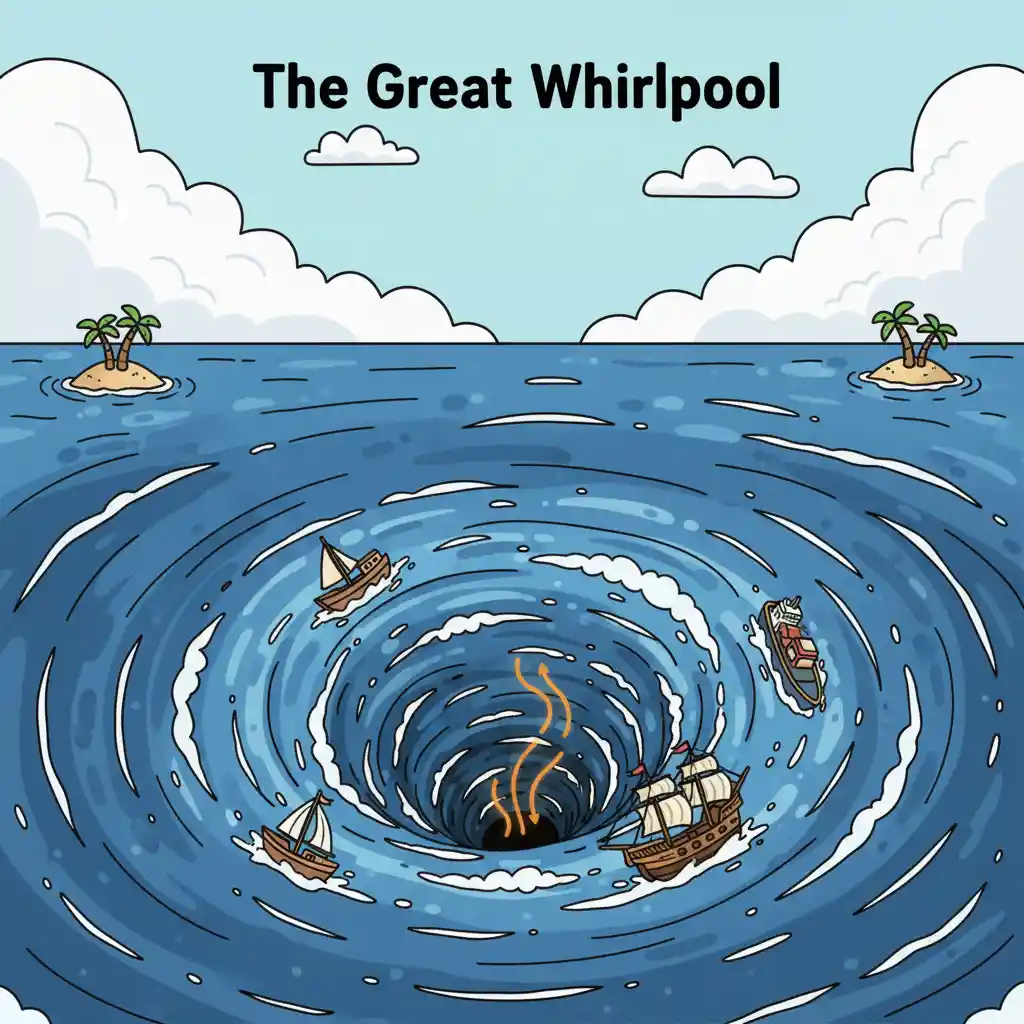
These enormous, spinning systems of ocean currents are called 'gyres.' They are the 'great whirlpools' of the ocean, but don't imagine them like a bathtub drain! They are thousands of miles wide and move very slowly, taking years, or even decades, for water to complete one full loop. There are five major gyres around the world, like the North Atlantic Gyre and the South Pacific Gyre.