
The Echo Riddle
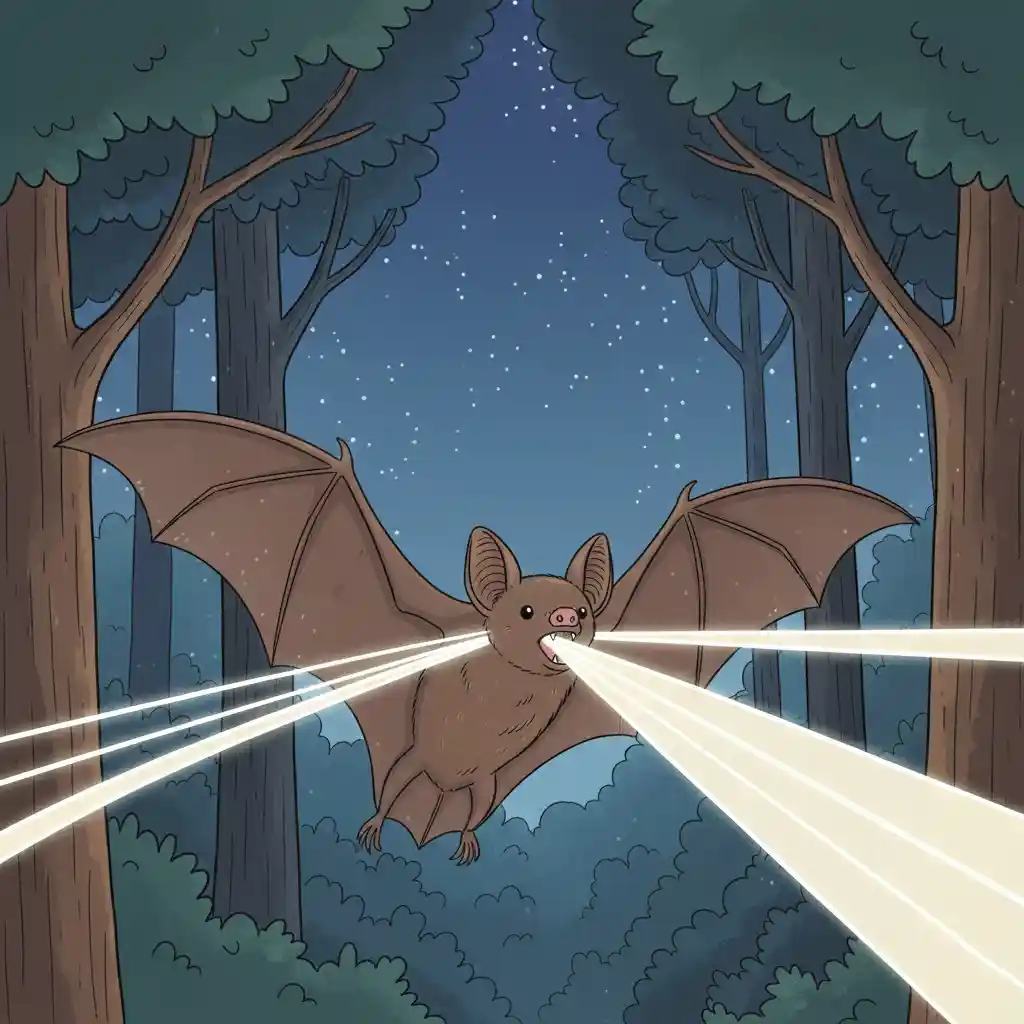
Imagine running through a dense forest at night with your eyes closed. For a bat, this is a daily routine. They solve the riddle of darkness using echolocation—a system of seeing with their ears.
They emit super-high-pitched 'screams' called ultrasound. These sounds are so high that human ears cannot detect them, but they carry an incredible amount of information about the physical world.
Bouncing Off Reality
When a bat's sound wave hits an object—like a mosquito or a tree branch—it bounces back like a rubber ball hitting a wall. The bat's massive, sensitive ears catch this returning 'echo.'
By measuring exactly how long it took for the sound to return, the bat's brain calculates the distance to the object. It is a biological sonar system that is more accurate than many human-made devices.
The 3D Mental Map
A bat doesn't just hear a 'ping'; it hears a shape. By processing thousands of echoes every second, the bat's brain builds a high-definition 3D map of its environment.
They can sense the texture of a leaf, the thinness of a wire, and even the type of insect they are chasing, all without ever seeing it with their eyes. Sound becomes their light.
The Doppler Effect
Bats can even predict the future movement of their prey. By listening to how the pitch of the echo changes as it returns, they can tell if a bug is flying away or coming closer.