
The Head-Banging Superheroes
Have you ever heard that 'rat-a-tat-tat' sound coming from a tree? That's a woodpecker, hard at work! These amazing birds spend their days hammering away at trees, looking for tasty bugs hiding inside the wood, or carving out a cozy nest. But here's the big WHY: how do they do all that pecking—sometimes over 12,000 times in just one day—without getting a super-duper headache or, even worse, brain damage?
Imagine hitting your head against a wall. Ouch! Even a tiny tap can make you feel dizzy. A woodpecker, however, smashes its head into a tree with forces up to 1,200 times the force of gravity! To put that in perspective, astronauts training for space only experience about 4-6 times the force of gravity. If a human experienced what a woodpecker does, their brain would turn into mush. So, what's their secret? Let's unlock the incredible engineering behind these feathered head-bangers!
A Beak Built for Business
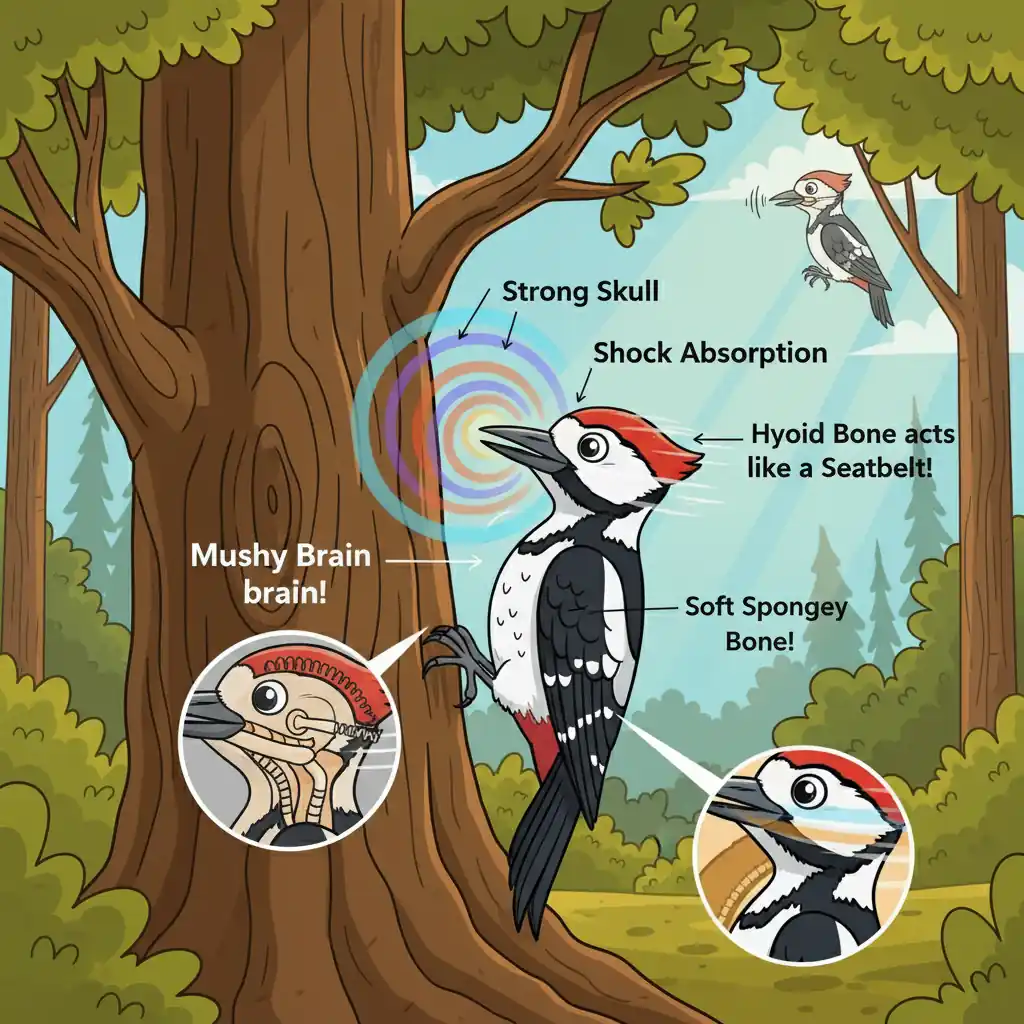
The first secret starts with their awesome beak! A woodpecker's beak isn't just one solid piece; it's designed like a tiny, super-strong chisel. The outer layer is extra tough, perfect for breaking through hard bark and wood. But the inner part of the beak is slightly softer and more flexible. This isn't a mistake; it's a clever trick!
When the woodpecker strikes the tree, the hard outer layer does the cutting, but the slightly softer inner layer helps to absorb some of that powerful shock, like a tiny cushion. Think of it like a car bumper that crumbles just a little bit to protect the rest of the car in a small bump. This two-part design spreads out the force, meaning less of it gets sent straight to the bird's brain.
The Spongy Helmet
Next up is the woodpecker's incredible skull, which acts like a built-in superhero helmet! Unlike a human skull, which is mostly solid bone, parts of a woodpecker's skull are made of a special kind of spongy, porous bone. Imagine a sponge or a piece of foam – it has lots of tiny holes and air pockets inside.
When the woodpecker pecks, the impact energy travels through its beak and then hits this spongy bone. Instead of all the force going directly to the brain, the spongy bone squishes and absorbs much of that energy, like a shock absorber in a car. It's like having hundreds of tiny springs inside their head, cushioning every single blow!
The Tongue's Superpower: A Built-In Seatbelt
This might sound strange, but a woodpecker's tongue is one of its most important brain protectors! Their tongue is incredibly long, sometimes so long it can wrap around its entire skull! This amazing tongue is attached to a flexible bone called the hyoid bone. Instead of just staying in their mouth, this bone wraps all the way around the back of their skull, over the top, and sometimes even into their nostril!
When the woodpecker pecks, this long, stretchy tongue and hyoid bone act like a super-tight seatbelt or a springy suspension system for its brain. It holds the brain firmly in place, stopping it from jiggling around inside the skull during those powerful impacts. This prevents the brain from hitting the inside of the skull, which is what causes concussions in humans.