
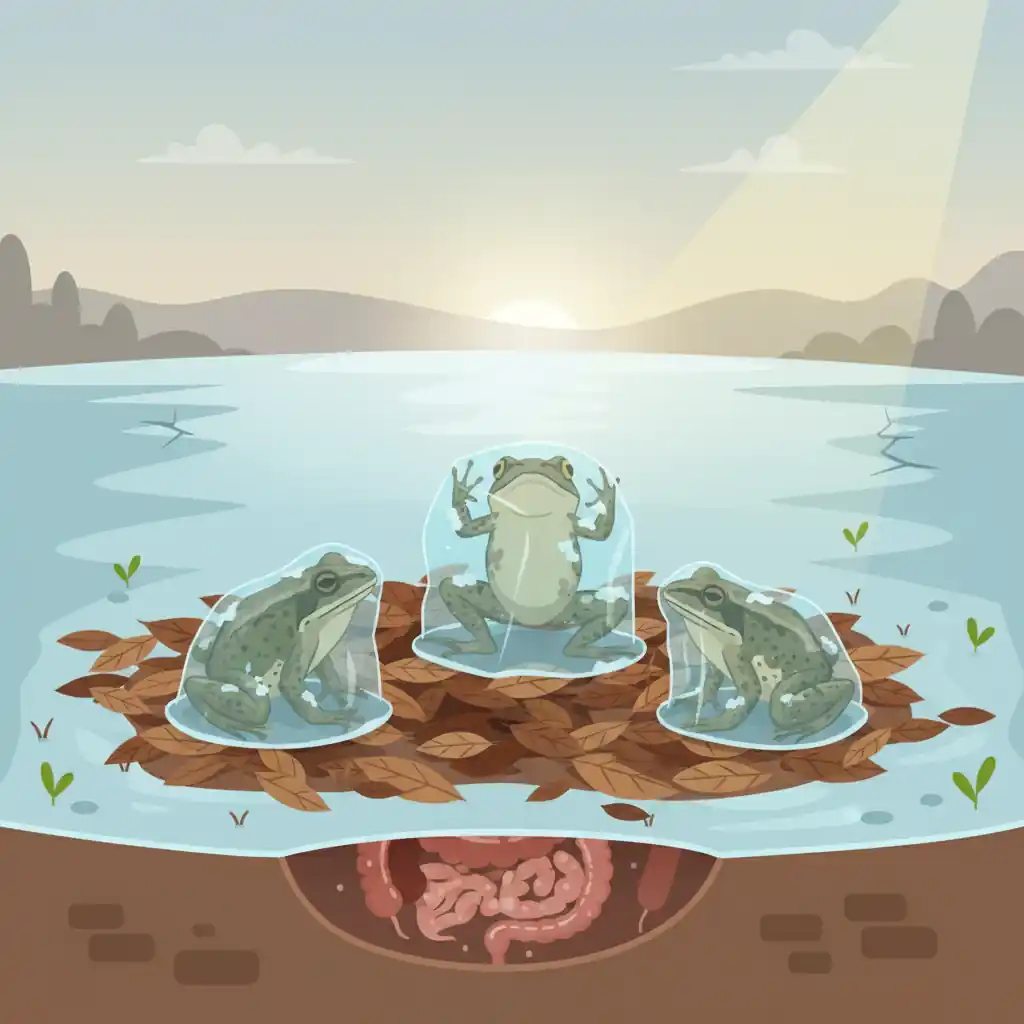
The Incredible Ice Frogs!
Imagine this: It’s the middle of winter, and everything is covered in a thick blanket of snow and ice. Most animals are snuggled deep in burrows, or flying south to warmer places. But not the amazing Wood Frog! This little amphibian does something truly mind-blowing. It lets itself freeze solid, like an ice cube, and then, months later, when spring arrives, it thaws out and hops away, good as new! How in the world can a frog turn into ice and come back to life? Let's dive into this super-cool mystery!
The Wood Frog is a small, brownish frog often found in forests across North America, especially in colder regions. Unlike many of its froggy cousins who might try to burrow deep underground below the frost line, the Wood Frog takes a different approach. It chooses to embrace the cold in a way that seems utterly impossible for almost any other creature. It’s like a real-life superhero with a power so unique, it sounds like something out of a science fiction movie.
A Deadly Freeze for Most Creatures
First, let's understand why freezing is usually a really, really bad thing for living beings. Think about what happens when water turns into ice. It expands! If you’ve ever left a bottle of soda in the freezer for too long, you know it can explode. That's because the water inside expands as it freezes, pushing outwards with incredible force. Our bodies, and the bodies of most animals, are mostly made of water.
When the water inside our cells and blood freezes, it forms sharp, pointy ice crystals. Imagine millions of tiny, microscopic daggers poking and bursting your cells, blood vessels, and even your vital organs like your heart and brain! This damage is usually irreversible, meaning once it happens, there's no going back. This is why frostbite is so dangerous to humans and why most animals would simply die if their bodies froze solid.
Nature's Sweet Anti-Freeze Secret
So, how do Wood Frogs avoid this cellular disaster? They have a secret weapon, and it's something you might recognize: sugar! When the temperature starts to drop in autumn, the Wood Frog's amazing liver goes into overdrive. Instead of just making a little sugar for energy, it starts pumping out huge amounts of a special kind of sugar called glucose (the same sugar we find in our blood, but way more concentrated in the frog!).
This glucose isn't for snacking; it's like a natural anti-freeze for the frog's body. Just like the anti-freeze in a car keeps the water in the engine from freezing and expanding, this super-sugary solution helps protect the frog's cells. The glucose acts in two clever ways: first, it lowers the freezing point of the water inside the cells, making it harder for ice crystals to form there. Second, it draws some of the water out of the cells and into the spaces between the cells. This is where ice can form safely, without bursting the cell walls!
The Big Chill: From Frog to Froz
Once the anti-freeze sugar is in place, the real magic (and science!) happens. As the ground temperature falls below freezing, tiny ice crystals begin to form on the frog’s skin. These crystals then spread throughout the frog's body, but crucially, only in the extracellular spaces – the areas outside the cells. Slowly but surely, the frog begins to freeze solid.
During this freezing process, everything in the frog's body seems to stop. Its heart stops beating, its breathing stops, and its brain activity goes completely silent. The frog becomes stiff, cold, and appears lifeless. If you were to pick up a frozen Wood Frog, it would feel like a little block of ice, truly indistinguishable from dead. It can stay in this frozen, suspended animation for days, weeks, or even months, waiting for the return of warmer weather.