
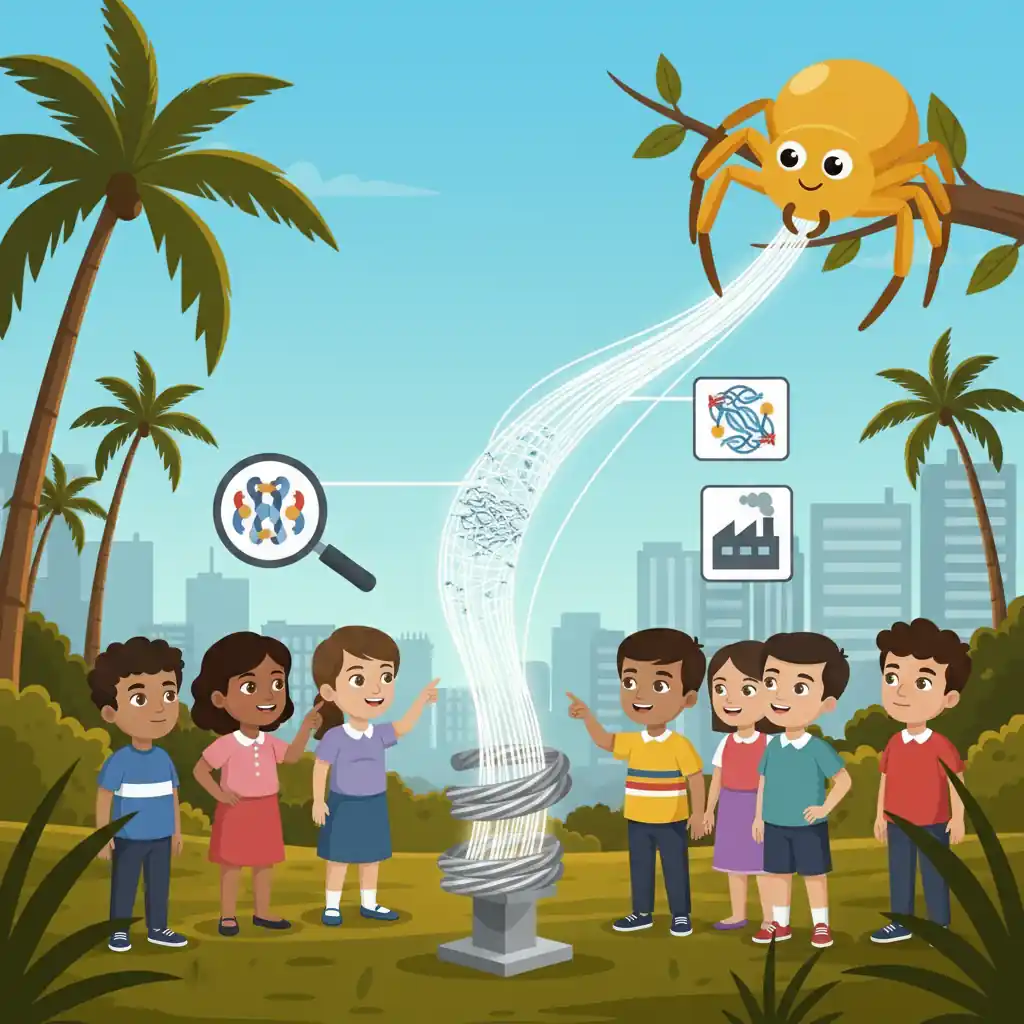
The Tiny Architects of Amazing Threads
Imagine a superhero with the power to spin ropes stronger than steel, stretchier than rubber bands, and lighter than a feather! Sounds like a comic book, right? Well, nature already has these tiny superheroes, and they live all around us: spiders! Their secret weapon isn't a superpower ray; it's something called spider silk. This isn't just any old string; it's one of the most incredible materials on our planet.
For millions of years, spiders have been busy little engineers, weaving intricate structures with their marvelous silk. From sticky traps to strong safety lines, and even tiny parachutes for flying through the air, spider silk does it all. It’s like a magical Swiss Army knife for these eight-legged wonders, and scientists are still amazed by its strength, elasticity, and versatility.
So, how does a creature smaller than your thumb create a material that makes human-made super-materials look weak? Get ready to unravel the 'Big Why' behind the spider's secret, and discover how these tiny architects spin engineering miracles right before our eyes!
Not Just One Silk! A Spider's Toolbox
When you think of spider silk, you probably imagine a sticky web catching flies. But did you know that spiders don't just make one type of silk? Oh no, that would be far too simple for these clever critters! A single spider can have up to seven different kinds of silk glands, each producing a unique type of silk for a specific job.
Think of it like a builder having a whole toolbox. There's dragline silk, which is super strong and stretchy, used for the main frame of a web and as a safety line (like a mountaineer's rope). Then there's sticky capture silk, designed to ensnare prey. Some silks are used to wrap up dinner, while others create cozy egg sacs to protect baby spiders.
They even have silk for 'ballooning,' where young spiders release a long strand into the wind and literally fly through the air to new homes! Each silk has a different recipe of proteins, making it perfect for its special task. It's truly an all-purpose, custom-made material.
The Amazing Liquid-to-Solid Trick
How do spiders make all this incredible silk? They don't have tiny weaving machines! Instead, it's a bit like magic, happening right inside their bodies. Spiders have special organs called 'spinnerets' located at the back of their abdomen. These spinnerets are like tiny nozzles, and they're connected to glands that hold a gooey, liquid protein solution.
This liquid protein is the raw material for silk, and it's mostly water with lots of very special protein molecules called 'spidroins' floating around. When the spider decides to spin, it pulls this liquid through a narrow, super-fine tube. As the liquid is pulled, the protein molecules start to line up in a very orderly way, and the water is removed.
Think of it like squeezing toothpaste from a tube, but imagine the toothpaste instantly hardening into a super-strong thread as it comes out! The pulling, the change in acidity, and the removal of water all work together to transform that gooey liquid into a solid, incredibly strong silk fiber in a blink of an eye. It's a natural spinning factory!
The Secret to Super Strength: Tiny Blocks and Stretchy Bands
So, what makes spider silk so unbelievably strong and stretchy at the same time? The secret lies in its microscopic structure, a brilliant design engineered by nature over millions of years. Imagine a rope that's not just one strand, but made of millions of tiny, perfectly arranged building blocks and stretchy rubber bands all woven together.
At its core, spider silk is made of long chains of protein molecules. These chains are arranged in two main ways. Some parts of the protein chains fold into very organized, crystal-like structures called 'beta-sheets.' These beta-sheets are like the super-strong, rigid blocks in our rope, giving the silk incredible stiffness and preventing it from breaking easily. They are responsible for its amazing tensile strength.
Other parts of the protein chains are all jumbled up and disordered, like springy, tangled coils. These are called 'amorphous regions,' and they act like the stretchy rubber bands in our imaginary rope. When the silk is pulled, these coiled parts can unwind and stretch, allowing the silk to absorb a huge amount of energy without snapping. This combination of strong, rigid blocks and stretchy, flexible springs is what gives spider silk its unmatched toughness and elasticity.