
The Jealous Gaze
In a small village, nestled between sand dunes and a small oasis, lived a man named Hamid. Hamid was a farmer by trade, but his heart held more envy than diligence.
His neighbor, Omar, possessed a vineyard. It was not vast, but it flourished. Every season, Omar harvested plump, sweet grapes that hung in heavy clusters, shining like jewels.
Villagers would gather near Omar’s fence, marveling at the abundance. They praised his patience, his careful pruning, and his deep understanding of the land.
Hamid watched from his own barren plot. A bitter taste filled his mouth, though no grape had touched his tongue.
“Why does Omar have such bounty, and I have naught?” he often muttered to himself. He forgot the long hours Omar spent, the sweat on his brow, the careful tending of each vine.
Hamid wanted the grapes. He desired the sweetness, the admiration, the cool shade of a leafy arbor. But he did not want the work.
He considered buying grape saplings. Too expensive. He thought about clearing new land. Too much effort. Hamid was always looking for a shortcut, an easier path to success.
His gaze often drifted to the harsh desert fringe, where tough, resilient plants clawed a living from the dry earth. Perhaps, he thought, the desert held a secret.
The Desert's False Promise
One blistering afternoon, Hamid ventured further into the desert than usual. The sun beat down, and the sand gleamed under the heat.
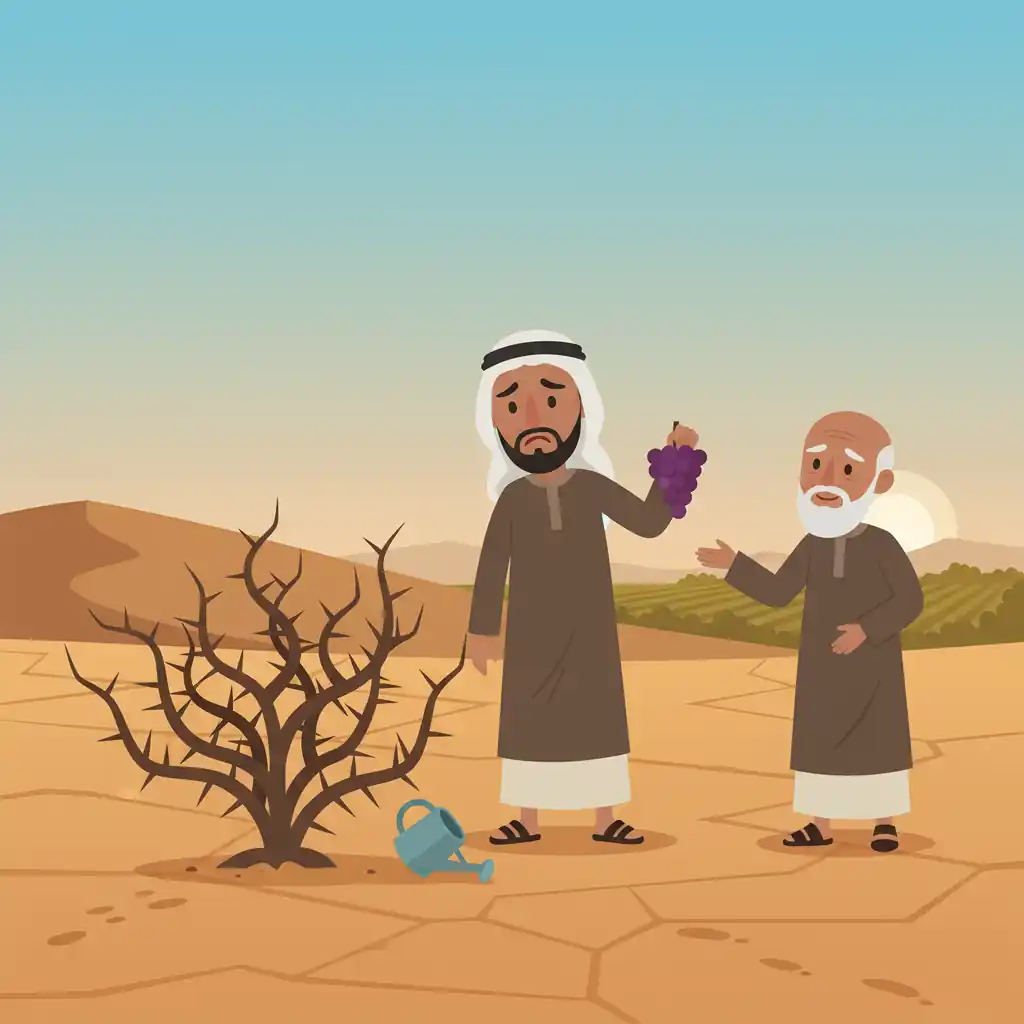
He stumbled upon a bush unlike any other. It was stout and sturdy, its branches thick and woody. Dark green leaves clung defiantly, and sharp, menacing thorns protected every inch.
Most would see it for what it was: a formidable desert thorn bush, built for survival in a cruel landscape.
But Hamid saw something else. He saw potential. He saw strength. He saw a plant that had endured, a plant that, to his deluded eyes, resembled a dormant, hardy grapevine.
“This is it!” he exclaimed, startling a lizard. “This bush is simply misunderstood. It lacks care, proper nourishment. It has been forced to be harsh by its environment.”
He convinced himself that with enough water and his devoted attention, he could 'train' this resilient plant. He would force it to shed its thorny nature and yield soft, juicy grapes.
“Why buy delicate saplings,” he reasoned, “when this powerful specimen simply needs a little guidance?” His logic was as twisted as the desert plant itself.
He dug around the bush, carefully avoiding the sharp spines. He would transplant it, nurture it, and soon, he imagined, he would have grapes even sweeter than Omar's.
A Season of Scratches and Wasted Water
Hamid worked with a new, misguided zeal. He carefully dug up the thorn bush and replanted it in his own field, near his meager well. His hands bled from the constant pricks, but he ignored the pain.
Every single day, under the blazing sun, he hauled buckets of precious water from the well. He poured it around the base of the thorn bush, tending it as if it were the most delicate fruit tree.
The bush, indeed, thrived. Its leaves grew greener, its branches thicker. Its thorns, however, grew sharper, longer, and more numerous. They seemed to multiply with every drop of water.
Days turned into weeks, weeks into months. The season progressed. Omar’s vineyard began to show the first small, green berries, promising a good harvest.
Hamid’s bush, meanwhile, showed no such promise. It grew into a formidable, impenetrable fortress of spines. Reaching its core became a painful, almost impossible task.