
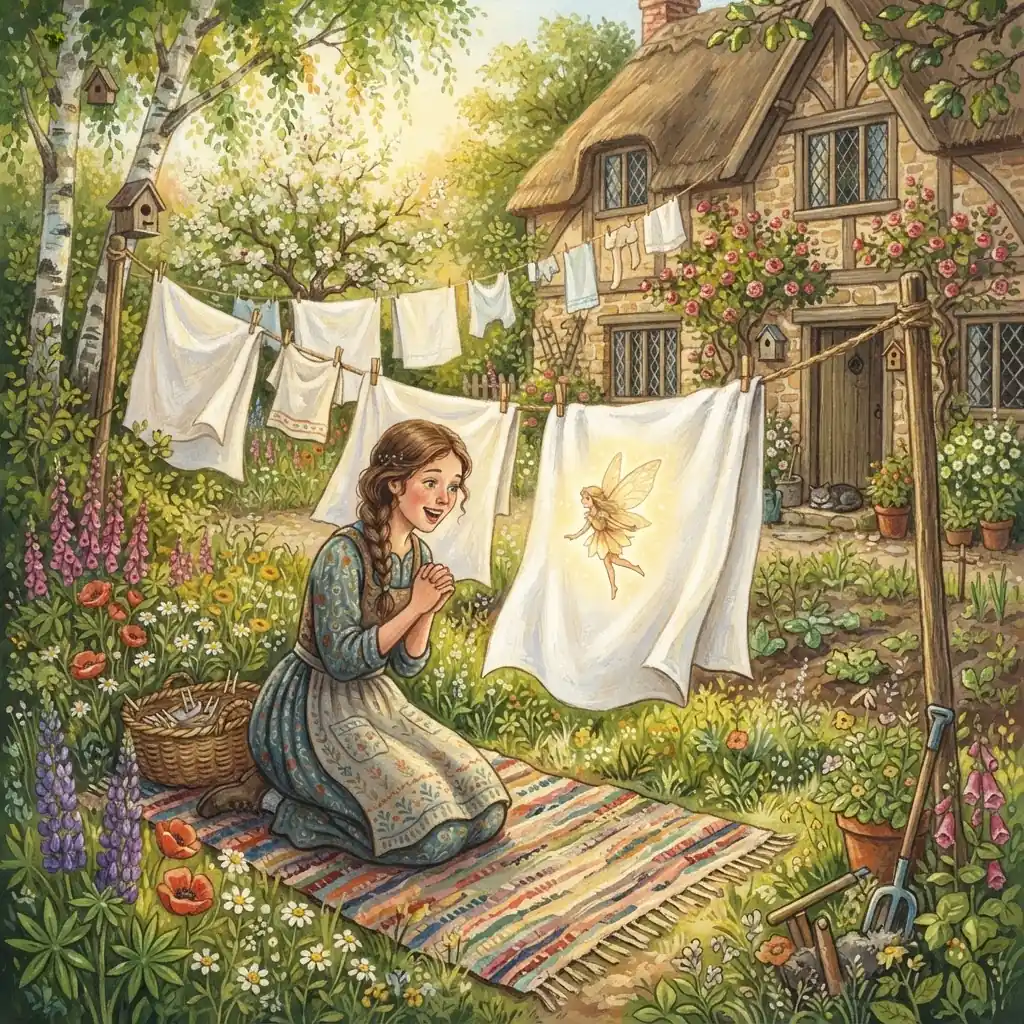
The wooden clothespins bit into Bri's thumb for the third time that morning, leaving a crescent dent in the skin. She shifted the wicker basket higher on her hip, the damp weight of the white cotton sheet pulling at her shoulder. Out beyond the high cedar fence, a car changed gears on the county road, and her chest tightened with the familiar, suffocating prickle of being watched. Nobody was there, of course, because nobody ever came down this overgrown gravel lane. They stayed in town where they could point and mutter about the recluse who let her rosebushes claw at the clapboards.
Bri smoothed the hem of the sheet against the wire line with a jerky, obsessive motion, making sure it hung dead straight. She wiped her palms on her faded jeans and stared at the gap beneath the back gate.
Ten years of looking at that three-inch strip of dirt and clover, and she had never once been tempted to slide her sneakers across it. The world beyond those boards was an endless tribunal of raised eyebrows and sharp, amused whispers about the way she spoke, the way she walked, the way she simply existed. Her mother used to say that people only stare because they are empty inside, but Bri had found that empty people could still pack a terrible wallop. She picked up a pillowcase, shook it until the fabric snapped in the hot July air, and jammed a pin over the corner.
The sun beat down on the back of her neck with the unsparing pressure of a heavy wool blanket. Sweat beaded along her hairline, itching against the tangled strands of brown hair she had pinned up with a broken chopstick.
There was safety in the routine of wet linen and yellow soap, a predictable geometry of chores that kept the walls from pressing in. She reached for another pillowcase from the basket, her fingers grazing the smooth plastic bottle of coconut tanning lotion buried at the bottom. It was five years old, half-separated and smelling faintly of stale paraffin, but she kept it out here just to pretend she cared about summer. A cicada rasped in the old apple tree, a dry, metallic screech that sawed through the heavy afternoon hush.
Bri hoisted the empty basket under her arm and turned toward the kitchen door, her rubber-soled clogs grinding against the concrete patio. She stopped with her foot on the threshold, her gaze fixed on the cool darkness of the hallway where the floorboards waited in silence. Nobody called, nobody knocked, and the brass deadbolt remained turned twice every single night without fail.
She lingered there for a second longer than usual, letting the cool draft from the air conditioner wash over her shins. A pair of mourning doves cooed from the telephone wire overhead, their soft notes dissolving into the shimmering glare off the roof. It was too hot to stay inside anyway, with the small kitchen smelling of old tea leaves and yesterday's toast. Bri turned back to the yard, dragging her clogs across the flagstones toward the battered lounge chair by the garden bed. She reached into the wicker basket, fished out the tanning lotion, and unscrewed the yellow cap with a wet squeak. The lotion plopped onto her palm with a tepid weight, smelling faintly of synthetic coconut and dust. She rubbed it briskly over her forearms, watching the white cream vanish into her pale, sun-starved skin.
The lounge chair creaked loudly as she lowered herself onto the faded floral cushion, closing her eyes against the blinding white glare of the noon sky. Down the lane, a dog barked twice, a dull, muffled sound that didn't reach her sanctuary. Her shoulders dropped an inch against the canvas, the heat baking the tension right out of her neck for a few brief seconds. She listened to the hum of the world shrinking down to the size of her small, fenced-in acre of clover and weeds. It was a good silence, the kind that didn't demand an explanation or an apology for taking up space. Then the voice cut through the hum, tiny and clear as a silver tack dropped on a porcelain plate.
“Bri, don't worry about what others say or think about you.”
Her eyes flew open, the sudden jolt sending a hot spike of adrenaline straight through her chest. She bolted upright on the cushion, her hands clawing at the canvas edges of the chair as she scanned the empty grass. There was nothing near the lawnmower, nothing under the overturned terracotta pots, and nothing in the strawberry patch.
“Hello?” she croaked, her voice rusty from disuse, sounding small and ridiculous even to her own ears. A shadow flickered near the base of the white sheet on the clothesline, too small for a bird, too bright for a mouse. She scrambled off the lounger, her clogs catching on the turf as she stumbled across the uneven turf. The cicadas kept up their monotonous saw-blade song, drowning out whatever else might be hiding in the long orchard grass. She dropped to her knees beside the fluttering white cotton, her breath coming in shallow, ragged hitches.
There, crumpled against the hem of the sheet like a fallen marigold blossom, was a tiny woman no taller than a teacup. The figure lay sideways in the dust, her delicate chest heaving in rapid, desperate little jerks that made her gossamer wings twitch. Those wings were the color of crushed marigolds, translucent and veined with gold, but now smeared with dry garden loam and bent at an awkward angle. She wore a tunic woven from pale dandelion down, torn at the shoulder where a drop of dark ichor stained the green threads.
Bri froze, her fingers hovering half an inch above the grass, terrified that reaching out would somehow make the vision vanish into smoke. The tiny woman’s mouth opened in a silent gasp, her eyelids fluttering over eyes the color of a stormy pond. She wasn't just small; she was wearing herself out simply trying to draw breath in the dry summer heat.
“Hold on,” Bri whispered, the panic in her own chest suddenly overriding every sensible thought she had nurtured for a decade. She scrambled backward on her hands and knees toward the patio table where a ceramic mug of tepid tap water sat half-full. Her fingers shook so badly she nearly knocked the handle off, spilling water over the gray slate tiles. She didn't have time to look for a proper vessel, so she pried off the plastic cap of the tanning lotion bottle instead. Dumping out the last dollop of white cream into the grass, she rinsed the cap twice under the garden hose with trembling haste.
She filled it to the brim with water, her heart thumping a frantic rhythm against her ribs as she raced back across the yard. The fairy was still there, curled tighter now, her tiny hands clutching at the dry clover as if the earth were slipping away beneath her.
Bri dropped onto her stomach in the dirt, ignoring the sharp stones that dug straight into her kneecaps. “Hey,” she murmured, her voice dropping into the soft, trembling tone she usually reserved for stray cats that wouldn't let her touch them.
“Hey, don't move. I've got water right here.” The tiny woman didn't answer, her chin pressed against her collarbone while her shoulders hitched with another dry, rattling gasp. Bri inched the plastic cap forward until it rested against a clump of moss inches from the fairy's face. The pale, bruised-looking fingers uncurled slowly, the tips brushing against the edge of the yellow plastic with a faint scratching sound. The fairy dipped her chin toward the water, her lips parting as she took a hesitant, trembling sip that sent ripples across the surface.
She drank with a fierce, desperate greed, her throat working in small, bird-like jerks before she pulled back, coughing weakly.
“That's it,” Bri coaxed, not daring to blink in case the tiny visitor dissolved into the bright afternoon glare. “Take your time. There's plenty more in the house if you want it.” The fairy raised her head, her wet lashes blinking rapidly as she focused on Bri's face hovering just above her. Up close, the stranger's skin looked like sun-baked porcelain, dusted with tiny freckles that looked like specks of cinnamon across her nose.
“Your hands are shaking,” the fairy said, her voice sounding like a tiny silver bell shaken underwater, remarkably sharp despite the exhaustion. Bri let out a dry, breathy laugh that ended halfway up her throat.
“I'm not used to company,” she admitted, her cheeks burning hotter than the midday sun could manage. The fairy tried to push herself up onto one elbow, her golden wings giving an involuntary, pathetic twitch that scattered a few grains of golden pollen into the dust.
“Company is usually overrated anyway,” the fairy muttered, her gaze darting toward the high wooden fence with a look of fierce irritation. “Especially the kind that carries iron pitchforks and shouts through keyholes.” Bri stared at her, the memory of her own neighbors flashing through her mind like a slide projector left on too long. How did a creature no larger than a teacup know anything about the way people shouted through keyholes in the towns beyond the hills?
“They do that everywhere, don't they?” Bri asked softly, her fingers tracing a pattern in the dirt near the fairy's knee. The tiny woman let out a dry huff of air that ruffled her dandelion tunic.
“Worse out east,” she said, closing her eyes for a long beat as if the mere thought made her head pound. “They wanted the dew-wells for their copper mills, and when I told them no, they started throwing gravel.”
Bri felt a cold knot form in her stomach, though whether it was for the fairy's trouble or the terrible familiarity of the story, she couldn't tell. People always wanted what didn't belong to them, and they always punished whoever stood quietly in the way with a full basket of judgment.
“Well,” Bri whispered, her voice dropping to a conspiratorial murmur as she glanced back toward the empty house. “They aren't getting in here. The gate's locked and the fence is six feet high.” The fairy opened one eye, looking up at Bri with a gaze that felt entirely too heavy for someone who weighed less than an autumn leaf.
“Six feet won't stop a boot with a heavy heel, human, but it's better than an open meadow.” She tried to sit up again, her left wing bending at an angle that made Bri wince in sympathetic pain.
“I need to get off the ground,” the fairy added, her tone sharpening into an urgent demand. “The ants around here have no respect for travelers.”
“I can put you somewhere safe,” Bri said quickly, her mind racing through every high shelf and out-of-reach corner inside the small, dark rooms. “Inside the house, on the mantelpiece behind the china tea service?” The fairy shuddered visibly, her small shoulders pulling up toward her ears.
“Too many drafts in a house, and your floors smell like floor wax and old panic. Put me outside where I can breathe.” Bri blinked, surprised by the blunt refusal, though she couldn't entirely argue with the assessment of her housekeeping.
“Outside?” she repeated, looking around the overgrown backyard as if seeing it for the first time through someone else's eyes. The high cedar fence blocked the road, the old apple tree reached toward the clouds with twisted, gnarled arms, and the silence was absolute.
“The old apple tree,” Bri said slowly, pointing a hesitant finger toward the heavy, rustling canopy in the corner of the yard. “Nobody goes over there, not even the crows.”
The fairy turned her head, her sharp gaze tracking the line of Bri's finger up to the thick, mossy fork where two main branches split apart. “High up?” the fairy asked, her voice softening just a fraction as she inspected the rough, gray bark.
“High enough,” Bri said, the ghost of a smile touching the corners of her mouth for the first time in a decade. “Out of reach of the ants and anyone else who happens to look over the boards.” The fairy nodded once, a sharp, decisive movement that set her marigold wings trembling.
“Do it then,” she said, holding out a hand no larger than a postage stamp. “Before my legs decide they're done working altogether.” Bri reached down with two fingers, her skin prickling with nervous awe as the tiny woman climbed onto her palm with surprising agility. She felt a warmth like a stray sunbeam against her skin, light as a dry leaf, and infinitely more fragile than anything she had held in ten long years.
She stood up slowly, keeping her hand cupped like a shell while she walked toward the gnarled trunk of the old apple tree. The grass brushed against her ankles, cool and damp from the shade of the low-hanging branches that smelled of rotting fruit and rich, dark earth. She reached the thickest part of the trunk, where the bark was rough and ridged with deep gray creases that looked like ancient wrinkles.
“Here?” Bri asked, lowering her hand until it rested against the mossy split in the wood where a hollow formed a natural cradle. The fairy stepped off her palm without a word, her tiny boots crunching softly against a bed of dry leaves and soft lichen inside the notch. She turned around twice, inspecting the space with the critical eye of a fussy tenant checking a rental property before signing the lease.
“It'll do,” the fairy announced, leaning back against the rough bark with a long, shuddering sigh that seemed to settle her wings back into place. “Better than most places I've stayed this month, anyway.”
Bri kept her hand near the opening, reluctant to pull away and leave the tree as empty as it had been that morning. “I can bring you some more water later,” she offered, her voice barely louder than the rustle of the apple leaves overhead.
“Maybe a crumb of bread, if you eat bread?” The fairy raised an eyebrow, a small, crooked smile finally breaking through her exhausted expression. “Only if it's white bread with crusts cut off, human. I'm not an animal.” Bri let out a short, startled laugh, the sound foreign in the quiet yard.
“I'll see what I can find in the tin,” she muttered, withdrawing her hand very slowly as if she were backing away from a sleeping cat. The fairy settled deeper into the moss, pulling her tattered dandelion tunic around her knees like a woolen blanket against the rising afternoon breeze. She closed her eyes again, her breathing falling into a slow, steady rhythm that matched the hum of the distant insects in the long grass. Bri stayed by the trunk for a long moment, her fingers still tingling from the impossible weight of her new guest.
She turned back toward the house, her steps feeling lighter against the flagstones than they had in years, though her chest still held its familiar, cautious ache. The white sheets on the clothesline snapped once in a sudden gust of wind, the clean scent of soap washing over the hot patio. She reached the kitchen door and paused with her hand on the cold brass knob, looking back across the sun-drenched lawn toward the dark shadow of the apple tree. The world beyond the fence was still out there, loud and judgmental and waiting for her to make a single wrong move in the open air. But the yard wasn't empty anymore, and the silence didn't feel quite so heavy as she pushed the door open and stepped inside.
The kitchen was dim after the blinding glare of the yard, the yellow walls casting a warm, buttery light across the chipped porcelain sink. Bri dropped the empty wicker basket onto the linoleum floor with a plastic clatter that made the water glasses in the drainer rattle. She walked over to the small wooden bread box on the counter, her fingers hesitating over the painted tin lid before she lifted it. Inside sat a half-loaf of sandwich bread she'd bought two days ago, the edges already turning slightly dry and firm in the summer heat.
Using a small paring knife with a wooden handle, she sliced off a thin corner of the white crumb, being careful not to include any of the dark crust. She laid the tiny piece of bread on a saucer, then hesitated and added a single drop of strawberry preserves from the jar in the back of the fridge. It looked ridiculous, like something a child would prepare for a game of tea party, but the thought of the tiny woman in the apple tree made her hands steady. She washed the knife under the tap, drying it with a dish towel that smelled faintly of old lavender and bleach.
Through the open kitchen window, the sound of the wind shifting through the apple leaves drifted in like a low, dry sigh. Bri carried the saucer across the room, her rubber-soled clogs making a soft, sticky sound against the linoleum. She stopped at the back screen door, pushing it open with her hip while balancing the small dish in both palms. The afternoon sun had shifted an inch, casting longer shadows across the clover and turning the white sheets on the line into pale, billowing sails. She walked across the grass without looking toward the high cedar fence, keeping her eyes fixed entirely on the gray, lichen-covered bark of the old tree.
When she reached the trunk, she didn't need to look up to know the fairy was watching her from the dark hollow in the fork. “Brought you something,” Bri said softly, lifting the saucer until it rested on a lower knot of wood just beneath the tenant's doorway.
“Though I'm not entirely sure it meets your standards.”
A small rustle came from the shadows, followed by the faint scuff of boots against dry wood and moss. The fairy appeared at the edge of the hollow, her marigold wings folded neatly behind her back like a pair of pressed autumn leaves. She looked down at the saucer with an expression of mild skepticism that didn't quite hide the sudden hunger in her eyes.
“Strawberry?” the fairy asked, leaning out over the edge to sniff the air with a delicate twitch of her nose. “It's from a jar,” Bri admitted, feeling suddenly defensive about her pantry staples.
“Not fresh-picked from a forest glade or whatever it is you people usually eat.” The fairy hopped down onto the knot of wood, her tiny boots making a sharp click against the bark. She knelt beside the saucer, poked the drop of preserves with a slender finger, and tasted it with a small, appreciative hum.
“It'll do,” she said, breaking off a crumb of white bread and popping it into her mouth with a quick, efficient motion. “Better than the bark I was chewing outside the mill yesterday.”
Bri crouched down until her knees were level with the branch, the rough bark of the tree pressing against her shins through her jeans. “What were you doing at the mill?” she asked, the question slipping out before she could catch it behind her teeth. The fairy stopped chewing for a second, her stormy-colored eyes fixing on Bri with a sudden, sharp wariness that made the air between them feel tight.
“Asking questions about things that don't concern humans,” the fairy said, her voice dropping an octave into something that sounded remarkably like a warning. Bri pulled back slightly, the old, familiar instinct to retreat into her shell flaring up in her throat like dry smoke. She had spent a decade making sure nobody asked her anything, and she certainly had no business prying into the troubles of a runaway sprite.
“Right,” Bri muttered, starting to stand up as her knees began to ache from the hard ground. “I'll just leave that there for you then.”
“Wait,” the fairy said, her tiny hand darting out to catch the edge of Bri's sleeve with surprising strength. Bri froze, looking down at the small fingers gripping her faded cotton fabric like a pair of metal clamps.
“Don't go back inside just yet,” the fairy added, her tone softening from a snap into something more like a request. “The sun's still up, and the shadows under this bark are full of earwigs.” Bri stared at the tiny hand on her sleeve, the warmth of it sinking right through the cotton and into her skin. It was the first time another living creature had touched her with an intention that wasn't about judgment or complaint in ten long years.
“I have to check the laundry,” Bri lied weakly, though the sheets had been dry since noon. The fairy let go of her sleeve, crossing her arms over her dandelion tunic with a dry little snort.
“Laundries don't run away,” she said. “Sit down for a minute, human. You look like you haven't seen a patch of green grass that didn't scare you half to death.”
Bri hesitated, her gaze darting from the high wooden fence back to the small, stubborn face in the tree fork. She didn't sit on the grass, but she lowered herself onto the bottom step of the back porch where the cedar was warm from the afternoon sun.
“My name's Bri,” she said to the toes of her clogs, feeling ridiculous for introducing herself to something smaller than a teacup. The fairy tilted her head, her marigold wings twitching once as she considered the syllables.
“Pip,” she said after a beat, picking up another crumb of the white bread from the saucer. “And before you ask, no, it's not short for anything, and yes, it's an absurd name for someone who's spent three days running from copper-miners.” Bri let out a quiet exhale that sounded almost like a laugh, the tension in her shoulders easing down another fraction.
“It suits you,” she said, resting her chin in her hands while she watched Pip finish the last of the strawberry preserves. “Like a bell.”
Pip wiped her fingers on her tunic, leaving a tiny red smudge near the hem that looked like a drop of ink. “A bell that's about ready to crack,” she muttered, leaning her back against the rough bark of the apple tree and staring out toward the cedar fence. The yard was quiet again, the cicadas resuming their steady, metallic drone in the overgrown weeds by the garden bed. Bri sat on the step, her mind racing with all the things she shouldn't be thinking about—the towns beyond the boards, the people who whispered, the life she had locked away behind a double deadbolt.
For ten years, the world had been something to keep out, a heavy stone wall that protected her from the sharp edges of human cruelty. But now there was a tiny creature sitting in an apple tree ten feet away, eating strawberry preserves off a saucer and telling her about copper mills. The thought of going back inside to the empty, wax-scented hallway suddenly felt less like safety and more like a cage.
“They won't come down this lane,” Bri said quietly, almost to herself, breaking the silence between them. Pip turned her head sharply, her stormy eyes narrowing as she studied Bri's profile in the golden afternoon light.
“People go wherever there's something they think they can take,” Pip said, her voice hard as a pebble. “Don't go trusting a dead-end road just because the weeds are high, human.” Bri didn't answer, her fingers tracing the grain of the weathered cedar step beneath her palms. She knew the fairy was right, because people had a way of sniffing out vulnerability the way crows sniffed out corn in a newly plowed field. Her whole life was built on the premise that if you hid long enough, the world would eventually forget you existed.
But as the afternoon sun began to dip toward the top of the fence, casting long, skeletal shadows across the clover, she realized something uncomfortable. The world hadn't forgotten her; it had simply stopped caring, which was supposed to be a relief. Instead, sitting there with the smell of old cedar and warm grass in her nose, it felt like nothing at all.
A sharp crack split the stillness of the yard, like a dry twig snapping under a heavy boot outside the fence. Bri froze on the porch step, her muscles locking up instantly as the old panic surged back into her throat with the taste of cold iron. Pip vanished from the apple tree branch in a blur of gold and green, dropping into the deep moss at the base of the trunk.
“Quiet,” Pip hissed from the weeds, her voice a thin, razor-sharp whisper that barely carried across the grass. Bri couldn't move if she wanted to, her fingers digging into the cedar wood of the step while her eyes fixed on the gap beneath the back gate. For a long second, there was only the hum of the cicadas and the distant, muffled rattle of a tractor out on the highway. Then a shadow fell across the bottom boards of the fence, long and unmistakably human, stretching out over the clover.
The gate didn't rattle, but the sound of gravel shifting right outside the wood sent a cold shiver down Bri's spine. Someone was standing out there, just beyond the three-inch strip of dirt and weeds, hesitating in the middle of the overgrown lane. Bri's breath caught, her chest tightening until she felt as though the air had turned to wet cement. Ten years of absolute silence, ten years of nobody ever stopping by the old well or the rusted mailbox, and now someone was lingering. Pip was completely invisible in the tall weeds by the apple tree, her presence marked only by a faint, warm scent of crushed clover and pine resin.
The shadow shifted on the boards, the head turning as if the person on the other side were inspecting the rusted padlock on the latch. Bri wanted to stand up, wanted to run inside and throw the deadbolt twice, but her legs felt like lead weights poured into her shoes.
“Hello?” a voice called out from beyond the fence, muffled by the cedar planks but clear enough to make Bri's ears ring. It wasn't the sharp, mocking tone of the villagers she remembered from a decade ago, but something flat and inquiring, like a stranger asking for directions to the post office. Bri didn't answer, her mouth dry as dust while she stared at the gap where the shadow was now lingering. The person outside didn't knock, because nobody knocked on doors down this lane unless they were lost or looking for trouble.
A hand struck the outside of the fence with a dull, wooden thud, testing the sturdiness of the old cedar posts. The whole fence gave a slight shudder, sending a shower of dry wood dust down into the weeds near where Pip was hiding. Bri's heart hammered against her ribs, the sound loud enough in her own ears to drown out the cicadas.
“Anybody home?” the voice asked again, louder this time, carrying a sharp edge of irritation that pierced straight through the quiet yard. Pip didn't move in the grass, but Bri saw the tip of a marigold wing flicker green against the dark earth. Whoever was out there was leaning against the wood right where the latch was bolted from the inside with a heavy iron chain. Bri stood up slowly, her knees trembling so badly she had to grab the doorframe to keep from pitching sideways onto the concrete. She took one step toward the edge of the porch, her eyes locked on the spot where the shadow was growing longer as the sun sank.
If she said nothing, if she stayed entirely still, they would eventually assume the place was abandoned and walk away down the lane. But the iron chain on the gate gave a sudden, metallic clink as someone tested the play in the old staples. Pip's voice hissed from the weeds, sharp as a dropped pin.
“Don't touch the latch.”
Bri stopped dead with her foot hovering over the first flagstone, her breath hitching as the stranger outside jiggled the gate handle again. The old wood groaned in protest, the rusted hinges creaking with a sound that seemed to echo off the clapboards of the house.
“I know someone's in there,” the voice said, dropping the polite inflection entirely and replacing it with something harder and colder. “The laundry's out on the line and it ain't rained for a week.” Bri felt the blood drain from her face, leaving her skin cold and prickling with sweat as the reality of her ten-year fortress closed in. The world hadn't forgotten her after all; it had just been waiting for a sunny afternoon and a pair of white sheets on a wire line. She looked back toward the apple tree, but the hollow was dark and empty, the empty saucer sitting on the lower branch.
The shadow outside stretched across the entire width of the yard, reaching right up to the bottom step of the porch where she stood trapped.
The wooden gate gave a sharp, splintering groan as a shoulder slammed against the outside of the cedar boards with sudden force. Bri jumped back, her heel catching on the edge of the screen door as she stumbled backward into the dim hallway. Pip shot out from the weeds like a golden spark, darting upward through the apple branches and disappearing into the dense leaves overhead.
“Get inside, you idiot,” Pip hissed down from the canopy, her voice tiny and fierce as a hornet. The second blow against the fence was heavier, rattling the rusted padlock and sending a shower of dry wood chips across the clover. Bri slammed the wooden door shut with both hands, her fingers fumbling blindly for the brass deadbolt in the half-light. The key was right where she always left it on the small ceramic dish by the mirror, but her trembling fingers knocked the dish onto the floorboards with a sharp crash.
Outside, a boot heel struck the bottom of the gate, and the wood gave way with a loud, tearing snap that echoed off the kitchen walls.
“Open up,” a man's voice shouted from the yard, no longer inquiring, but harsh and demanding as he stepped through the broken latch. Bri didn't look down at the shattered ceramic plate or the white porcelain pieces rolling across the floor toward her shoes. She grabbed the brass key from the dust, shoved it into the keyhole of the back door, and turned it twice with a violent, metallic click. Through the sheer lace curtain of the front window, she saw a tall man in a dust-stained canvas jacket step out from the shadow of the cedar fence into the blinding sunlight.
He wasn't one of the villagers from her memories, but a stranger with rough-shaven cheeks and cold, gray eyes that scanned the overgrown yard with practiced contempt. He stopped by the clothesline, his gaze locking instantly on the white sheets billowing in the afternoon breeze as if he owned them. Bri backed away from the window into the cool, dark hallway, her chest heaving as she listened to his heavy boots crunching across her clover. He walked right past the apple tree without looking up, his hand resting casually on the handle of a heavy iron wrench tucked into his belt.
She reached out blindly behind her, her fingers brushing against the cold wall while she waited for him to reach the kitchen steps. Then the man stopped dead in his tracks, staring down at the tiny saucer of strawberry preserves sitting on the lower branch of the apple tree. He knelt down slowly in the dirt, picked up the white dish between two thick fingers, and held it up to the light with a narrow, suspicious squint. Bri held her breath in the dark hallway, her hand squeezing the brass doorknob until her knuckles turned white as bone.
“What the hell is this?” the man muttered to the empty yard, his voice dropping into a low, flat growl that made her blood run cold.