
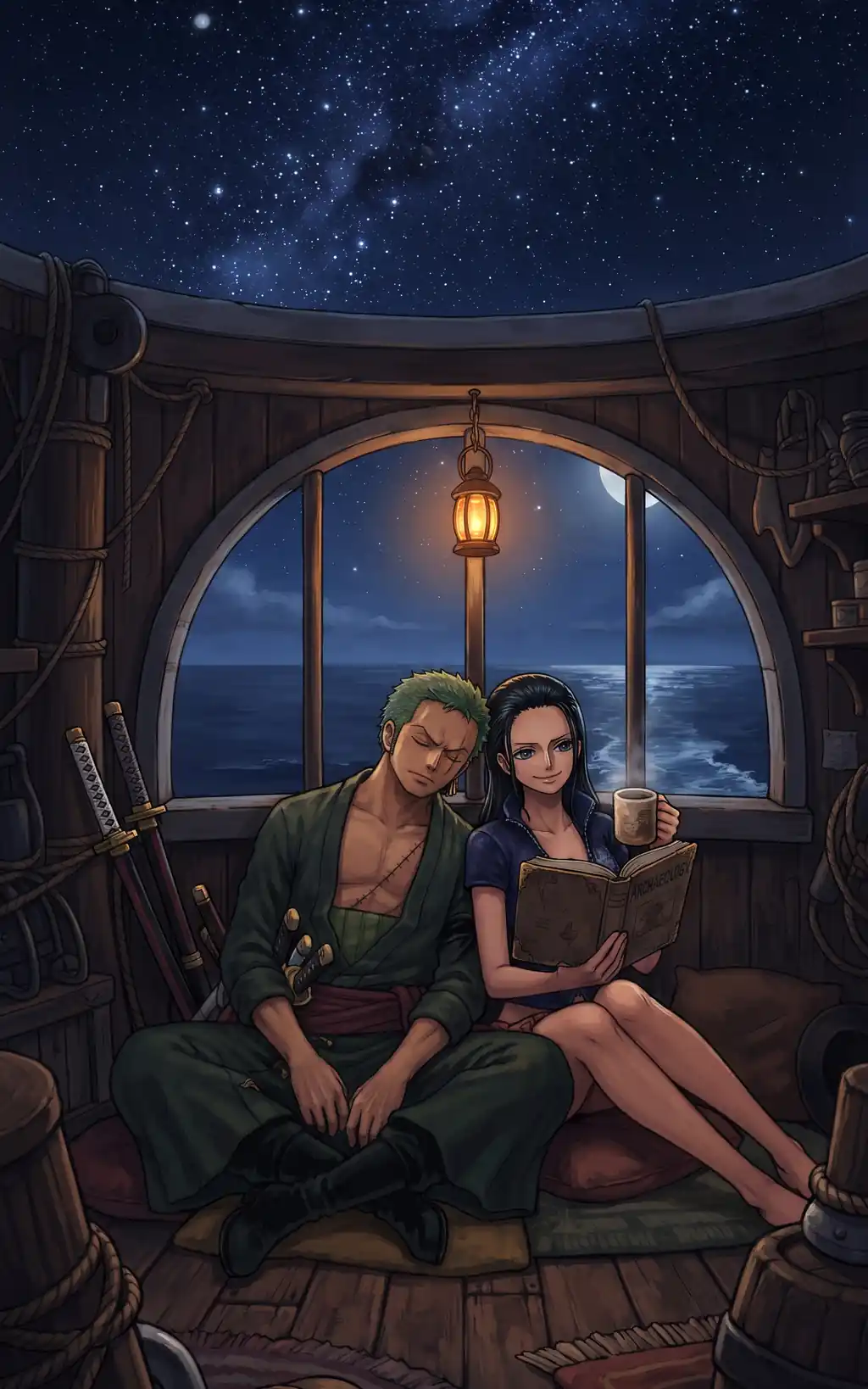
Raike took the night watch because nobody else wanted it, and because he liked the quiet, and because on a ship with Jory on it, the hours between midnight and dawn were the only quiet there was.
The crow's nest of the Halcyon Merrow was a round room at the top of the mainmast. Corso called it the gym, because Raike kept his weights there. Rusko called it the observation deck, because he'd built it with windows on every side. Mireya called it "that sweaty room," and never went in.
Raike called it nothing. He just sat in it.
He was sitting in it now, at a quarter past one on a calm night somewhere on the Farward side of the Spinewater, with his back against the curved wall and his three swords leaning beside him and a bottle of rum he'd liberated from the galley while Corso was distracted by Mireya. The windows were open. The sea was black and silver and almost flat, breathing slowly under the moon, and the Halcyon rocked on it like a cradle.
He wasn't asleep. People thought he slept on watch. He didn't. He closed his eyes, because he could hear better with them closed, and he sat very still, because sitting still was how you heard things.
He heard the ladder.
Not loud. Hardly anything. A hand on the rung below the hatch, light, deliberate. He knew everyone on the ship by the way they climbed. Jory didn't climb; Jory stretched up the mast and came through the window. Pellam climbed fast and nervous, rattling. Tibbet climbed in his small form and got stuck at the hatch. Corso didn't climb at all, because Corso would rather die than visit him.
This was slow, and quiet, and sure. Like someone who'd learned a long time ago how to move through the world without making any noise.
He didn't open his eyes.
"Imra," he said.
The hatch opened. "You weren't asleep."
"I don't sleep on watch."
"You were snoring last Tuesday."
"That was breathing."
He heard her come up through the hatch and close it behind her. He heard her cross the room, soft, and stop. He heard the faint clink of two cups set down on the bench.
He opened his eyes.
She was standing in the moonlight from the window with a book under her arm and two cups of something steaming on the bench beside her. She wore a long dark coat over whatever she slept in, and her black hair was loose down her back, and her face was calm, and pale, and very still, the way it always was.
She looked down at him sitting against the wall with the rum.
"I couldn't sleep," said Selva Imra.
He didn't ask why. He didn't ask anything. That was one of the things she'd come to rely on about him, in the two years since Bubblemoor and the months since they'd all come back together. You didn't have to explain yourself to Raike. He'd just look at you, and nod, and that would be that.
He looked at her. He nodded.
She sat down on the bench under the window. Not near him. On the far side of the round room. She picked up one of the cups and held it out across the space between them.
"Tea," she said.
"I've got rum."
"You can have both."
He looked at the cup. Then at her. Then he got up, and crossed the room, and took it, and went back and sat down against the wall again with a cup of tea in one hand and a bottle of rum in the other, looking faintly baffled.
She opened her book.
He drank the tea.
It was good tea. He didn't know anything about tea, but he could tell. Not too strong. Not too sweet. Something in it that tasted like smoke and flowers. He drank all of it without meaning to, and put the cup down, and picked up the rum, and then didn't drink any.
She turned a page.
The sea breathed. The moon moved. Somewhere far below, through the deck, he could hear Rusko snoring like an engine and Dorrel humming in his sleep.
"What are you reading?" he said, after a long time.
She looked up. Surprised, he thought. He didn't usually ask.
"A history," she said. "Of the island we'll reach in four days. It was a kingdom once. Very rich. Eight hundred years ago it was attacked by a navy no one has a record of, and it vanished in a single night. No one knows why."
"Sounds cheerful."
"It's fascinating." She turned the book toward him so he could see. Old pages, yellow, covered in small cramped writing he couldn't read. "There are carvings on the ruins that no one has ever translated. If any of them are in the old script —"
She stopped.
He knew why. He knew what the old script was. Poneglyphs. The stones. The ones she'd spent her whole life chasing, since she was eight years old and her island burned.
"You'll read them," he said.
She looked at him over the book.
"If they're there," he said. "You'll read them. You always do."
Something moved in her face. Very small. He didn't know what it was. Then she looked back down at the page.
"Thank you," she said quietly.
He didn't know what for. He didn't ask.
She stayed until three.
She didn't talk much. Neither did he. She read, and every so often she turned a page, and once she laughed, very softly, at something in the book, and he looked up and she shook her head and said "a footnote" and went on reading. He sat against the wall and closed his eyes and listened. To the sea. To the ship. To the pages turning.
He didn't know when he'd last sat in a room with someone and not had to say anything.
At three, she closed the book. She stood. She picked up both cups.
"Goodnight, swordsman," she said.
"Night."
She went to the hatch. She stopped with her hand on it.
"Raike."
He opened his eyes.
She wasn't looking at him. She was looking at the hatch. Her voice was very even.
"Would you mind," said Imra, "if I came back tomorrow?"
He looked at her. At her back, in the long coat, with her black hair over it. At her hand on the hatch, which was, he noticed, holding on a little harder than it needed to.
"It's a free ship," he said.
She was quiet for a moment.
"That isn't an answer," she said.
He thought about it.
"No," he said. "I wouldn't mind."
She went down the ladder. He heard her go, slow and quiet and sure, rung by rung, until he couldn't hear her anymore.
He sat in the crow's nest for the rest of the watch with the rum unopened beside him, and the empty space on the bench under the window where she'd been, and the faint smell of smoke and flowers.
He didn't close his eyes again until dawn.