
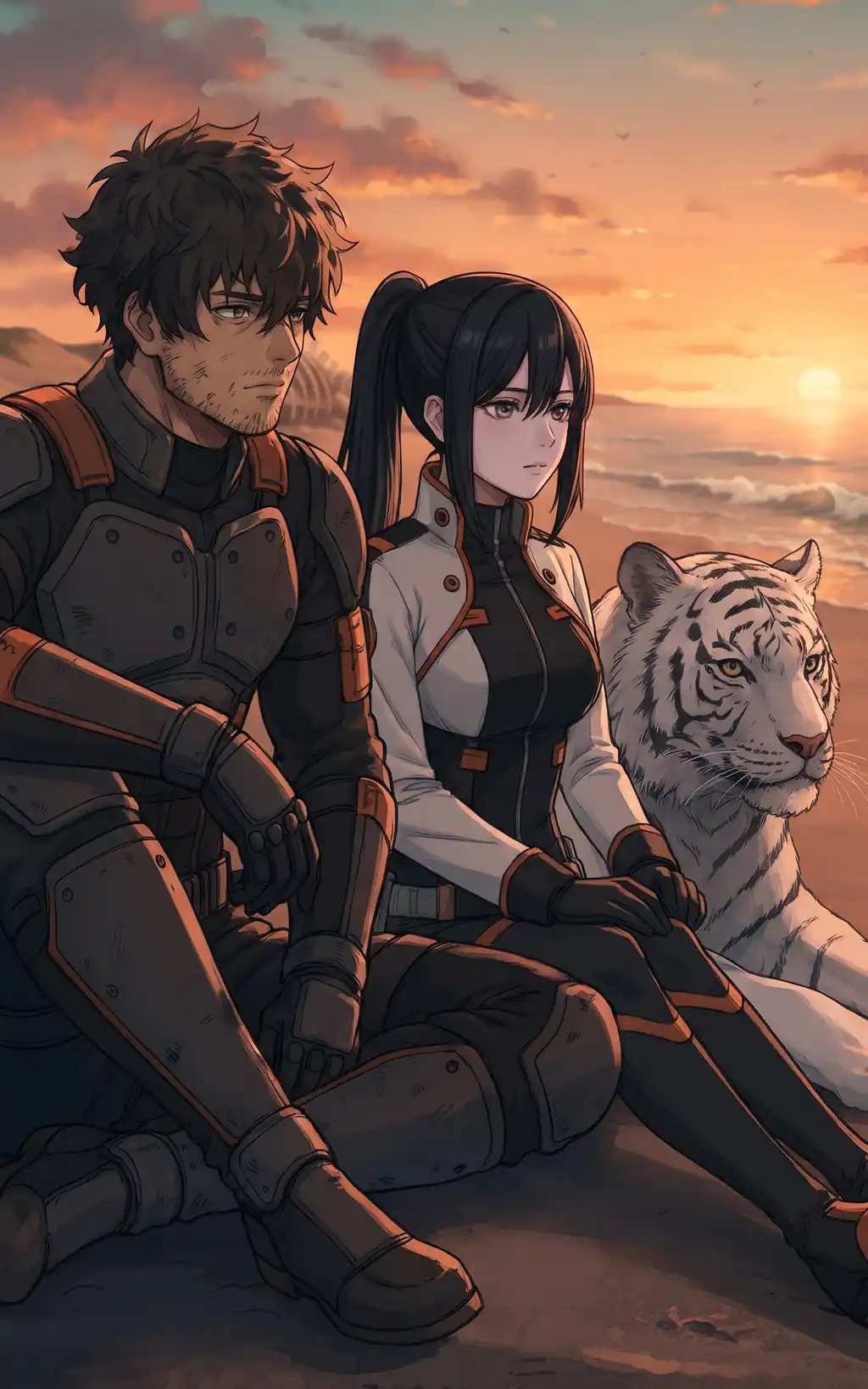
Captain Rio Takamine took her first day off in six years on a Thursday in April.
It was not her idea. It was the Director General's. He called her into his office in Tokyo a week after the beach, read the whole of Nagase's report in front of her, very slowly, all forty-one pages of it, and then put it down on his desk and took off his glasses and looked at her for a long time.
"You stole a dive rig," he said.
"Yes, sir."
"From Captain Kuroiwa's supply truck."
"Yes, sir."
"While under orders to withdraw."
"Yes, sir."
"And you fired a Class Four artillery cannon three hundred metres underwater, which every one of my engineers has told me is physically impossible, and killed a Kaimetric 9.7 core that we'd mistakenly classed as 9.1, with a single round." He paused. "Braced against the chest of Hachiban."
"Yes, sir."
The Director General put his glasses back on.
"Take a day off, Captain," he said. "That's an order. I'm told you haven't taken one in six years. And when you come back, you'll find there's a commendation on your desk, and a reprimand underneath it, and I'd like you to frame both." He picked up his pen. "And take Officer Arakaki with you. He's on leave too. Same day. I'd hate for the kaiju to get lonely."
She'd stood in the Director General's office with her face like stone.
"Sir," she'd said.
"Dismissed, Takamine."
So on Thursday morning she stood outside the gates of the Tachikawa base at eight o'clock in a long grey coat and ordinary jeans and a scarf that Nagase's sister had knitted for her two Christmases ago and she'd never worn, and waited.
She didn't know what to do with her hands. She didn't know what to do with any of it. She hadn't had a whole day with nothing in it since she was twenty-one. No briefings. No reports. No alarms. Just a Thursday, and a sky the colour of milk, and the cherry trees along the road outside the base just starting to open.
She'd almost not come. She'd almost stayed in her quarters and done paperwork. She'd stood at her door at seven-thirty with her hand on the handle for ten minutes, thinking: what if it's strange. What if, without the base and the uniforms and the kaiju, there's nothing to say. What if we're just two people who knew each other as children, and that's all.
"You're early," said Kenzo.
She turned round.
He was coming up the road from the barracks. Not in uniform. In jeans and a jacket that was slightly too big for him and a T-shirt with a cartoon fish on it that she was fairly sure was one of Teramoto's. His hair was sticking up at the back. He was carrying two paper cups.
He held one out to her.
"It's not frog tea," he said. "I went to the convenience store. It's real coffee. It's still terrible. But it's real."
She took it.
She looked at him. At the cartoon fish. At his hair. At his face, which was nervous, and hopeful, and exactly the face of a twelve-year-old boy holding out the good half of a melon pan.
All of it went away. Every what if. Gone.
"Where are we going?" she said.
He grinned.
"Yokohama," said Kenzo.
The new Matsuda's was on a narrow street near the harbour, wedged between a phone repair shop and a laundromat. It had a red awning. Faded. Slightly crooked. The bell on the door was the old kind, brass, and it rang when he opened it, and the smell came out and hit them both.
Warm bread. Sugar. And underneath, unmistakably, something burnt.
Rio stopped in the doorway.
He didn't push her. He just stood beside her and waited, the way he'd waited on the roof, on the stairs, on the beach.
The shop was small. Glass cases of bread and buns. A counter with an old till. And on the wall behind the counter, in a frame, a photograph of a grumpy old man with flour in his eyebrows, standing outside a shop with a red awning by a harbour that didn't exist anymore.
A young man was behind the counter. Twenty-five, maybe. Flour on his apron. He looked up, and looked at Rio, and his eyes went wide.
"You're —" he said. "Aren't you — on the posters — the captain —"
"Not today," said Rio. "Today I'm just here for melon pan."
He blinked. Then he grinned. It was the old man's grin. Exactly.
"You came before," he said. "Didn't you? Last year. I remember. You bought one and you —" He stopped, embarrassed.
"Cried on the train," said Rio. "Yes."
"Grandpa used to talk about two kids," the young man said slowly. "From the old town. Before the kaiju. A boy and a girl. They came every morning and the boy always bought the burnt melon pan and gave the girl the good half." He looked from her to Kenzo. "He said he always wondered what happened to them."
Kenzo's throat had gone tight. He couldn't say anything.
"He kept burning the first batch," said the young man. "Every morning. Even here. Even when he was ninety. He said it was for them. In case they ever came back." He reached under the counter. He came up with something on a paper napkin. Round and golden and cracked on top, and very, very burnt on one side. "I still do it. Every morning. I don't know why. It's just — it's what he did."
He held it out across the counter.
Rio looked at it for a long time. Then she looked at Kenzo.
"You buy it," she said. Her voice wasn't steady. "You always bought it."