
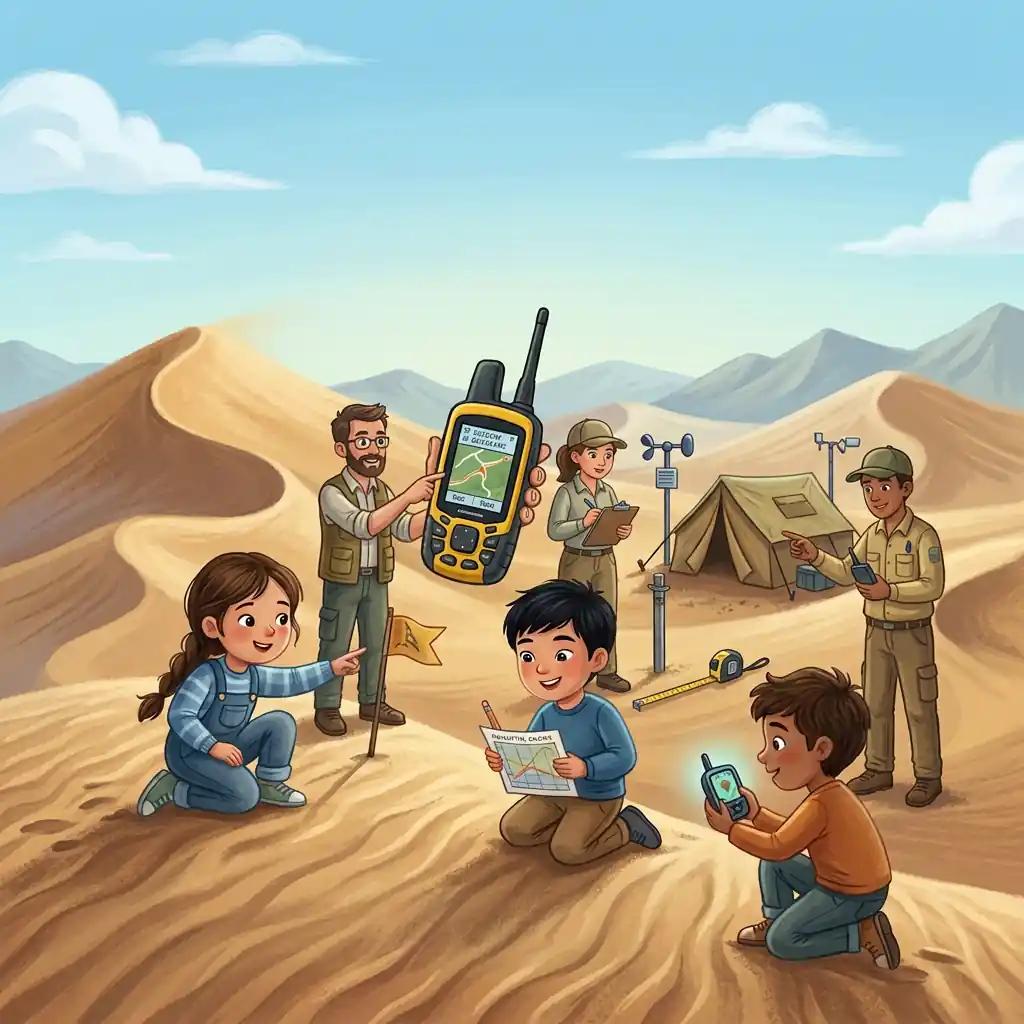
The morning after the sandstorm, the desert felt fresh and quiet, as if it had just had a big, powerful wash. The sun shone brightly, and a gentle breeze made the air feel crisp and clean. Layla, Sami, and Noah were excited to continue their work with Dr. Anya, eager to learn even more.
Dr. Anya led them back to the dune where they had placed their flags. This time, she brought a special device that looked like a fancy walkie-talkie with a small, glowing screen. “This is a GPS tool,” she explained. “It helps us know exactly where we are on Earth, using special signals from satellites far, far above us in space!”
She showed them the screen. Little dots marked where their flags had been yesterday, and a new dot showed exactly where they were now, after the big storm. “See?” she pointed. “The dune has indeed moved! Even more than we thought, it took a giant leap!”
The children peered closely at the screen. The distance the dune had moved seemed small on the little map, but they knew it represented many big steps for the giant sandy mountain. It was amazing how a place that looked so still could actually be moving so much.
“Now, we’re going to map this change on paper,” Dr. Anya said, laying out a large chart on a flat table. It was a beautiful drawing of the desert with many lines, numbers, and symbols.
Sami carefully helped Dr. Anya mark the new position of the dune on the chart. Layla used colorful pencils to draw tiny new flags, showing where the dune’s slip face had shifted to. Noah, feeling very important, helped write down the measurements, carefully copying the numbers from the GPS tool.
Scientists use satellites that orbit Earth to track moving deserts and how they change over time. These 'eyes in the sky' help them see giant patterns of movement that are impossible to see just from the ground!
They spent the whole morning measuring, drawing, and talking, watching the desert’s movements come alive on their chart. They saw how different dunes had moved in different directions and by different amounts. Each one had its own special journey.