
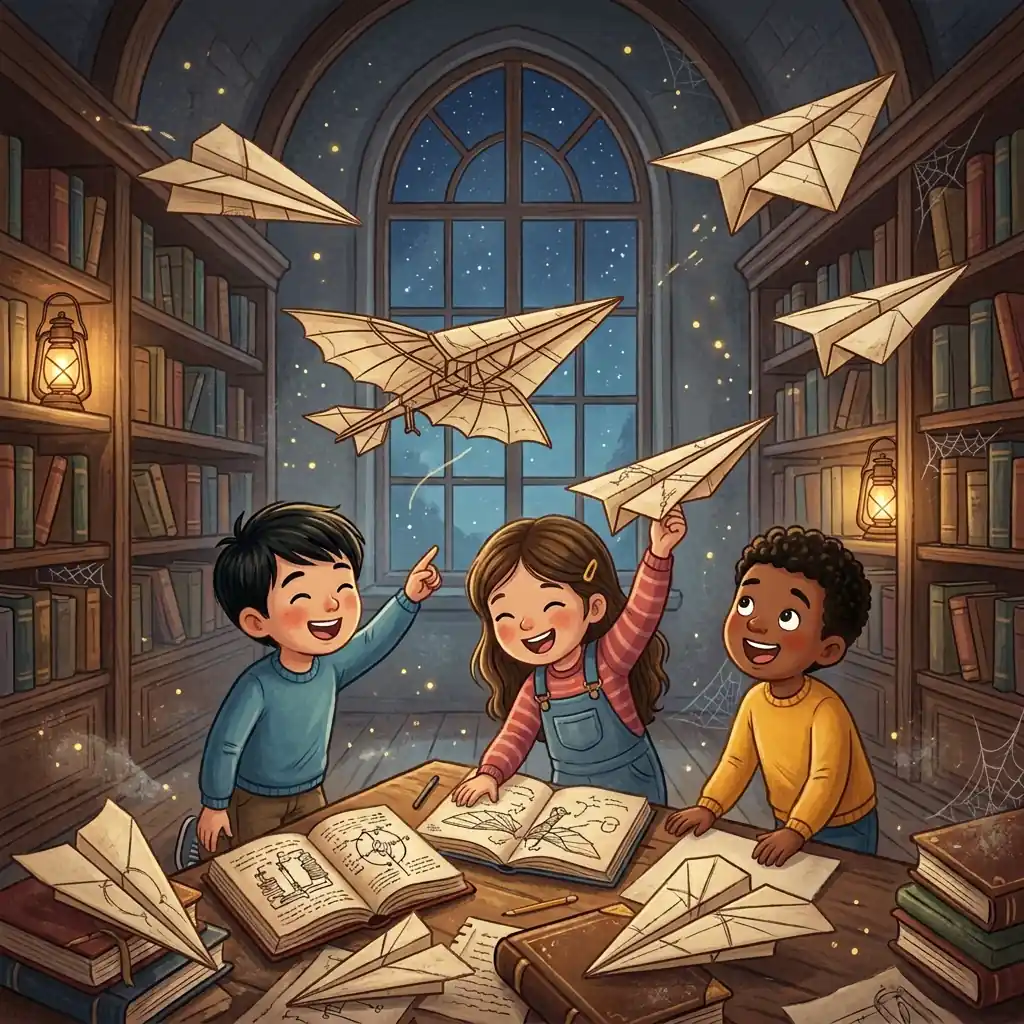
The success of their lemon battery made the friends even more excited to discover what other secrets the Library of Lost Inventions held. The next day, they were back in the dusty archive, their minds buzzing with anticipation.
Raymond, with his love for drawing, gravitated towards a large, worn-out sketchbook. Its pages were filled with elegant, detailed drawings of birds. Not just any birds, but birds with clever notes about their wings, their feathers, and how they soared through the sky.
“Look at these!” Raymond called out, pointing to a drawing of a giant, mechanical bird with wide, sweeping wings. “Someone wanted to fly, just like a bird!”
Chloe leaned closer. “It looks so real! Like a real bird, but made of wood and metal.” Arthur traced the lines of a wing with his finger. “How did they think it would fly without an engine?”
Miss Lily came over, her eyes twinkling. “Ah, yes, the dream of flight! For thousands of years, humans looked at birds and wished they could fly. These drawings are early ideas for flying machines, inspired by nature.”
Long before real airplanes existed, brilliant thinkers like Leonardo da Vinci, a famous artist and inventor, designed flying machines hundreds of years ago! He studied birds very closely.
One particular drawing was very intricate, showing a person strapped into a machine with huge, bat-like wings. The notes talked about how air would push against the wings, lifting the person up, just like a bird’s wings push against the air.
“It’s all about ‘lift’,” Miss Lily explained, gesturing with her hands. “When air moves quickly over the curved top of a wing, it creates less pressure there. Underneath the wing, the air moves slower and creates more pressure. This difference in pressure pushes the wing, and whatever is attached to it, upwards!”
Arthur tried to imagine it. “So, the wing has to be the right shape?” Chloe thought about how her arms felt when she ran very fast. “Like a strong push from underneath?”
Raymond, ever practical, got an idea. “We can test it! We can make our own little flying machines, just like the inventors did with their early ideas!”
Miss Lily retrieved a stack of colorful paper, scissors, and tape. “A wonderful idea, Raymond! Let's become flight engineers for the afternoon!”
The children carefully studied the sketches. Some wings were long and thin, like a hawk’s. Others were broad and rounded, like an owl’s. They noticed how the inventors thought about the 'aerodynamics' – a big word for how air moves around things – of their designs.
Arthur decided to make a paper glider with very long, straight wings, hoping it would soar far. Chloe, inspired by a drawing of a graceful dove, created a glider with slightly curved, wide wings.