
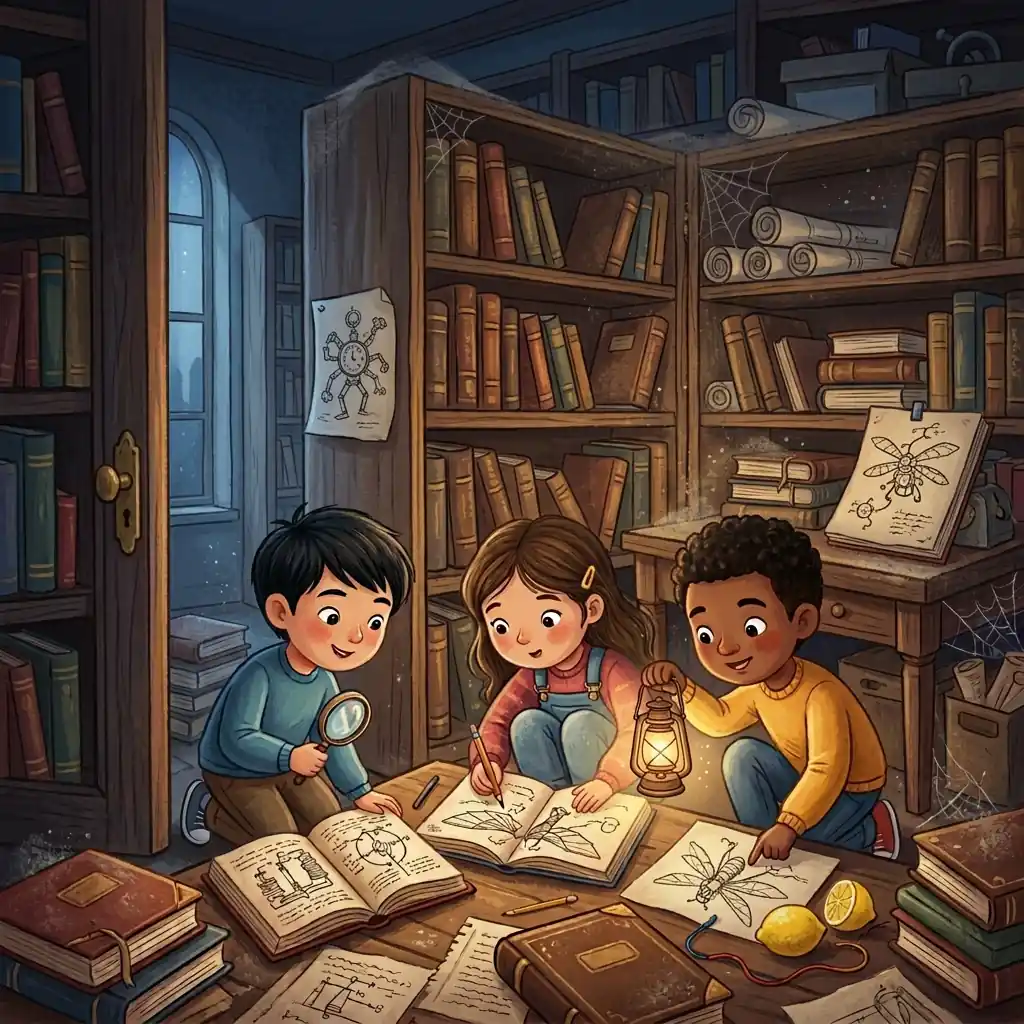
In a cozy little town, nestled beside a whispering willow tree, stood an old library. It wasn't just any library; it was a magical place filled with stories waiting to be read. Every afternoon, after school, three best friends, Arthur, Chloe, and Raymond, loved to visit.
Arthur had hair like sunny hay and eyes that sparkled with questions. Chloe wore bright red shoes and had a laugh like tiny bells. And Raymond, with his round glasses, always carried a small notepad for drawing everything he saw.
“Hello, Miss Lily!” they would chorus, as they tiptoed past the tall bookshelves. Miss Lily was the kindest librarian in the whole wide world, with spectacles perched on her nose and a smile that warmed the whole room. She knew every book by heart.
One breezy Tuesday, Miss Lily had a big job to do. “Oh, my dears,” she sighed, gently pushing a wobbly cart piled high with very old, very heavy books. “These books need to go into the back storage, but my old bones aren't as strong as they used to be.”
Arthur, Chloe, and Raymond exchanged excited glances. Helping Miss Lily was always an adventure! “We can help!” Arthur declared, puffing out his chest. Chloe bounced on her red shoes. “We’re very strong!” Raymond just nodded, already imagining how many books they would see.
They carefully began moving the dusty, leather-bound books, one by one. Each book smelled like old paper and forgotten adventures. The shelves were so tall, they almost touched the ceiling, like giant wooden ladders.
As they moved a particularly huge, heavy shelf, something unexpected happened. "Thump-thump!" went the shelf, revealing a hidden space behind it. It wasn't just a wall; it was an old, wooden door!
The door was dark and plain, almost blending into the wall, as if it had been hiding there for a very, very long time. It had a strange, rusty lock, shaped like a grumpy old owl.
“A secret door!” whispered Chloe, her eyes wide as saucers. Raymond quickly sketched the owl lock in his notepad. Arthur gently touched the cool, smooth wood.
Miss Lily peered over her spectacles. “Oh my goodness gracious!” she exclaimed, her voice a little shaky. “I quite forgot about this old door! It leads to the forgotten archives, where dusty dreams and bright ideas once slept.”
She rummaged through her jingling key ring, filled with keys of all shapes and sizes. Finally, she found a tiny, intricate key that looked just like a dancing butterfly. With a click and a creak, the grumpy owl lock sprang open.
The door swung inward with a soft sigh, revealing a small, dark room. It smelled of old paper, a little bit like forgotten cookies, and just a tiny bit like magic. Dust motes danced in the slivers of light peeking through a high window.
The room was filled to the brim with stacks of shelves, and on those shelves, not just books, but hundreds and hundreds of notebooks! They were old and worn, some tied with faded ribbons, others bursting with loose pages.
“What are these?” Arthur asked, his voice barely a whisper. He carefully picked up a notebook. The cover was worn smooth, and the pages inside were filled with delicate drawings.
Chloe picked up another. “Look! There are little machines drawn here! And strange squiggles and notes!” She pointed to a drawing of a contraption with many gears and levers, like a clockwork bird.
Raymond, with his keen artist’s eye, was already flipping through a thick journal. “These are invention ideas!” he declared, his voice filled with awe. “Someone drew all the things they wished they could build!”
Miss Lily smiled. “Indeed, my dears. This is the Library of Lost Inventions. A place where brilliant minds once recorded their biggest, wildest, and sometimes wackiest ideas. Each notebook holds a piece of someone’s dream.”
Many famous inventors kept journals to record their ideas and experiments. It helped them remember their thoughts and plan new steps.
One journal, bound in dark green leather, caught Arthur’s eye. He opened it carefully. Inside were drawings of wires, glass jars, and sparks. The notes next to them talked about ‘electricity’ and ‘making light’.
“Electricity?” Arthur pondered. “Like what makes our lights glow and our toys move?” The drawings showed simple ways people tried to understand this mysterious power a long, long time ago.
The children gathered around, completely fascinated. They imagined the inventors, with ink-stained fingers and bright, curious eyes, carefully drawing and writing down every single thought. It was like peeking into a secret garden of minds.
They realized that these notebooks weren't just old paper; they were tiny time capsules, holding the very first seeds of big ideas. Ideas that, perhaps, had blossomed into things we use every day, or ideas that were still waiting for someone to discover them anew.
Thomas Edison, who invented the light bulb, recorded thousands of invention ideas in notebooks! He often drew pictures to go with his words.
The afternoon quickly turned into evening, but the children didn't even notice. They were too busy turning pages, gasping at clever designs, and whispering about what everything could possibly be for. The library wasn't just about reading stories anymore; it was about discovering how stories become real.
Miss Lily watched them, her smile growing wider. She knew that sometimes, the best lessons weren't found in a textbook, but in the magic of discovery. And in a dusty old room, behind a forgotten door, a new adventure had just begun for Arthur, Chloe, and Raymond.
- Why is it important to write down ideas and experiments? Imagine if inventors never wrote anything down!
- How might future inventions start with simple sketches, just like these old ones?