
The Game of Hito
Centuries ago, in the sun-baked villages of Spain, life was simple. Work was hard, but leisure was vital. After long days in the fields or crafting goods, villagers would gather. They didn't have grand theaters or complex board games. They had the earth beneath their feet and the ingenuity of simple fun.
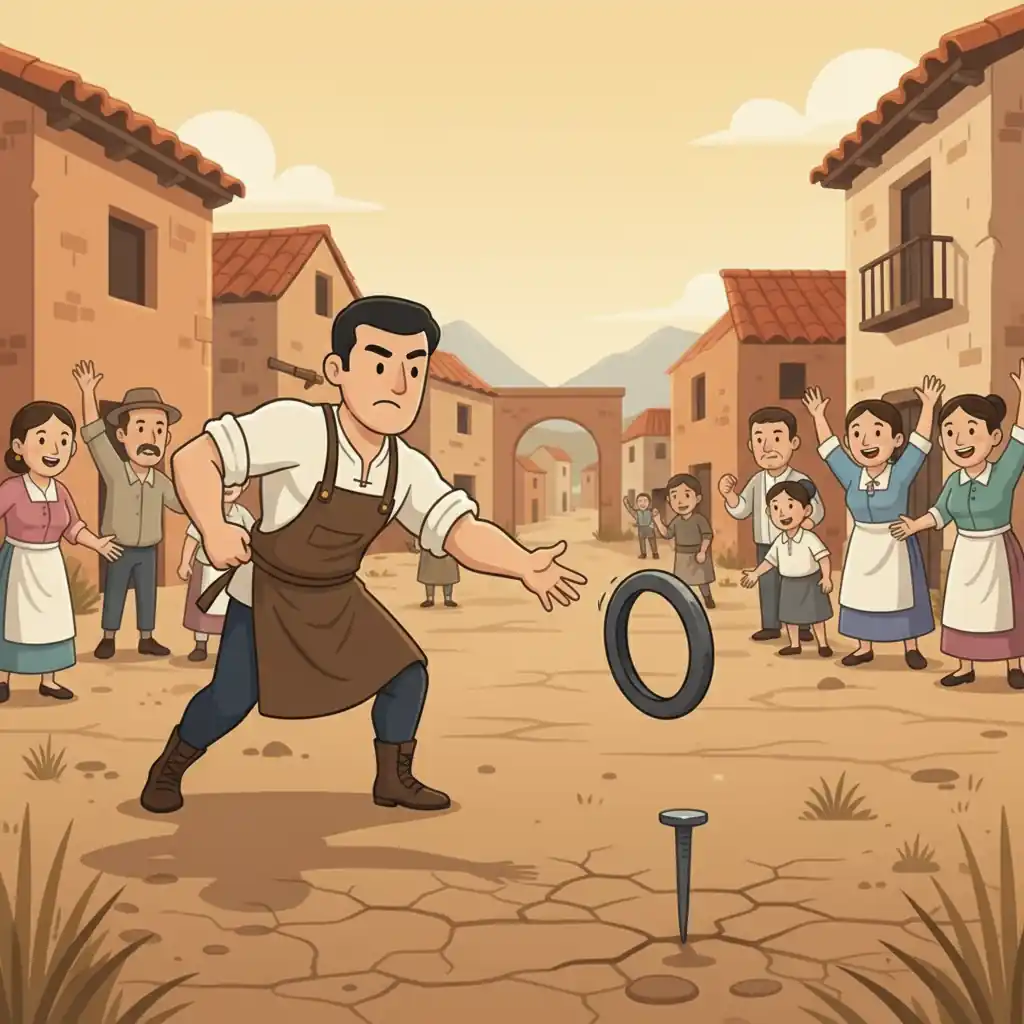
One of the most popular pastimes was a game called 'Hito'. It was straightforward. Someone would drive a single, small iron nail – the 'clavo' – into the hard-packed earth of the village square. It was often placed a good distance away, maybe twenty paces or more.
Then, players would take turns. They’d throw heavy iron rings, hoping to land one around the nail. It sounds easy, perhaps. But imagine the uneven ground, the varying weight of the rings, and the pressure of a dozen pairs of eyes watching your every move. It required focus, strength, and a keen eye.
The game wasn't just for bragging rights. Small bets were often made – a handful of coins, a round of wine at the tavern, or a promise of help with the next harvest. It was a communal event, filled with cheers, groans, and the occasional burst of laughter.
Every village had its local champions, men (and sometimes women) whose skill with the ring was legendary. They were the ones everyone watched, the ones who could seemingly bend the iron to their will. This particular story begins with two such legends.
The Rivalry
In a village nestled by the Guadalquivir river, two men consistently stood out. One was Pedro, the baker. Pedro was a man of flair. His loaves were famous, and so were his throws. He’d spin the ring dramatically, a flourish of his wrist, and release it with a grand gesture. Sometimes it worked. Often, it didn't.
His throws were a spectacle. The ring would often fly wide, kicking up dust a meter from the clavo, or bounce off a stray stone. But when he did land one close, the crowd erupted, swept up in his showmanship. He was a crowd-pleaser, if not always the most consistent player.
The other champion was Mateo, the blacksmith. Mateo was a quiet man. His hands, gnarled from years of hammering iron, were precise. He didn't have Pedro's theatrics. He approached the line with a serious calm. His throws were less flashy but far more accurate. He was a man who understood precision.
One sweltering afternoon, the final round of the annual Hito championship came down to Pedro and Mateo. They were tied. The village square was packed. Every eye was on the clavo, glinting innocently in the center of the dusty arena. Pedro stepped up first.
He took a deep breath, puffed out his chest, and sent his ring sailing. It looked promising for a moment, a high arc against the blue sky. Then, it veered left, landing with a dull thud in the dirt. A collective sigh went through the crowd. Pedro’s show had failed him.
The Moment of Focus
Now it was Mateo’s turn. He walked to the throwing line with no fanfare. He didn't look at the crowd, only at the clavo. He held the heavy iron ring, feeling its weight, its balance.
He squinted, closing one eye. He wasn't just looking; he was measuring. He saw the subtle slope of the ground, the way the light hit the nail, even felt the faint, hot breeze on his cheek. For Mateo, this wasn't just a game; it was a problem to be solved, like shaping hot metal.
He took a moment, his body still. The entire village seemed to hold its breath. Even the flies seemed to pause in the air. The only sound was the distant chirping of crickets and the frantic beat of the blacksmith’s own heart.