
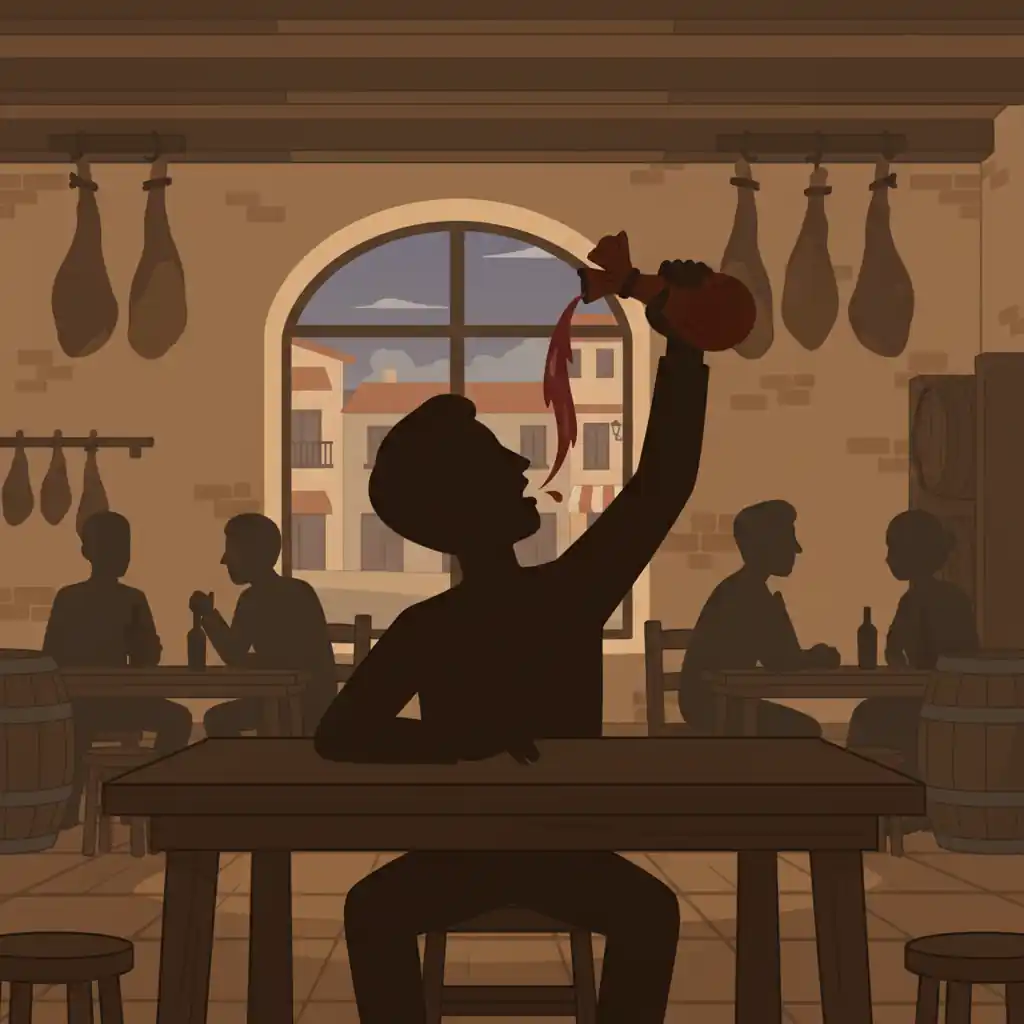
Ricardo and His Bota
In a sun-drenched village, nestled deep within the rolling, olive-tree-covered hills of Andalusia, Spain, stood a tavern. It was called 'El Rincón del Sol,' the Sun's Corner. Inside, the air was a comforting, timeless blend: the savory scent of cured jamón, the sharp brininess of olives, and the rich, earthy aroma of robust red wine. This wasn't just a building; it was the social heart of the village, a place where daily life unfolded and stories took root.
And in El Rincón del Sol, almost every afternoon, you would find Ricardo. He wasn't a man known for grand speeches or boisterous laughter. His conversations were typically brief, his nods thoughtful, his gaze often distant. Yet, his presence was as constant as the midday sun. Ricardo was a true fixture, his daily ritual as well-known as the ringing of the church bells or the dust stirred by passing donkeys.
He always occupied the same heavy, scarred wooden table in the corner, worn smooth by generations of elbows and tales. His hands, gnarled and strong from a lifetime spent tending vineyards and fields, often cradled his most prized possession: a leather bota. This bota was more than just a drinking vessel; it was his personal wine skin, dark with age, supple from constant use, its surface conforming perfectly to his grip. It held the local red wine, strong, honest, and as deeply ingrained in the culture as the village itself.
The bota itself boasted a long and practical history. For centuries, shepherds, laborers, and weary travelers relied on these ingenious, waterproof leather bags. They were designed to keep wine cool under the harsh sun and, crucially, allowed one to drink without ever touching lips to the spout. This made sharing easy and hygienic, a blessing in a time before personal cups were common. For Ricardo, it wasn't a trend; it was simply tradition. The most natural way to enjoy his wine.
Ricardo didn't drink to escape or to cause trouble. He wasn't a man prone to rowdy outbursts or loud celebrations. He was a quiet, contemplative drinker. His eyes, often half-closed, would scan the dusty street through the open tavern door. He observed the children playing, the old men debating cards, the women carrying water jugs. He simply watched life, absorbing its rhythms, and he drank. Silently. Steadily. With a practiced cadence that spoke of years of devotion to his bota.
The Unmistakable Gesture
Drinking from a bota is an art form. It demands a specific, almost theatrical technique, far removed from simply lifting a glass. You don't just 'sip.' You hold the bota at arm's length, often extended far above your head, a master of physics and aim. Then, with a gentle but firm squeeze, you direct a thin, controlled stream of wine. It arcs gracefully downward, a liquid ribbon, directly into your waiting, open mouth. It demands practice. It requires focus. And it absolutely needs a steady hand.
To achieve that perfect arc, that clean, spill-free flow—a matter of village pride, no doubt—Ricardo had to lift his arm high. Very high. His entire arm extended upwards, his hand pinching the bota, his wrist angled just so to guide the stream. The most striking element of this motion, however, was undeniably his elbow. It pointed skyward, a sharp, prominent angle against the dark, cool interior of the tavern. It was a beacon. An unmistakable signal of his current activity.
He would tilt his head far back, eyes narrowed slightly, fixed on the descending stream. A quick gulp, a satisfying swallow. Then, with a practiced, almost dismissive flick, he would wipe his mouth with the back of his hand. The bota would then settle back onto the table, its soft leather making a slight sigh against the worn wood. But only for a few minutes. Soon, the arm would rise again. The elbow would once more point towards the heavens, repeating the ritual.
This wasn't a subtle movement that could be missed or misinterpreted. It was distinct. It commanded attention. Anyone glancing into El Rincón del Sol, or simply passing by the open door, would immediately notice Ricardo. And they would see that conspicuously raised elbow. It was his signature. His personal mark. A reliable, rhythmic punctuation mark in the quiet unfolding of each village afternoon.
A Village's Shared Gaze
Outside the tavern, the rhythm of village life continued its hum. María, the baker, kneaded dough, her ears always open for the latest news. Juan, the farmer, guided his patient donkey through the dusty square, his eyes observing everything with a quiet wisdom. They saw Ricardo. Everyone did. His routine was as predictable as the sunrise.