
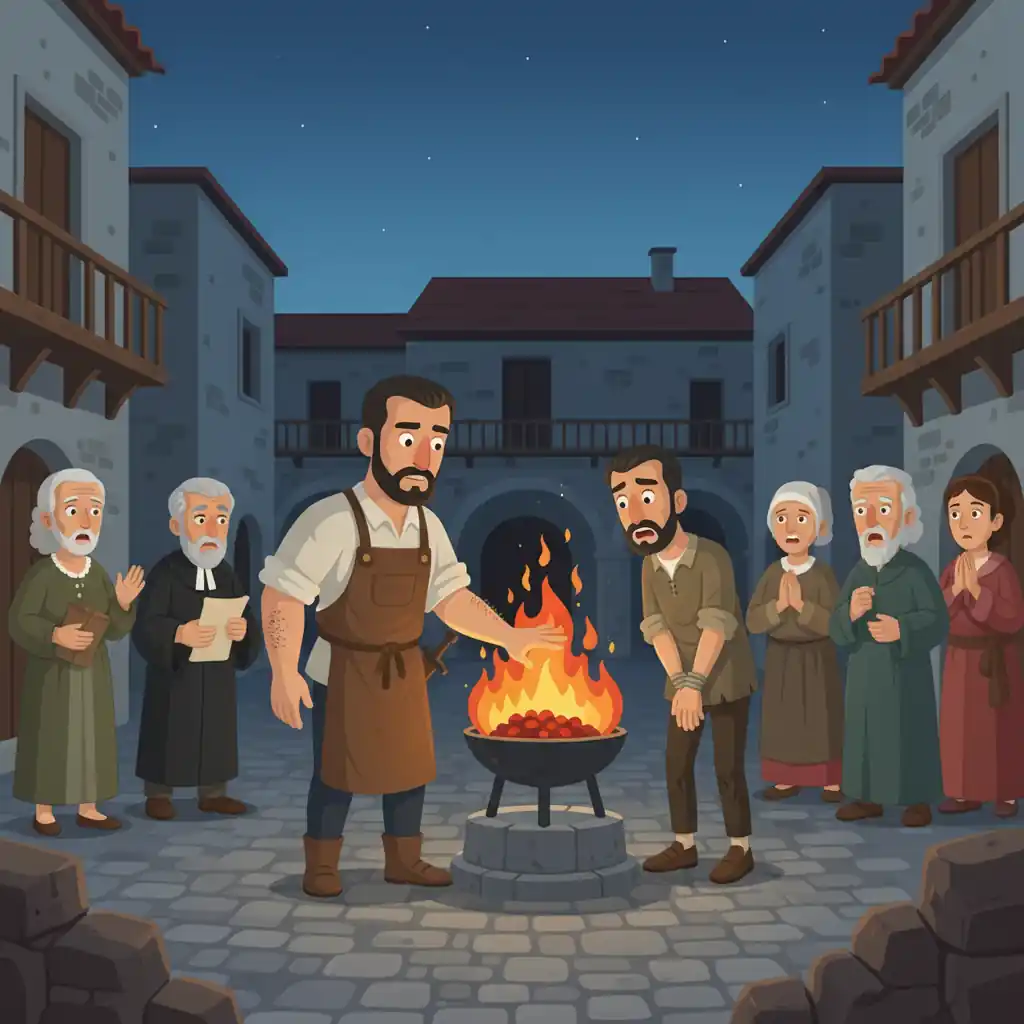
The Missing Chalice
The year was 1488. The air in the small Spanish village of San Marcos del Monte hung heavy with dust and the scent of olives. Life was hard, but predictable. Until the morning the silver chalice vanished.
The chalice was the pride of the local monastery, intricate and ancient. It disappeared from the altar during the night. Panic spread. Such a theft was not just a crime; it was sacrilege.
Suspicion fell quickly on Mateo, a woodcutter. He was a simple, quiet man, known for his strong back and honest eyes. But he had been found near the monastery walls just before dawn. He claimed he was checking rabbit traps.
No one believed him. Not the fearful villagers, not the stern monks. Not even the local constable. Everyone spoke of Mateo’s sudden greed, of divine wrath.
Everyone, that is, except Jorge. Jorge was the village blacksmith, a man of muscle and common sense. He knew Mateo better than most. Mateo was his friend. More importantly, Jorge knew Mateo was with him, helping mend the forge chimney, until well past midnight. Far from any monastery wall.
The Ordeal of Fire
Justice in those days often involved God. With no witnesses and no confession, the local judge, Don Esteban, invoked an ancient, terrifying law: the 'Iudicium Dei.' A Trial by Ordeal.
The specific ordeal chosen was the 'Ordeal of Hot Iron.' It was a brutal test. A heavy iron bar would be heated in the forge until it glowed cherry red. The accused, or a willing witness on their behalf, had to grasp it and walk nine measured paces.
Afterward, the scorched hand would be wrapped in clean linen and sealed with wax. Three days of agonizing wait would follow. If, upon unwrapping, the hand showed signs of healing without festering, God declared innocence. If it festered, guilt was proven.
The crowd gasped. Mateo looked pale, his eyes wide with terror. Who would volunteer for such a barbaric act? To hold fire, to risk ruin and death, for a friend no one believed?
The Blacksmith’s Choice
Then, Jorge stepped forward. The movement was slow, deliberate. A hush fell over the square. All eyes turned to the blacksmith, whose hands were his livelihood, his very identity.
Jorge’s hands were thick with calluses, strong enough to shape steel, precise enough to mend delicate locks. Without them, he was nothing. He couldn’t forge, couldn’t shoe a horse, couldn’t feed his wife and children.
He knew the risk. A ruined hand meant destitution. It meant pain beyond imagining. And if his hand failed to heal, he would not only suffer physical agony but confirm Mateo's guilt in the eyes of God and man.
But he also remembered Mateo, laughing as they worked, always ready to lend a hand, never asking for more than he gave. Mateo, simple and kind. Not a thief. Jorge's conviction was absolute.
He looked at Don Esteban, his gaze unwavering. “I will stand for Mateo,” Jorge said, his voice ringing clear. “He is innocent. I stake my life, and my hands, on it.” The judge warned him again of the grim consequences. Jorge simply nodded. His decision was made.