
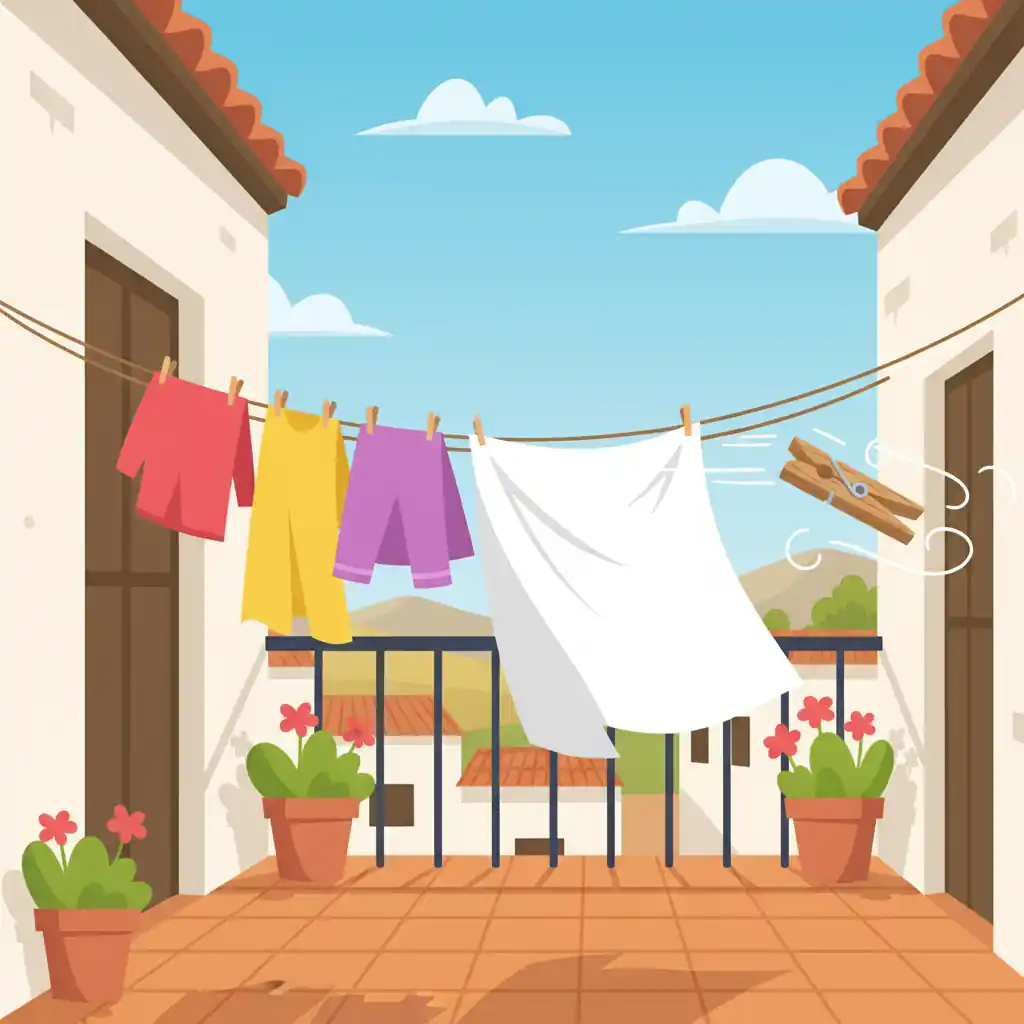
The Balcony's Daily Drama
Picture a typical Spanish apartment building. Rows and rows of balconies. Each one a small, open-air stage for daily life. And on almost every balcony, laundry. Sheets, shirts, socks, all dancing in the breeze.
This laundry isn't just draped over a railing. It's secured. Held tight against the often-gusty winds by small, indispensable heroes: the 'pinzas'.
A 'pinza' is a clothespin. Usually wooden, sometimes plastic. Simple in design, vital in function. Without them, a sudden breeze could turn laundry day into a neighborhood treasure hunt for stray underwear.
Everyone knew the importance of a good pinza. A strong grip. A reliable spring. A tiny guardian for your clean clothes, keeping them tethered to the line, connected to the world, and far from the dusty streets below.
For generations, the snap of a pinza opening and closing was a familiar sound across Spain. It was a sound of order, of things being held together.
The Moment of Disconnection
But even the best pinzas eventually wear out. The wood splits. The spring loses its snap. Or sometimes, a particularly mischievous gust of wind, stronger than usual, would hit just right.
Then, it happened. A tiny moment of drama on an ordinary balcony. A pinza would fail. Or simply slip. Its grip, once so firm, would suddenly loosen.
And the garment it held? Whoosh! Disconnected. Free. The shirt, the towel, the sock—whatever it was—would take flight. It would spiral down, perhaps briefly catching on a neighbor's awning, or more often, sailing away completely.
It was a tiny disaster. A mild frustration. A piece of the laundry, once part of the orderly line, was now unmoored. It had lost its connection. It was gone.
The owner of the flying laundry would often gasp. Maybe point a finger. '¡Ay, mi camisa!' they might cry, watching their garment disappear around the corner of the building.
Elena's Creative Mind (and Absent Pinza)
In a bustling neighborhood of Madrid lived a woman named Elena. Elena was a painter. Her mind was a whirlwind of colors, ideas, and abstract thoughts. She saw beauty where others saw mundane details.
She also had a tendency to say things that made absolutely no sense. Or to forget simple, obvious facts. Her friends loved her, but they often wondered if her brain operated on a different frequency.
One sunny afternoon, Elena was chatting with her friend, Carlos, on her balcony. She was in the middle of a passionate explanation about why purple was the most misunderstood color in the universe. Her laundry, still damp, hung nearby.
Suddenly, a strong breeze swept through the street. One of Elena's old, wooden pinzas, holding a particularly vibrant scarf, finally gave up. The pinza snapped. The scarf lifted, danced for a second, then sailed off into the clear blue sky, heading towards the plaza below.
Elena stopped mid-sentence. Her eyes, wide with surprise, followed the scarf's trajectory. 'Oh, look!' she exclaimed, completely forgetting her purple philosophy. 'My scarf is going on an adventure! I wonder if it will reach Morocco!'
Carlos, who had just watched the pinza break and the scarf vanish, stared at her. He then looked at the empty spot on the line, then back at Elena, whose eyes were still fixed on the horizon as if tracking a migratory bird.