
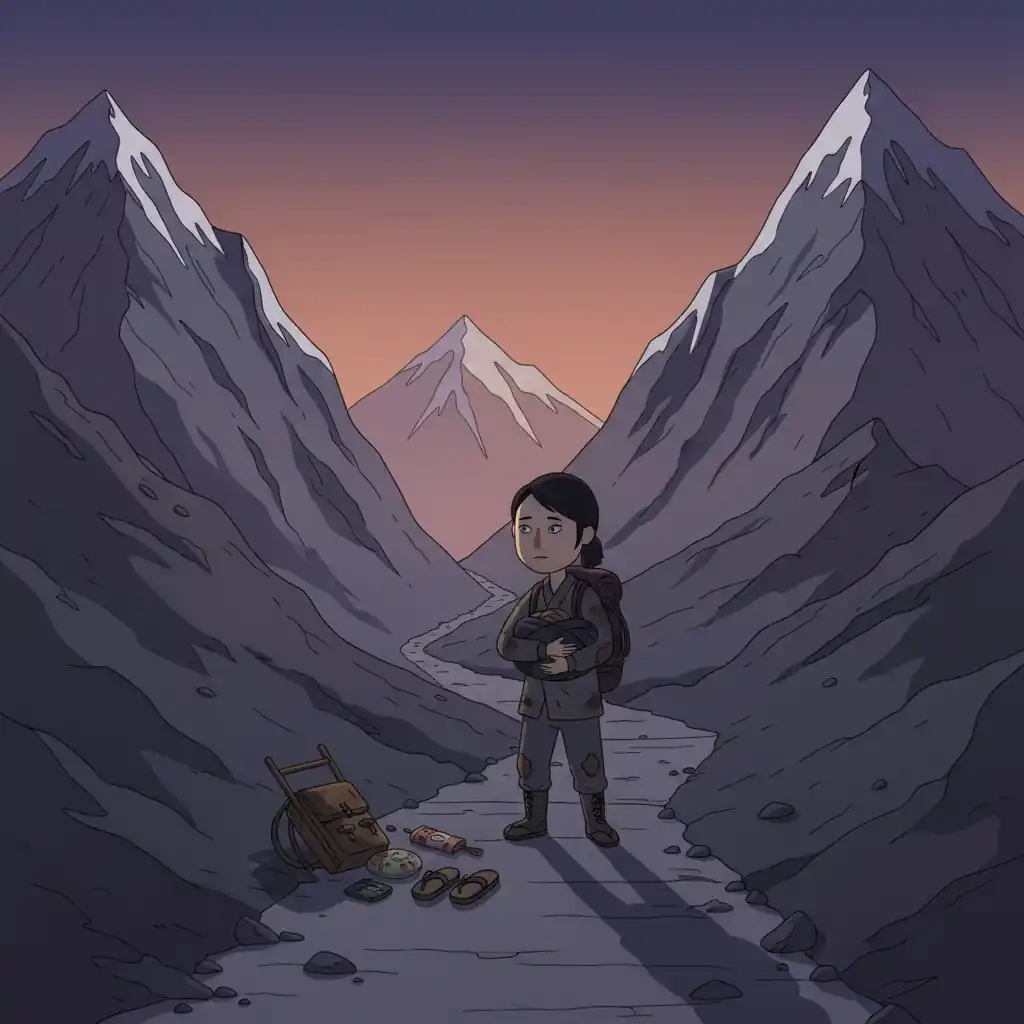
The Icy Pass to Echigo
Centuries ago, in a Japan often blanketed by unforgiving winters, travel was a gamble. Especially for those crossing the treacherous mountain passes between provinces. One such journey involved Kenji, a salt merchant from a small, snowbound village. His mission was simple but vital: deliver a precious load of salt to the bustling markets of Echigo, then return with enough rice to feed his hungry family and neighbors through the long winter.
The Kiso Road was legendary for its beauty and its brutality. Icy winds howled down from the peaks, and snow piled high, swallowing the narrow paths. Kenji was a sturdy man, but even he felt the bite of the cold deep in his bones. His only real defense against the elements was a thick, padded cloak, a gift from his wife on their wedding day. It was heavy, but it was warm. It kept the chill from his back, a shield against the endless grey.
Days blended into a blur of numb feet and frozen breath. Each step was a battle against the snow and the growing doubt in his heart. His satchels, heavy with the salt, were balanced precariously on a carrying pole across his shoulders. His personal bag, holding his meager rations and his precious cloak, hung at his hip. The cold was a constant companion, but a deeper dread began to settle in: his provisions were running low. Much lower than he had anticipated.
The Unbearable Weight of Hunger
One morning, as a weak sun struggled to pierce the overcast sky, Kenji checked his food pouch. A few dried persimmons. A handful of roasted beans. That was it. He was still days from Echigo, and even more days from home. The gnawing emptiness in his stomach was more menacing than any icy gust. His body shivered, but his mind raced with a far more primal fear: starvation.
He slumped against a snow-covered pine, its branches heavy with white. He considered his options. There were none. He couldn't simply wish more food into existence. He couldn't abandon the salt; his village depended on the rice it would buy. He had only so much strength, and he could carry only so much weight.
His eyes fell upon his thick cloak. Its familiar, comforting weight now felt like a burden. It was keeping him warm, yes, protecting his back from the biting cold. But what good was a warm back if his belly was empty? What good was comfort if survival itself was at stake? He had a small, emergency packet of dried rice he had not been able to fit, deeming the cloak more essential at the start. Now, that calculus had changed.
A Life for a Cloak
With a heavy sigh, Kenji began to untie his cloak. His fingers, already stiff with cold, fumbled with the knots. Each movement was deliberate, almost ritualistic. This wasn't just a piece of clothing; it was a connection to home, a symbol of warmth and safety. To leave it behind felt like tearing a part of himself away.
He folded the thick fabric carefully, placing it at the base of the pine tree. Perhaps another traveler, less desperate, would find use for it. A bitter draft immediately hit his back, making him gasp. The cold felt sharper, more direct. But as he felt the chill, he also felt a strange lightness. A new kind of clarity. He now had space in his bag for that emergency packet of dried rice.