
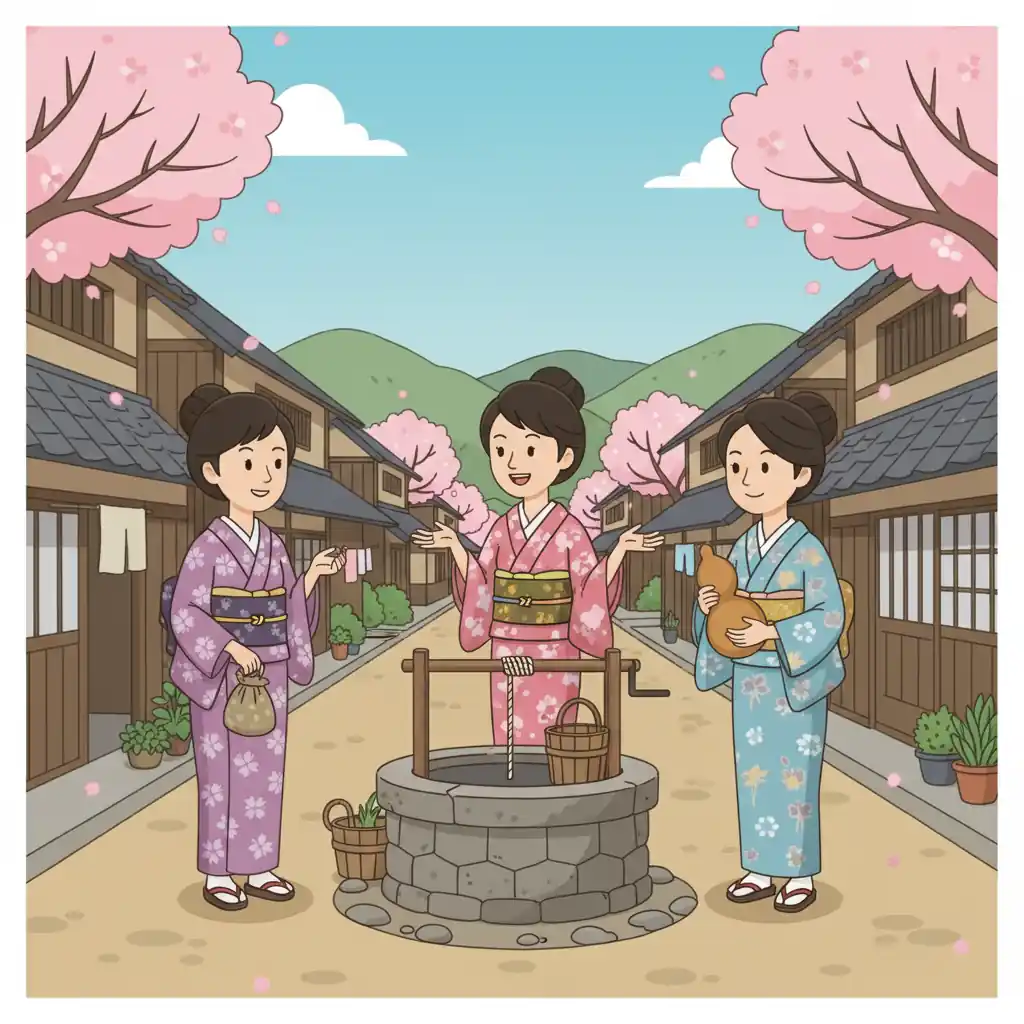
The Village's Lifeline
Long ago, in countless small villages across Japan, life moved at the rhythm of the sun and the needs of the earth. There were no taps, no pumps in every home. The central well was everything.
It was usually a simple stone structure, sometimes with a wooden roof, sometimes just an open hole. But its importance was absolute.
Every day, from dawn until dusk, villagers would make their pilgrimage. Women, often with babies strapped to their backs, carried heavy wooden buckets. Children, eager to help, carried smaller pails. Old men and young men would stop by on their way to or from the fields.
Drawing water was a chore. It was hard work. The bucket was heavy. The rope could fray. But it was also unavoidable. Without water, there was no cooking, no cleaning, no tea, no life.
The well wasn't just a source of water. It was the only public space most villagers visited daily. It was the one place where everyone, regardless of status, would gather.
In a world without newspapers, radios, or telephones, the well became the village's communication hub. It was where the day truly began and often ended, not just with a full bucket, but with a full mind.
More Than Just Water
Imagine Mrs. Tanaka, a lively woman with a booming laugh, arriving at the well one morning. She finds Mrs. Sato already there, her brow furrowed as she struggles with a stubborn bucket.
“Good morning, Sato-san!” Tanaka-san calls out. “Having trouble with that old bucket again? Let me help.”
As they work together, the first drops of conversation begin. “Did you hear about the new silk merchant who came through yesterday?” Mrs. Sato asks, adjusting her headscarf.
“Oh, really? I heard his prices were outrageous!” Tanaka-san replies, pulling the rope with practiced ease. “And did you see young Kenji from the blacksmith’s family? He cut his hair short!”
Soon, others arrive. Mr. Hiroshi, the rice farmer, complaining about the lack of rain. Old Granny Kiku, sharing her wisdom about the best way to pickle daikon.
The small talk evolved naturally. The weather. The harvest. Then, the children. The latest visitor. A new recipe. Before long, these brief exchanges became longer chats.
It was where news of a marriage proposal first spread. Where worries about a sick child were shared. Where the community discussed upcoming festivals or shared a good laugh about the mayor’s new hat.
The wait for water, once a simple chore, transformed into a cherished social ritual. People would linger, even if their bucket was already full. They sought not just water, but company, connection, and information.