
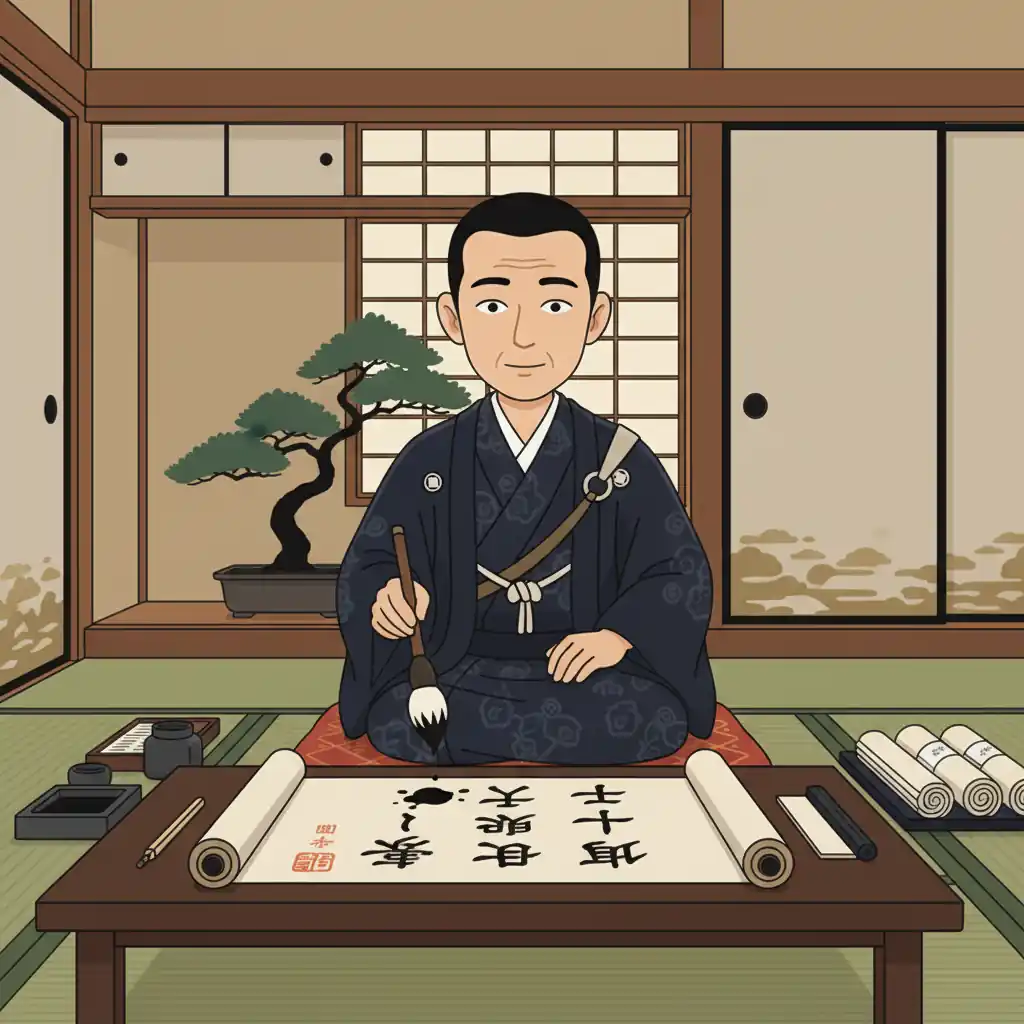
The Unrivaled Hand
Long ago, in the land of Japan, there lived a monk named Kūkai. Most people knew him by his posthumous title, Kobo Daishi. He was a revered figure. A scholar, a spiritual leader, and a man of immense talent.
But among all his gifts, one shone brightest: his calligraphy. Kobo Daishi was not just good with a brush. He was extraordinary. He was considered a living legend, a master whose skill was beyond human comprehension.
His brushstrokes were said to possess life. Each character flowed with grace, precision, and spirit. People believed his writing was flawless. Divine, even. He mastered every style, every intricate stroke, with an ease that baffled lesser artists.
Stories circulated about his calligraphic feats. He could write with both hands simultaneously. He once wrote a poem so quickly, the words seemed to spill from his brush like water from a spring. Emperors sought his work. Temples proudly displayed his inscriptions.
To the common person, Kobo Daishi embodied perfection. His characters were etched not just in ink, but in the hearts and minds of all who saw them. He was the standard against which all other calligraphers were measured. And no one, it seemed, could ever hope to reach it.
The Imperial Commission
One day, a grand commission arrived. The Emperor himself requested Kobo Daishi to inscribe a name plaque for a magnificent new temple gate. This was not just any gate; it was to be the main entrance, a symbol of national reverence.
The monk prepared with his usual meticulousness. The finest ink was ground to a smooth, dark liquid. The brush, chosen from his prized collection, was perfectly balanced. The wooden plaque, smooth and polished, lay before him.
A hushed silence filled the room. A few acolytes watched, their breath held. Kobo Daishi knelt, his mind clear, his focus absolute. He dipped his brush, the tip absorbing the rich, black ink.
With a slow, deliberate motion, he began the first character. It was '門' (Mon), meaning 'Gate.' A complex character, requiring several precise vertical and horizontal strokes. Each one, a testament to his skill.
The brush glided. The ink flowed. The character began to form, perfect in its balance, strong in its presence. Everyone watched, mesmerized by the master's touch.
He completed the first part. Then, for the final, crucial vertical stroke, his hand moved. A single, almost imperceptible deviation. A tiny flick of the wrist. Just a fraction of an inch too far, or perhaps a stroke that ended ever so slightly abruptly.