
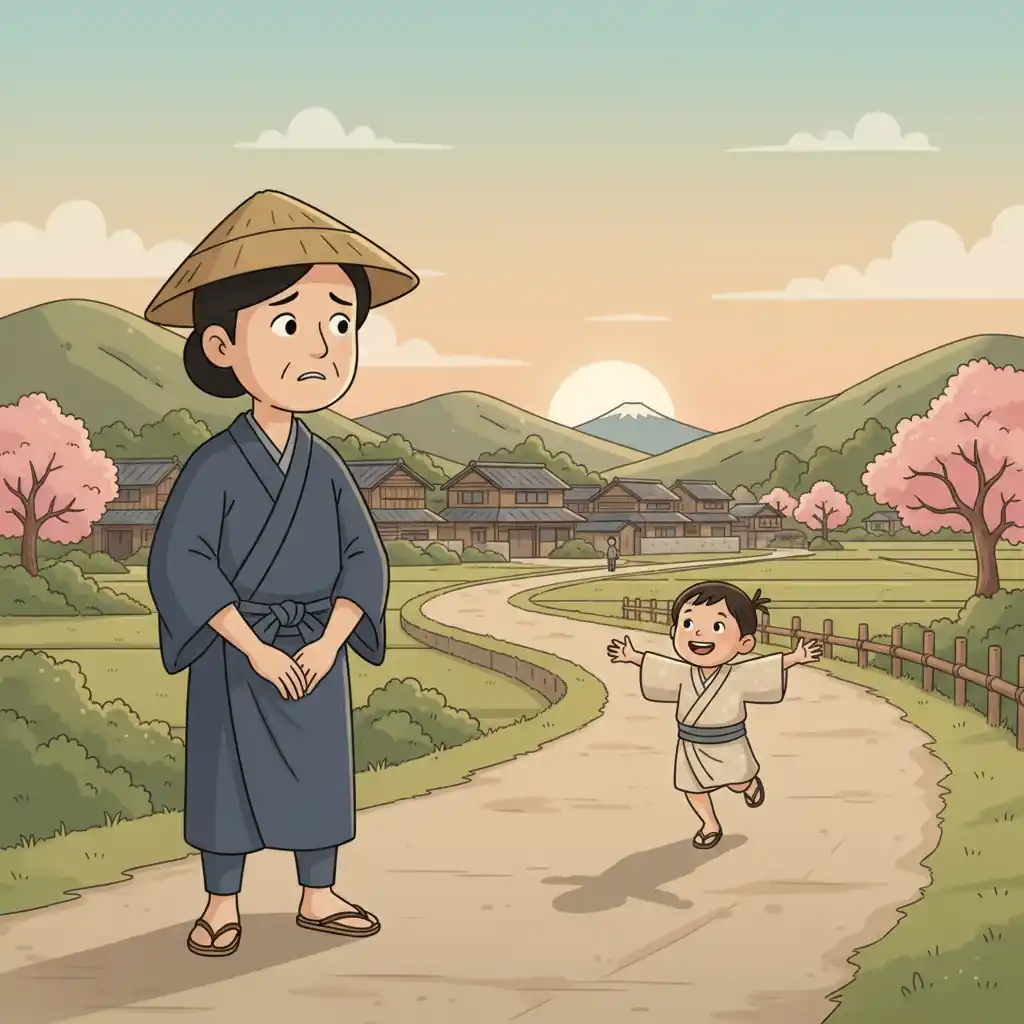
The Village of Silent Sacrifices
In a valley cradled by gentle hills, lay the village of Koda. Its days moved with the rhythm of the seasons. Rice paddies stretched green in summer, golden in autumn. The air often smelled of damp earth and distant cooking fires.
Taro was a farmer. His hands were wide, his back strong. Every dawn, he was among the first in the fields. Rain or shine, his straw hat bobbed above the crops. He knew the soil like an old friend.
Hana, his wife, worked just as hard. She tended their small garden, cooked meals over a charcoal hearth. She mended clothes, spun thread, and wove sturdy mats. Her fingers were always busy, moving with practiced speed.
They had two children, Kenji and Yumi. Kenji, seven, was a whirlwind of energy. Yumi, five, was a quiet sprite, her eyes wide with curiosity. Their laughter often echoed through their small home, a sound Taro and Hana cherished above all else.
Their lives were simple. Money was scarce. Every coin earned, every grain harvested, was a result of their tireless effort. They worked for the sake of their children. For food on the table, for new sandals, for a small toy on a festival day. These were the silent promises they kept.
Small Wants, Big Efforts
Kenji, like many boys his age, had endless desires. He wanted a wooden sword like the one his friend, Hiroshi, had. He wanted sweet rice cakes after dinner. He wanted to spend all day by the river, not helping with chores.
“My shoes are too small,” he complained one morning. “They pinch my toes.” Taro nodded, silently noting it. He would work extra hours, perhaps selling more of their modest harvest at the market.
Yumi was gentler, but still expressed her wishes. “Mama, the doll I have is old. Can I have one with real hair?” she asked, clutching her worn fabric doll. Hana would smile, her heart heavy. She knew the cost of such a doll. She would try to find scraps of silk, maybe even take on extra weaving work in the evenings.
The children saw their parents. They saw them leave early, return late. But they did not see the calloused hands that trembled slightly with exhaustion. They did not see the tired lines around their parents' eyes. They did not see the quiet worries about the next harvest, the price of rice, or if the roof would hold through the next storm.
To Kenji and Yumi, food simply appeared on the table. Clothes were simply there when needed. The small comforts they enjoyed were just things. They did not connect these things to the relentless effort, the quiet sacrifice, that went into acquiring each one. Their world was bright and full of their own small needs. Their parents' world was largely invisible to them.
The Elder's Observation
Old Kiku lived next door. Her hair was white as winter snow, her face a map of countless seasons. She had seen generations come and go in Koda. She had raised children of her own, and then grandchildren. Her wisdom was deep, her observations sharp.
She watched Taro leave before sunrise, his shoulders slumped from the previous day's labor, but his step steady. She saw Hana light the cooking fire before the first bird sang, humming a soft tune. Kiku saw the love in their actions, even when it went unacknowledged.
One afternoon, Kenji stormed past Kiku's gate. “It's not fair!” he grumbled. “All the other boys have new kites for the wind festival. Mine is old and torn.” His voice was loud, full of a child's indignation.
Kiku watched him go, then her gaze fell on Hana, who was carefully patching Kenji's old kite with bits of paper, her brow furrowed in concentration. Hana wanted nothing more than to see her son's face light up with joy. She would spend hours making sure that patched kite flew higher than any other.