
The Craft of Harmony
In ancient Japan, harmony was not merely an aesthetic ideal; it was a foundational principle of life. It shaped everything, from the careful arrangement of a garden to the meticulous craft in a carpenter's workshop.
Master Kenji, a venerable figure with hands calloused by years of work, was revered throughout his province. His reputation wasn't built on grand structures, but on the flawless quality of his wooden planks, the seamless precision of his joints, and the absolute perfection of every surface he touched.
He taught his young apprentices a core truth: the goal of their craft was not just to build, but to create a unified whole. This meant no protrusions, no rough edges, nothing that disturbed the smooth flow of the wood.
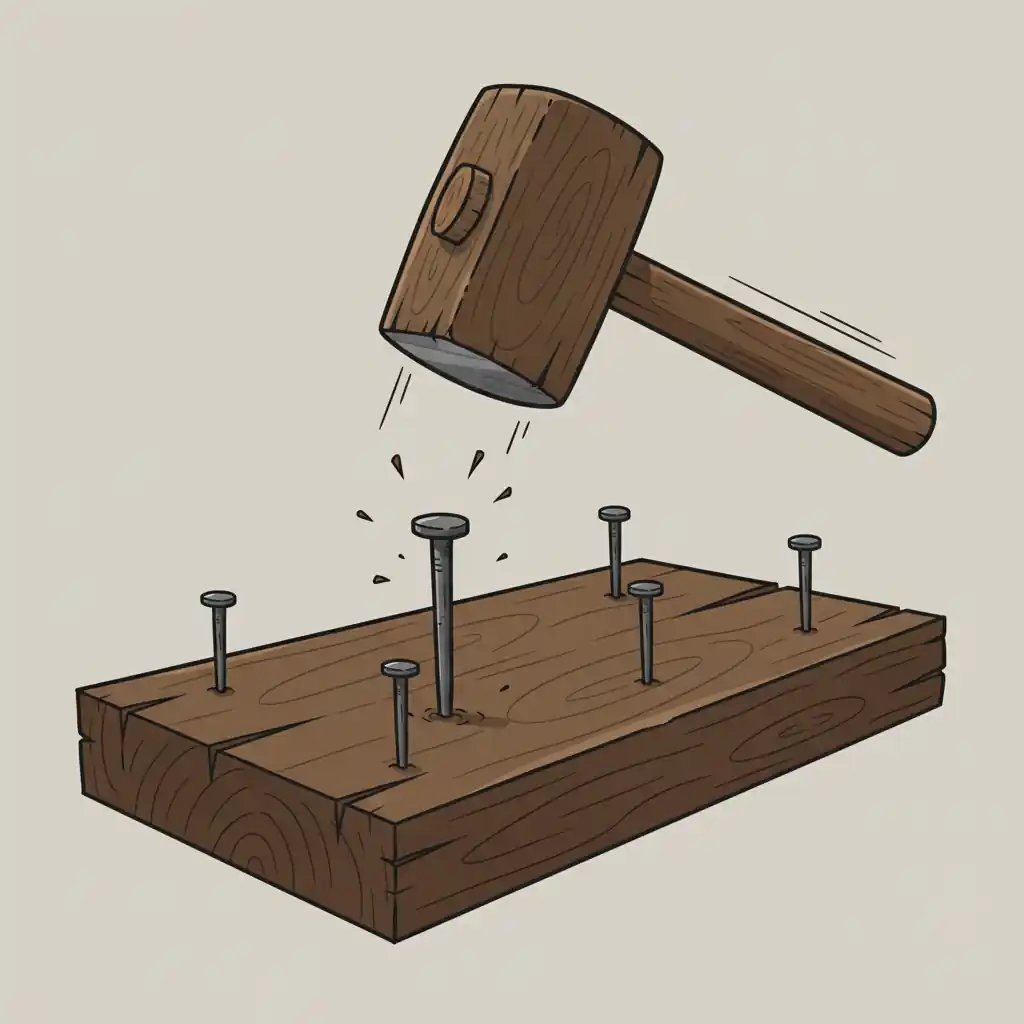
Picture a finished plank. It lies on Kenji's workbench, ready for its final place in a tea house wall or a temple floor. Nails have been driven with practiced, deliberate care. Each one sinking deeply, securing the wood without a trace.
But sometimes, despite all the skill, a nail would defy the ideal. It would stubbornly stick up. Just a hair's breadth above the wood's surface. A tiny rebellion in an otherwise perfect plane.
It would catch the soft light filtering through the workshop window. It would snag a passing sleeve. More than that, it disturbed the visual balance. It was an imperfection, a discordant note in Kenji's symphony of wood.
What was Master Kenji’s response to such an anomaly? He did not ponder its uniqueness. He did not admire its independent spirit. He certainly didn't let it be.
He would reach for his hammer, a tool as old and worn as his own hands. With a single, firm, resonant strike, he would drive that proud nail down. Down until it was flush with the surrounding wood. Down until it blended seamlessly with its brothers.
"A smooth surface," he would declare, his voice quiet but firm, "is not just pleasing to the eye. It is strong. It is lasting. It signifies purpose and unity."
This act was not a punishment for the nail. It was a necessary step. An obvious action born from centuries of practical wisdom. But for those watching, especially the young apprentices, its simple truth carried a profound weight, hinting at a meaning far beyond just carpentry.
Hiroki's New Ideas
Generations passed, and Master Kenji's legacy continued. Among a fresh cohort of apprentices arrived a young man named Hiroki. He was bright, restless, and brimming with fresh ideas. "Too clever for his own good," some of the older, more traditional craftsmen murmured.
Hiroki saw the world not as it was, but as it could be. He observed the traditional techniques and immediately envisioned improvements. He experimented with new ways to join wood, creating stronger, less visible connections. He devised faster, more efficient methods for planing rough planks.
One day, with a glint of genuine excitement in his eyes, he presented his latest creation: a unique kind of storage shelf. It was undeniably stronger, required less material, and could be assembled with surprising speed. He beamed, certain his innovation would be met with praise.
The other apprentices, however, exchanged uneasy glances. The senior craftsmen stroked their beards thoughtfully, their expressions unreadable.
"This is... different," one apprentice finally said, his tone flat. "Master Kenji taught us the ancient ways. The proven ways."
Hiroki, fueled by youthful idealism, launched into a passionate defense. He explained the engineering, the logic, the undeniable efficiency of his design. "It's better," he insisted. "It's progress!"
But in the revered workshop, tradition wasn't just a guide; it was almost a religion. Innovation, especially when it challenged established norms, was often perceived not as an improvement, but as a form of insolence, a silent critique of the masters who came before.
His elders, rather than acknowledging his ingenuity, found themselves focusing on the disruption. They scrutinized his shelf, not for its strengths, but for any deviation from the conventional. They pointed out minor, cosmetic differences. They subtly downplayed his achievements.
"Your shelf might be new, Hiroki," Master Kenji finally said, his voice calm, "but it stands apart from the harmony of our established methods." His words, delivered without anger, carried the weight of an invisible hammer.
Hiroki felt a profound chill. His innovative spirit, his desire to excel, to create something truly his own – it was like that protruding nail. Not celebrated for its distinctiveness, but marked for being outside the norm. It was noticed, certainly, but in a way that signaled correction, not commendation.
The Unspoken Rules of the Village
The sentiment wasn't confined to the hallowed halls of Master Kenji's workshop. It was the silent, operating system of the entire village, indeed, of much of society.
Life in the community was a carefully orchestrated dance, a delicate balance where everyone understood their role and played their part without seeking undue attention. Individual glory often took a back seat to collective harmony.