
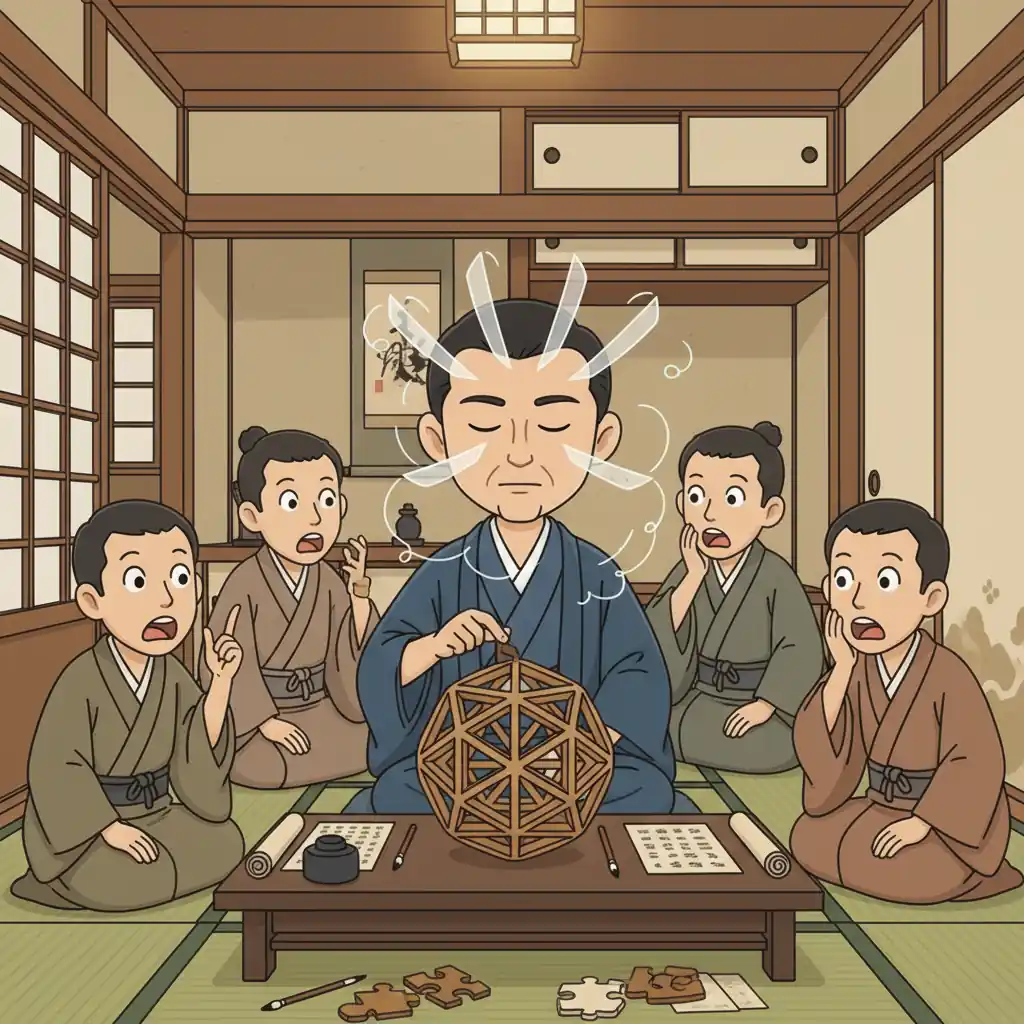
The Stumbling Minds of Kyoto
Centuries ago, in the bustling heart of Kyoto, stood an academy famed for its rigorous studies. Scholars gathered there, their heads bowed over scrolls, their minds wrestling with ancient texts and complex logic.
Among them was a young student named Kageyama. He was not the loudest, nor the most boastful. He sat quietly, observing, listening, his presence almost easy to overlook.
The Sensei, a stern man with an impressive beard, often presented his students with intricate problems. These were not simple math sums. They were philosophical riddles, logistical nightmares, or moral dilemmas designed to twist the mind into knots.
Most students would furrow their brows. They would pace. They would draw diagrams on their practice boards, only to erase them again in frustration. Solutions came slowly, if at all, emerging from layers of doubt and careful deliberation.
They were like woodsmen trying to fell a mighty tree with a dull axe, hacking away with great effort, making little clean progress.
But Kageyama was different. When a problem was posed, his gaze would sharpen. He wouldn't doodle or pace. He would simply listen, process, and then, often with startling speed, speak.
The Disappearing Riddle
One morning, the Sensei presented a particularly vexing koan. It involved a paradox of truth and deception, a tangled web of statements that seemed impossible to unravel. The room fell silent as students grappled with it.
Ten minutes passed. Then twenty. Scrolls remained blank, or filled with abandoned attempts.
Finally, the Sensei sighed. “Well, who believes they have glimpsed a path?”
No one moved. Then, from the back, Kageyama raised a hand. “Sensei, the core of the problem lies in the assumption of simultaneous contradiction. If we separate the statements by intention, the path becomes clear.”
He then provided an explanation so concise, so elegant, that the complex riddle seemed to dissolve into thin air. The students blinked. The Sensei, for a moment, simply stared.
It wasn't just that Kageyama was correct. It was the effortless way he had sliced through the confusion, revealing the answer with a single, clean stroke.
Later that week, a more practical challenge arrived. A dispute between two neighboring villages over a shared irrigation channel. The elders had argued for days, unable to agree on a fair division of water.
The Sensei brought the problem to his advanced students. They debated land maps, seasonal flow rates, and historical precedents. The arguments grew as tangled as the river reeds.
A Blade of Thought
Kageyama listened to the conflicting points, his eyes scanning the crude map laid before them. The other students were bogged down in details, each trying to build a fortress of their own logic.