
PROLOGUE: THE MOMENT THE WORLD STOPPED
This story is based on historical records, official reports, and interpretations discussed by historians and researchers. Where evidence is debated, different perspectives are presented as part of the historical discussion rather than definitive facts. The narrative is intended for educational and storytelling purposes.
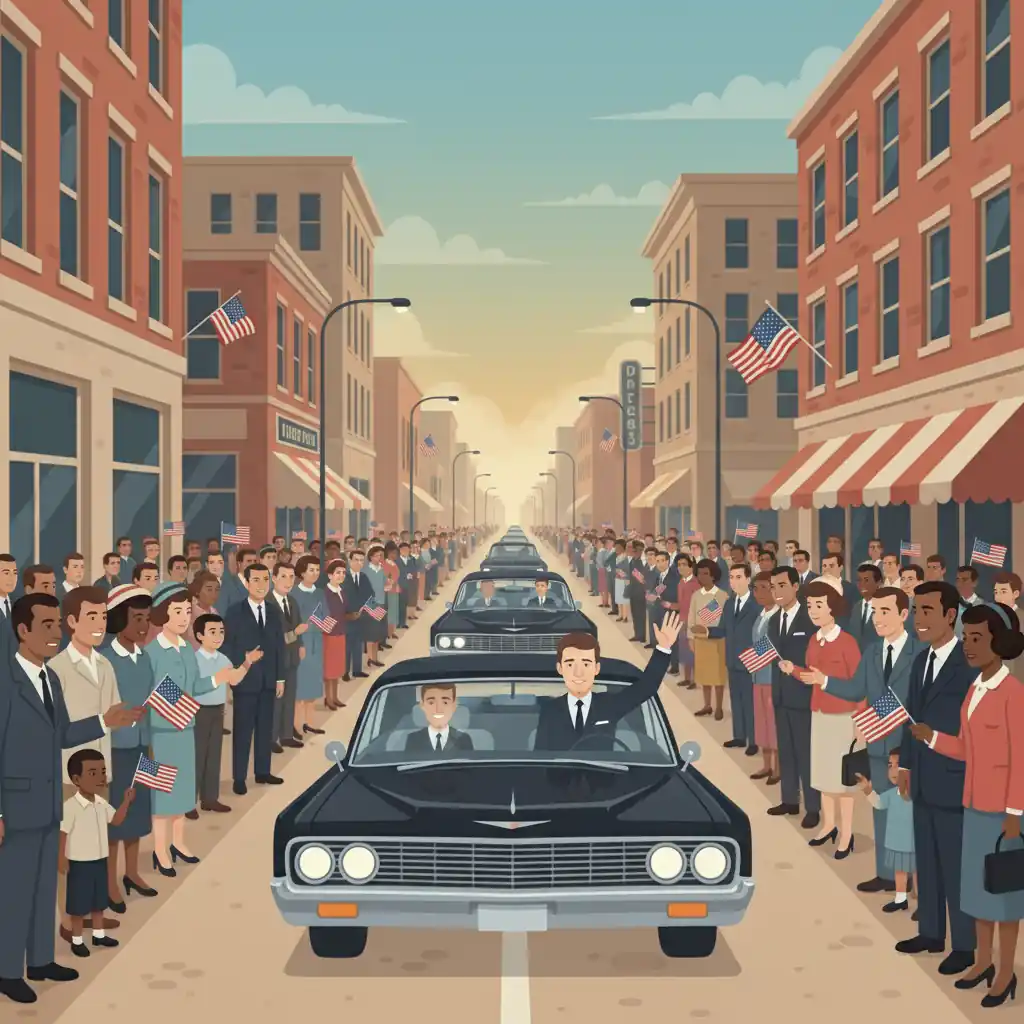
November 22, 1963. Dallas, Texas. A crisp autumn day transformed into a crucible of chaos that would forever reshape American history. President John F. Kennedy, a vibrant symbol of youthful optimism, was riding in an open-top limousine through Dealey Plaza, waving to enthusiastic crowds. The motorcade was a spectacle of hope, a moment of connection between a nation and its leader. Then, the shots rang out. Three distinct cracks, or perhaps more, echoing off the surrounding buildings, instantly shattering the illusion of peace and plunging a generation into profound shock and a pervasive, lingering doubt.
The immediate aftermath was pandemonium. Secret Service agents swarmed the limousine, local police converged on the Texas School Book Depository, and eyewitnesses scattered, their memories fractured by terror and confusion. In minutes, the news flashed across the globe, paralyzing millions. A young, charismatic president, who had championed a 'New Frontier' and navigated the Cuban Missile Crisis, was gone. But for many, the official explanation, delivered in the days and weeks that followed, would never quite fit the enormity of the event, igniting a half-century of scrutiny, speculation, and relentless debate.
The assassination of JFK became more than a tragic historical event; it became the ultimate American whodunit, a national trauma wrapped in layers of conflicting evidence, whispered motives, and the persistent feeling that the full truth remained hidden. This narrative delves into the official accounts, the contentious details, and the myriad of alternative theories that have captivated minds, seeking to understand why the shots in Dallas continue to echo so loudly through the corridors of time.
ACT I: THE OFFICIAL STORY – THE WARREN COMMISSION'S VERDICT
Within an hour of the assassination, authorities arrested Lee Harvey Oswald, a former Marine with a peculiar history and known Marxist sympathies, inside a movie theater. Oswald was quickly identified as the prime suspect, allegedly linked to the rifle found on the sixth floor of the Texas School Book Depository, a building overlooking the motorcade route. Two days later, as Oswald was being transferred from the city jail, he was himself gunned down by Dallas nightclub owner Jack Ruby in a shocking, live televised event, silencing the man who claimed to be 'just a patsy.'
To quell the mounting public unease and address the myriad of unanswered questions, President Lyndon B. Johnson established the Warren Commission on November 29, 1963. Composed of eminent figures, including Supreme Court Chief Justice Earl Warren, the commission was tasked with investigating the assassination thoroughly and presenting its findings to the American people. Their final report, released in September 1964, was designed to be definitive, comprehensive, and above all, reassuring.
The Lone Assassin Theory
The Warren Commission's central conclusion was unequivocal: Lee Harvey Oswald acted alone in assassinating President Kennedy and wounding Governor John Connally. The report detailed Oswald's procurement of a 6.5mm Italian Mannlicher-Carcano rifle, mail-ordered under an alias, and his employment at the Texas School Book Depository, which provided him with a clear, elevated vantage point over Dealey Plaza. Forensic evidence, including ballistics matching bullet fragments to Oswald's rifle, finger- and palm-prints on the weapon and in the 'sniper's nest,' and his demonstrated marksmanship skills, were presented as proof.
The Single-Bullet Theory (The 'Magic Bullet')
Perhaps the most controversial, yet crucial, element of the Warren Commission's findings was the single-bullet theory, sometimes derisively called the 'magic bullet' theory. This theory, attributed primarily to Commission staffer Arlen Specter (later a U.S. Senator), posited that a single bullet, designated Commission Exhibit 399 (CE 399), passed through President Kennedy's back and neck, then exited and proceeded to strike Governor Connally, who was seated in front of Kennedy, inflicting multiple wounds to his back, chest, wrist, and thigh. The bullet was reportedly found nearly pristine on Connally's hospital stretcher.
The Warren Commission argued that this theory was essential to explain how Oswald, firing only three shots (one missing entirely, one hitting Kennedy's head), could have caused all of Kennedy's and Connally's non-fatal wounds within the incredibly short timeframe captured by the Zapruder film. Without CE 399, multiple gunmen or a different shooting sequence would have been difficult to dismiss.
The official report also concluded that Jack Ruby acted alone in killing Oswald, driven by grief and a desire to spare Jacqueline Kennedy the ordeal of a trial. The Warren Commission unequivocally dismissed any claims of a broader conspiracy, stating that it found 'no evidence that either Oswald or Ruby was part of any conspiracy, domestic or foreign.' This comprehensive narrative aimed to close the book on the tragedy, but for a skeptical public, it only opened a new one.
ACT II: THE DETAILS – SCRUTINY AND SKEPTICISM
Despite the Warren Commission's efforts to provide a definitive account, numerous details within the official narrative immediately sparked questions and laid the groundwork for decades of skepticism. The sheer speed of the investigation, the secrecy surrounding some evidence, and perceived inconsistencies began to chip away at public confidence almost immediately.
The Zapruder Film: A Window to Doubt
The 8mm home movie filmed by Abraham Zapruder, capturing the assassination in chilling detail, became a central piece of evidence and a catalyst for doubt. The film showed Kennedy's head snapping violently backward and to the left after the fatal shot, an apparent trajectory that many observers, including medical experts and ballistics specialists, argued was inconsistent with a shot fired from behind, as Oswald's position indicated. This backward motion suggested to many that a shot might have come from the front, specifically from the infamous 'Grassy Knoll' area to the right of the motorcade.
Oswald's Background and Behavior
Lee Harvey Oswald himself presented a complex and often contradictory figure. His defection to the Soviet Union, his subsequent return, his involvement with the Fair Play for Cuba Committee, and his alleged attempt to assassinate retired General Edwin Walker months before Kennedy's death painted a picture of a volatile individual. However, his firm denials of guilt, his repeated cries of being a 'patsy,' and his seemingly disorganized actions before and after the assassination led some to question if he truly possessed the operational capacity, or indeed the sole motive, to execute such a high-profile attack.
One curious detail involved Oswald's rifle. The Mannlicher-Carcano, a relatively inexpensive and often criticized weapon, was reportedly purchased by Oswald via mail order. Critics questioned its accuracy for such a precise, rapid-fire assassination, and some even questioned if Oswald, a known 'showboat' with a military background, would have chosen such a seemingly inferior weapon if planning such a momentous act.
The Jack Ruby Connection
Jack Ruby's assassination of Oswald, just two days after Kennedy's death, was another critical detail that fueled suspicion. Ruby, a strip club owner with alleged ties to organized crime figures in Dallas and Chicago, claimed he acted out of grief and patriotic fervor. However, critics questioned the remarkable ease with which he accessed the police basement where Oswald was being held, especially given the heightened security. His sudden act eliminated the only person who could definitively answer questions about the assassination, leading many to believe he was silencing Oswald to prevent him from revealing a larger plot.
Ruby's own inconsistent testimony, his later claims of being used, and his desperate pleas for a polygraph test that were denied, added further layers of intrigue. The seemingly convenient death of the primary suspect at the hands of a figure with criminal underworld connections immediately made many skeptical of the official 'lone wolf' narratives.
ACT III: THE CONFLICTING ACCOUNTS – A DELUGE OF DISCREPANCIES
The Warren Commission's report, while meticulously detailed, failed to account for a multitude of eyewitness statements, medical findings, and photographic evidence that seemed to contradict its conclusions. These discrepancies formed the bedrock of the persistent 'conspiracy theory' that continues to challenge the official narrative.
Eyewitnesses and the Number of Shots
Numerous eyewitnesses in Dealey Plaza reported hearing more than three shots, with many distinctly recalling shots coming from different directions. The Warren Commission determined that three shots were fired from the Texas School Book Depository. However, a significant number of people interviewed immediately after the event, including police officers, spectators, and even other Secret Service agents, claimed to have heard four, five, or even six shots. Furthermore, a substantial number of witnesses, particularly those positioned near the infamous Grassy Knoll, reportedly believed shots emanated from that direction, not just from the Depository. This mass of contradictory auditory evidence presented a significant challenge to the lone gunman theory.
One particularly compelling piece of evidence came from the Dallas Police Department's dictabelt recording, which captured ambient sounds from a motorcycle policeman's open microphone during the motorcade. Decades later, analyses by the House Select Committee on Assassinations (HSCA) and others suggested that four distinct shots were recorded, with one potentially originating from the Grassy Knoll. The HSCA concluded that this acoustic evidence indicated a high probability of a second gunman, though this analysis remains debated by acoustics experts.
Medical Controversies and Autopsy Disputes
The medical evidence surrounding Kennedy's wounds also became a major point of contention. The official autopsy, performed by military doctors at Bethesda Naval Hospital, was reportedly conducted under unusual circumstances, with Secret Service agents allegedly present and dictating aspects of the procedure. Critics have pointed to several key discrepancies:
- Entry and Exit Wounds: Early reports from Dallas doctors at Parkland Hospital indicated a bullet wound in Kennedy's throat that appeared to be an entrance wound. However, the Bethesda autopsy concluded this was an exit wound for the bullet that entered his upper back. This required the initial bullet to travel through Kennedy's body on a downward trajectory, inconsistent with a straight shot from the Depository if the 'throat wound' was an entrance.
- Brain Examination: The autopsy photos and X-rays of Kennedy's brain became subjects of intense scrutiny. Some medical professionals who reviewed the evidence for various committees later claimed that critical portions of the brain, particularly those showing the full extent of the skull damage, were either missing or had been altered. The 'back and to the left' head snap in the Zapruder film strongly suggested a frontal shot, which was difficult to reconcile with the official autopsy photos depicting a wound predominantly on the right side of the head from a rear shot.
- Missing Evidence: Critics alleged that the haste and perceived lack of transparency in handling Kennedy's body and evidence (such as the brain itself, which mysteriously disappeared) created an environment ripe for suspicion, leading to claims of a cover-up designed to obscure the true nature of the fatal wounds.
These medical controversies, fueled by the conflicting observations of multiple doctors and the secrecy surrounding the evidence, significantly undermined public trust in the Warren Commission's medical conclusions and fueled the belief that a more complex narrative was being suppressed.
ACT IV: THE SHADOW WORLD – THE CONSPIRACY THEORIES
The gaps, contradictions, and perceived evasions within the official narrative quickly led to a flourishing ecosystem of alternative theories. These theories, often intricately detailed and drawing on a wide range of circumstantial evidence, provided more satisfying, albeit unproven, explanations for an event of such monumental impact. Researchers and journalists have proposed different explanations, though these interpretations remain debated and unproven.
The Mafia Connection
One of the earliest and most enduring theories points to organized crime. According to this theory, key mob figures, such as Santo Trafficante Jr. and Carlos Marcello, harbored deep grudges against the Kennedy administration, particularly Attorney General Robert F. Kennedy, who had aggressively pursued them. The alleged involvement of Jack Ruby, with his reported underworld ties, lent credence to this theory. Critics have theorized that the Mafia orchestrated the assassination, possibly using Oswald as a patsy, and then silenced him through Ruby to prevent exposure. Some researchers, including those for the HSCA, explored this possibility, noting the mob's reach and motives.
The CIA and Anti-Castro Exiles
Another prominent theory involves the Central Intelligence Agency (CIA), often in conjunction with Cuban exile groups. The Kennedy administration had notoriously botched the Bay of Pigs invasion and, according to critics, had become increasingly unpopular with elements within the intelligence community and among vehemently anti-Castro Cubans who felt betrayed. The theory suggests that rogue elements within the CIA, possibly those involved in covert operations to assassinate Fidel Castro (some of which allegedly involved mob figures), turned their skills against Kennedy. Oswald's known pro-Castro sympathies and his prior interactions with intelligence agencies (which remain debated) were sometimes cited as convenient cover. Authors like Jim Garrison, a New Orleans District Attorney, vigorously pursued this line of inquiry, alleging high-level complicity.
The Military-Industrial Complex
Some theorists posit that Kennedy's alleged intentions to withdraw from Vietnam, his perceived softness on communism, or his disagreements with powerful figures within the military-industrial complex led to his assassination. Proponents of this theory often point to President Dwight D. Eisenhower's famous warning about the rising power of this complex. Kennedy’s reported secret attempts to pursue peace with Cuba and his efforts to curb the power of the Federal Reserve (as detailed in certain independent publications) are sometimes presented as motives for a powerful, secretive faction to orchestrate his removal. This theory suggests a highly organized, shadowy group of military and industrial leaders, perhaps with intelligence agency assistance, was behind the plot.
Other Theories
Beyond these major theories, many other permutations exist: Texas oil tycoons allegedly angered by Kennedy's tax policies, Soviet or Cuban foreign agents acting independently of Oswald (despite Oswald's defection and sympathies), or even Vice President Lyndon B. Johnson himself, allegedly plotting to assume the presidency. While these theories often lack concrete, verifiable evidence and rely heavily on circumstantial connections, they persist in public discourse, fueled by ongoing document releases and academic critiques of the official story.
The sheer volume and variety of these theories underscore the profound distrust generated by the official investigation. For many, the assassination could not simply be the act of one disgruntled individual; the power dynamics, the geopolitical implications, and the convenient timing for various factions seemed too significant to be mere coincidence.
ACT V: THE QUESTIONS THAT REMAIN – A HAUNTING LEGACY
Decades have passed since the shots in Dallas, yet the assassination of John F. Kennedy remains one of history's most enduring and hotly debated mysteries. Despite further investigations and the release of millions of pages of documents, a definitive consensus beyond the Warren Commission's findings has never been reached, leaving a haunting legacy of unresolved questions.
The House Select Committee on Assassinations (HSCA)
In the late 1970s, amidst renewed public skepticism, the House Select Committee on Assassinations (HSCA) re-examined the cases of JFK and Martin Luther King Jr. Unlike the Warren Commission, the HSCA concluded in 1979 that President Kennedy 'was probably assassinated as a result of a conspiracy.' This represented a dramatic departure from the lone gunman theory. However, the HSCA also stated that it could not identify the specific individuals or groups involved in such a conspiracy. They pointed to the acoustic evidence from the dictabelt recording as a primary reason for their conclusion, suggesting a high probability of a second gunman on the Grassy Knoll. Despite this, the HSCA found no evidence of conspiracy involving the Soviet or Cuban governments, the CIA, or the FBI, though they criticized the performance of the FBI and CIA in the original investigation.
Document Releases and Continued Debate
Throughout the decades, public pressure and legislative action, notably the JFK Assassination Records Collection Act of 1992, have led to the release of millions of pages of previously classified documents related to the assassination. While these releases have provided new insights into the inner workings of government agencies and figures like Oswald, they have largely failed to produce a smoking gun that definitively proves or disproves any major conspiracy theory. Each tranche of documents has been met with intense scrutiny by researchers, who often find new avenues for speculation rather than ultimate answers.
These documents have revealed the extent of secret government operations (like CIA assassination plots against Castro) and the sometimes clandestine activities of intelligence agencies, inadvertently fueling public distrust. The very act of withholding and then releasing information in drips and drabs has, for many, reinforced the belief that there is something to hide.
The Enduring Mystery
The assassination's impact goes beyond the political; it fundamentally altered the American psyche, marking a loss of innocence and instilling a pervasive cynicism towards authority that continues to resonate today. The memory of Kennedy, frozen in time and controversy, serves as a constant reminder that for some of the most pivotal moments in history, the official narrative often struggles to compete with the persistent, compelling allure of alternative truths.
The questions that remain are not merely historical curiosities. They speak to fundamental anxieties about power, secrecy, and the nature of truth itself. Was it a lone, disturbed individual acting out a private grievance? Or was it the culmination of a larger, darker plot, orchestrated by forces yet unidentified? The event continues to be studied by historians. While official investigations reached conclusions, public debate has continued for decades, ensuring that the shots in Dallas will remain a haunting, unsolved chord in the American symphony.