
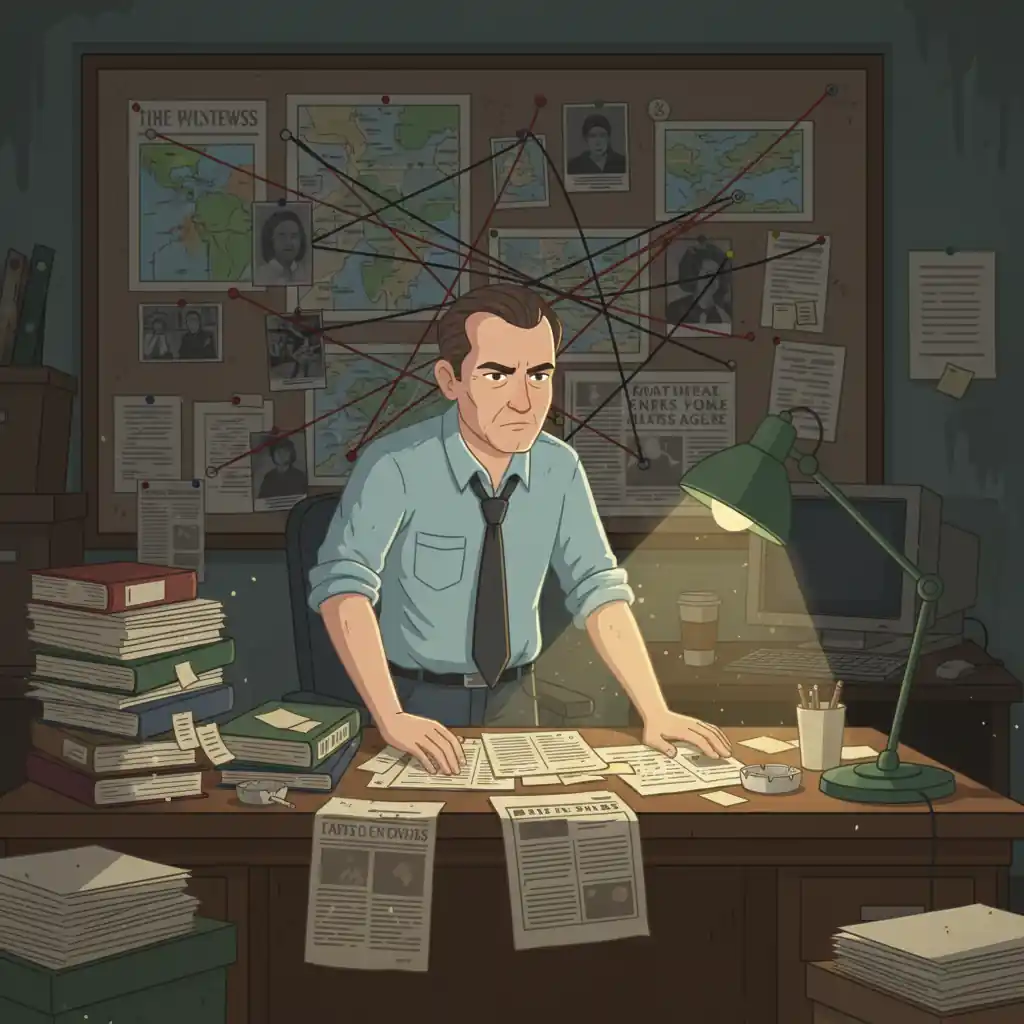
PROLOGUE: THE SHADOW IN THE NEWSROOM
This story is based on historical records, official reports, and interpretations discussed by historians and researchers. Where evidence is debated, different perspectives are presented as part of the historical discussion rather than definitive facts. The events surrounding journalist Gary Webb's 'Dark Alliance' series ignited a firestorm, raising uncomfortable questions about government oversight, clandestine operations, and the devastating impact of illegal drugs on American communities. It's a tale steeped in the paranoia of the Cold War, the tragic rise of the crack cocaine epidemic, and the brutal realities of journalistic investigation.
In August 1996, the San Jose Mercury News published a three-part series titled 'Dark Alliance,' penned by investigative reporter Gary Webb. The allegations were explosive: a direct link between the CIA-backed Nicaraguan Contras, cocaine trafficking into the United States, and the subsequent explosion of the crack epidemic in Los Angeles. Webb’s reporting suggested that the very agency sworn to protect Americans had, by design or negligence, played a role in fueling a crisis that ravaged inner cities.
The series struck a raw nerve, particularly within the African American community, where the crack epidemic had exacted its heaviest toll. It wasn't just a story about drugs; it was about trust, betrayal, and the hidden costs of covert foreign policy. Webb's work brought to the forefront decades-old suspicions, morphing them into a national debate that continues to echo today.
Before 'Dark Alliance' hit the headlines, Gary Webb was a respected, award-winning journalist. His career had been built on solid reporting, digging into uncomfortable truths. But this story was different. It threatened to expose a conspiracy of grand proportions, pulling back the curtain on the murky intersection of geopolitics, drug running, and domestic suffering. This is the story of a journalist who believed he uncovered a truth too big to ignore, and the immense consequences that followed.
ACT I: THE ROOTS OF 'DARK ALLIANCE' — COVERT WARS AND CRACK'S DAWN
To understand the gravity of Webb's allegations, one must first grasp the tumultuous political landscape of the 1980s. The Cold War was in its final, fervent decades, and the Reagan administration was intensely focused on combating Soviet-backed communist movements across the globe, especially in Central America. Nicaragua was a particular flashpoint, where the Sandinista government, seen by Washington as Marxist, had overthrown the U.S.-backed Somoza dictatorship.
The Contra War and the Boland Amendments
The United States covertly supported various rebel groups, collectively known as the Contras, seeking to destabilize or overthrow the Sandinistas. This support, however, became deeply controversial. In 1982, Congress passed the Boland Amendments, which, in various iterations, restricted or outright banned U.S. government agencies, including the CIA, from providing military aid to the Contras.
Despite these legislative roadblocks, the Reagan administration reportedly remained committed to the Contra cause. Critics alleged that this led to a desperate search for alternative, clandestine funding sources. It was into this shadowy world of 'off-the-books' operations that allegations of drug trafficking would later emerge.
The Emergence of Crack Cocaine
Simultaneously, American inner cities were grappling with a burgeoning crisis: the rise of crack cocaine. Prior to the mid-1980s, cocaine was an expensive drug, largely confined to affluent users. Crack, a cheaper, smokeable form of cocaine, hit the streets with devastating speed, creating widespread addiction, violence, and despair in marginalized communities across the nation. Its sudden, explosive ubiquity fueled a public health and law enforcement nightmare.
The prevailing narrative attributed the crack epidemic to opportunistic street dealers and complex supply chains originating from South American cartels. However, in communities ravaged by the drug, rumors and suspicions began to circulate. How could such vast quantities of cocaine, and then crack, flood their neighborhoods with seemingly little intervention from authorities? These unasked questions formed a fertile ground for the seeds of conspiracy.
A Nation Divided and Desperate
The early 1980s were a time of deep ideological division. While the government focused on perceived threats abroad, many Americans felt neglected at home. The 'War on Drugs' was declared, yet the drug trade seemed only to intensify. This backdrop of geopolitical intrigue, congressional restrictions, and domestic crisis created a perfect storm for a story like 'Dark Alliance' to resonate deeply. It suggested that the very mechanisms of national security might have inadvertently, or even deliberately, contributed to a profound domestic tragedy.
ACT II: THE INVESTIGATION AND THE 'DARK ALLIANCE' CLAIMS
Gary Webb’s investigation for the San Jose Mercury News began in earnest in 1995, following a tip regarding an unusual drug case. He began connecting seemingly disparate threads: a federal drug investigation, a Nicaraguan drug lord, and the U.S.-backed Contra rebels. What he reportedly uncovered, and what became the core of his 'Dark Alliance' series, was a nexus that few in the mainstream media had dared to fully explore.
The Key Figures: Blandón, Meneses, and 'Freeway Rick' Ross
Webb’s series centered on two Nicaraguan exiles, Oscar Danilo Blandón and Juan Norwin Meneses, whom Webb alleged were major cocaine traffickers. According to Webb, Blandón and Meneses were prominent suppliers of cocaine to Los Angeles street gangs in the 1980s, playing a significant role in introducing large quantities of crack cocaine to the city. Webb claimed that a portion of the profits from their drug sales was funneled directly to the Contra rebels in Nicaragua, with the knowledge, and alleged protection, of the CIA.
The Los Angeles Connection
Crucially, Webb alleged that Blandón became the primary supplier to Rick Ross, known as 'Freeway Rick,' a notorious Los Angeles drug dealer who, according to Webb’s reporting, built a multi-million dollar crack empire. Webb detailed how Blandón reportedly moved huge quantities of cocaine into Los Angeles, selling it at remarkably low prices, which in turn made crack cocaine widely accessible and affordable. Webb’s reporting highlighted a specific claim: this influx of cheap cocaine directly fueled the rapid and devastating spread of crack through South Central Los Angeles.
Webb’s series meticulously traced connections, citing court documents, federal law enforcement reports, and interviews with sources ranging from former drug dealers to U.S. officials. He described how Meneses, a long-time drug smuggler and a Contra supporter, reportedly introduced Blandón to Contra leaders, solidifying the alleged drug-for-arms pipeline.
The CIA's Alleged Role
The most controversial aspect of 'Dark Alliance' was its assertion of the CIA’s alleged complicity. Webb did not claim the CIA itself directly trafficked drugs. Instead, he alleged that the agency was aware of Blandón and Meneses’ drug activities and their contributions to the Contra cause, yet chose to look the other way, or even facilitate their operations, to protect the Contras. Webb suggested that intelligence agencies might have provided these traffickers with a degree of immunity or ignored evidence against them, essentially prioritizing the Contra war over the domestic 'War on Drugs.'
Webb’s work painted a picture of a national security apparatus so focused on its anti-communist agenda that it allegedly tolerated, and perhaps indirectly enabled, a trade that devastated American communities. The series provided specific dates, names, and transactions, attempting to build a comprehensive case for a connection that many had only whispered about for years.
ACT III: THE FIRESTORMS — PUBLIC OUTRAGE AND GOVERNMENT SCRAMBLE
The publication of 'Dark Alliance' in August 1996 was an immediate sensation. It spread rapidly, not just through traditional newspapers but also through the nascent internet, reaching an audience far beyond the typical San Jose Mercury News readership. The series was particularly impactful in African American communities, where the allegations resonated deeply with existing suspicions about governmental negligence or malice regarding the crack epidemic.
A Community Betrayed?
For many, Webb’s story confirmed long-held fears. Community leaders, activists, and ordinary citizens in affected areas felt that the government had either been complicit in, or indifferent to, the destruction wrought by crack cocaine. The idea that the CIA, an agency meant to protect the nation, might have indirectly contributed to this crisis ignited widespread outrage and a profound sense of betrayal. Town hall meetings were held, demanding answers; protests erupted in major cities.