
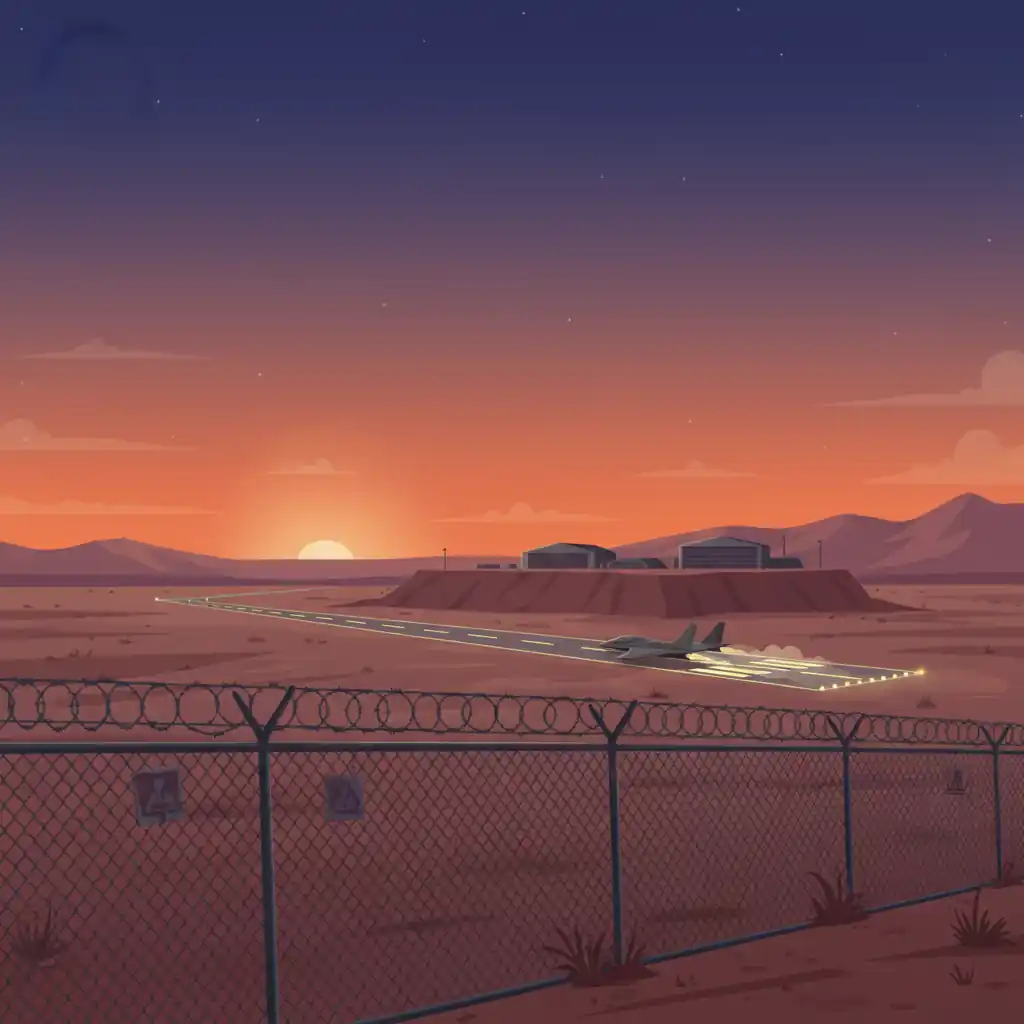
PROLOGUE: THE FORBIDDEN ZONE
Deep within the scorched, unforgiving expanse of the Nevada desert, lies a place synonymous with secrecy, advanced technology, and otherworldly speculation: Area 51. For decades, this patch of barren earth, centered around a clandestine airstrip on a dry lakebed known as Groom Lake, existed in a legal and public vacuum, a cartographic anomaly conspicuously absent from official maps. Its very existence was a whispered legend, a potent symbol of government opacity and the tantalizing possibility of truths hidden just beyond our grasp. This story is based on historical records, official reports, and interpretations discussed by historians and researchers. Where evidence is debated, different perspectives are presented as part of the historical discussion rather than definitive facts.
From the mid-1950s, a veil of absolute secrecy descended upon this remote installation. Its official purpose remained shrouded in mystery, fueling an insatiable public curiosity that transformed it from a mere military testing ground into the epicenter of a global conspiracy phenomenon. What began as whispers of unusual aircraft quickly escalated into full-blown theories involving extraterrestrial visitation, reverse-engineered alien spacecraft, and covert government contact with beings from another world. The base’s very obscurity became its most captivating feature, allowing the public imagination to fill the void left by official silence with scenarios more fantastic than any fictional thriller.
The narrative of Area 51 is a compelling blend of Cold War espionage, cutting-edge aviation, and the human propensity for seeking answers in the unknown. It’s a tale where the pursuit of national security intersected with the cosmic question of alien life, creating a legacy that continues to fascinate and divide. As we delve into the history and legends surrounding this enigmatic site, we peel back layers of secrecy to examine the facts, the official denials, the compelling claims, and the enduring questions that have cemented Area 51’s place in the pantheon of history’s greatest conspiracies.
ACT I: THE COLD WAR'S SHADOW PLAY
The true origins of Area 51 are rooted not in alien encounters, but in the tense geopolitical climate of the Cold War. In the early 1950s, as the ideological battle between the United States and the Soviet Union intensified, the need for advanced intelligence gathering became paramount. The U.S. government, particularly the Central Intelligence Agency (CIA), urgently sought a way to observe Soviet military capabilities without risking direct confrontation.
Project AQUATONE and the U-2 Spy Plane
In 1955, the solution arrived in the form of the U-2 Dragon Lady – a revolutionary high-altitude reconnaissance aircraft capable of flying above the reach of Soviet interceptors and surface-to-air missiles. But to develop and test such a classified asset, the CIA needed a location so remote, so secure, and so inconspicuous that it could operate in absolute secrecy. Enter Groom Lake.
A dry lakebed located roughly 80 miles northwest of Las Vegas, Groom Lake offered an ideal natural runway more than three miles long. Its isolation, surrounded by vast, uninhabited desert and existing within the already massive Nevada Test Site, made it the perfect clandestine laboratory. According to declassified CIA documents, the site was officially designated as 'Site II' and later became known by its map grid coordinates: Area 51. It was chosen primarily for its remoteness and the existing infrastructure from World War II-era bombing ranges.
The first U-2 test flight took place in August 1955. From that moment, a massive security operation was initiated to maintain strict secrecy around the base and its activities. Workers were flown in from Burbank, California, on unmarked planes, operating under strict non-disclosure agreements. The very air traffic control radar in the region was adjusted to exclude the airspace above Groom Lake, creating a literal blank spot on the map, both cartographically and aerially. This deliberate act of erasure, designed to protect national security, inadvertently created the perfect conditions for the birth of a legend.
Beyond the U-2: Project Oxcart
Even after the U-2's existence became publicly known following Francis Gary Powers' downing over the Soviet Union in 1960, Area 51's purpose remained veiled. Its next major assignment was Project Oxcart, the development of the A-12 Oxcart – the precursor to the SR-71 Blackbird. This Mach-3+ reconnaissance aircraft was even more advanced, faster, and required even greater secrecy than the U-2. Testing the A-12 involved unprecedented speeds and altitudes, pushing the boundaries of known aerospace technology.
The sight of the A-12, a sleek, black delta-winged marvel, streaking across the Nevada sky at three times the speed of sound, created sonic booms that rattled windows and generated bright, unusual lights in the night sky. These phenomena, while entirely attributable to groundbreaking aerospace engineering, were often observed by civilians and pilots who had no knowledge of their classified origins. The official government response to inquiries about these sightings was, almost without exception, either a flat denial or a vague, uninformative statement. This policy of deliberate obfuscation, though intended to safeguard critical national security projects, inadvertently laid the groundwork for decades of public mistrust and speculative theories, ensuring that Area 51 would become much more than just a secret airbase.
ACT II: THE DETAILS OF DISAPPEARANCE
The physical details of Area 51, meticulously guarded and intentionally obscured, contributed significantly to its mystique. The base, officially designated as a detachment of Edwards Air Force Base, earned numerous unofficial nicknames among its personnel: 'Dreamland,' 'Paradise Ranch,' 'Homey Airport,' and 'Watertown Strip.' These names, hinting at both the allure and the absurdity of its existence, did little to pierce the dense fog of secrecy.
A Fortress in the Desert
Access to Area 51 was, and remains, severely restricted. The perimeter, stretching for miles across desolate terrain, is guarded by motion sensors, cameras, and patrols of camouflaged security personnel, colloquially known as 'Camo Dudes.' Warning signs clearly state that unauthorized entry will be met with lethal force. According to local lore and eyewitness accounts, these warnings were not idle threats, though documented cases of their execution are rare. The air space above Groom Lake is a permanently restricted area, designated as R-4808N, making it illegal for any unauthorized aircraft to fly overhead.
The base itself comprises a sprawling complex of hangars, workshops, radar installations, and administrative buildings. Beneath the surface, the extent of the underground facilities has been a perennial subject of speculation. While official documents only acknowledge surface structures, persistent rumors, often fueled by former employees and whistleblowers, allege vast subterranean networks, some reaching multiple levels deep, housing laboratories, storage facilities, and even runways.
The Unidentified Flying Objects
The classified aircraft tested at Area 51 were, by their very nature, designed to appear unlike anything else in the sky. When the U-2 first flew at 70,000 feet, conventional aircraft could only reach half that altitude. Pilots in civilian and military aircraft who spotted the silver-winged U-2 above them had no frame of reference; to them, these high-flying, unconventional craft were 'Unidentified Flying Objects.' The CIA, according to declassified documents, was well aware that their secret test flights accounted for a significant portion of reported UFO sightings in the late 1950s and 1960s.
As subsequent projects like the A-12 Oxcart and the stealth fighter prototypes (F-117 Nighthawk) took to the skies, the phenomenon intensified. These aircraft, with their angular, radar-evading designs and unconventional flight characteristics, continued to confound observers. The government's standard policy of 'neither confirm nor deny' regarding Area 51's activities effectively created a vacuum. Without official explanations for the bizarre aerial phenomena witnessed in the Nevada desert, the public imagination naturally gravitated towards the most extraordinary possibilities, paving the way for the alien narrative to take root. The official secrecy, intended to protect military advantage, ironically nurtured the very conspiracy theories it later sought to dispel.
ACT III: THE CONFLICTING ACCOUNTS AND ALIEN CLAIMS
For decades, the official narrative regarding Area 51 was simple: it didn't exist. When its existence became undeniable, the explanation shifted to that of a 'research and development facility.' This deliberate ambiguity, combined with the bizarre aerial phenomena witnessed in the area, left a gaping void for alternative explanations to flourish. It was in this vacuum that the narrative transitioned from secret spy planes to something far more extraordinary: alien technology.