
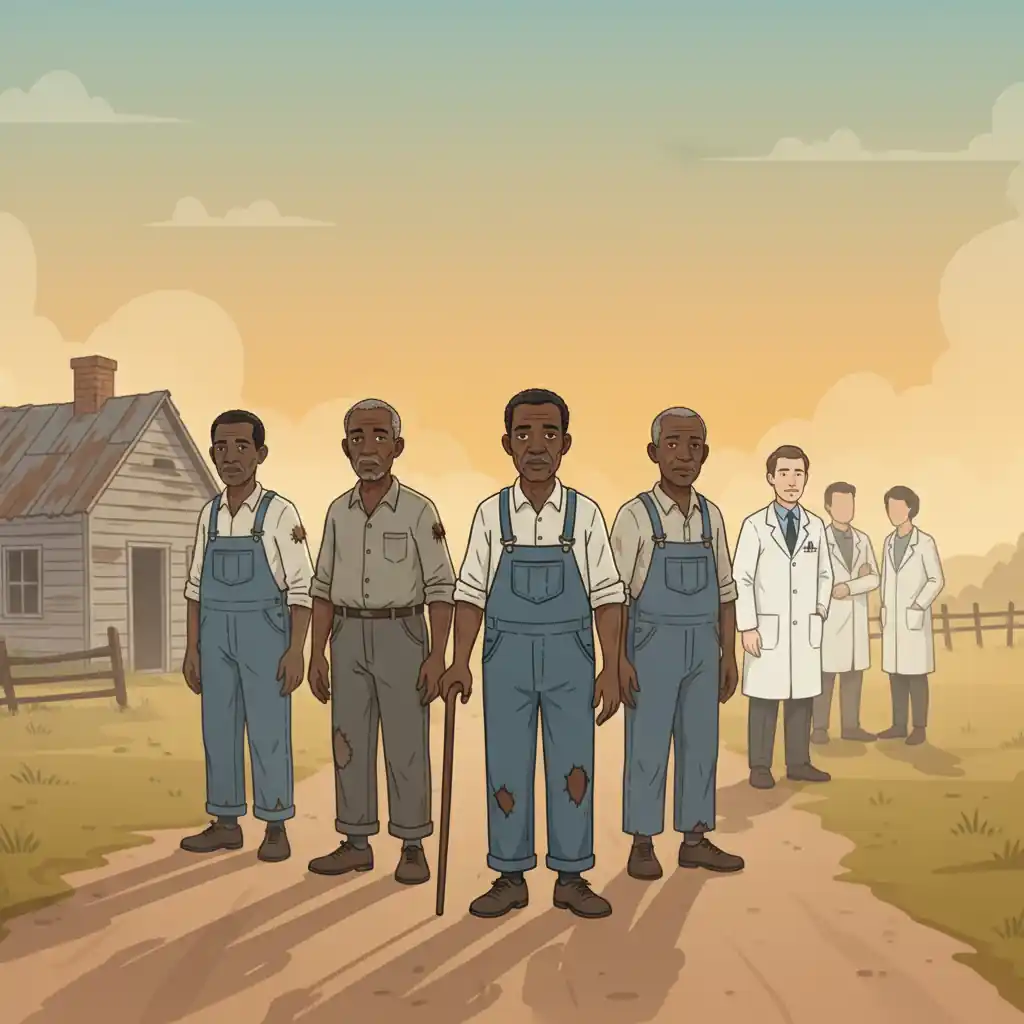
The Oslo Study Begins
A long-term study in Norway on untreated syphilis begins, influencing the later design of the Tuskegee Study by demonstrating a perceived 'scientific value' in observing the disease's natural course.
Tuskegee Study Initiated
The U.S. Public Health Service (PHS), in partnership with the Tuskegee Institute, begins 'A Study of Untreated Syphilis in the Negro Male' in Macon County, Alabama, enrolling 600 impoverished African American men.
Initial Funding Concerns
The Rosenwald Fund, a key philanthropic backer, withdraws its support, citing ethical concerns about not treating patients. The PHS decides to continue the study regardless.
Penicillin Becomes Available
Penicillin emerges as a safe and highly effective treatment for syphilis. Despite this medical breakthrough, researchers reportedly make the decision to actively withhold the cure from study participants.
Prevention of Treatment During WWII
During World War II, 250 men from the study cohort are identified as having syphilis during their draft physicals. According to reports, the PHS intervened to prevent these men from receiving penicillin treatment.
Peter Buxtun Raises Concerns
Peter Buxtun, a PHS venereal disease investigator, sends a letter to his superiors raising ethical objections to the study, reportedly receiving a rejection of his concerns.
Internal Debates Intensify
Buxtun reiterates his objections to the CDC, leading to an internal committee meeting. The committee allegedly votes to continue the study, arguing that it was 'too far gone' to stop.
Story Breaks to the Press
Associated Press reporter Jean Heller publishes Peter Buxtun's story, exposing the study to the world and generating widespread public outrage.
Study is Halted
Under immense public pressure, a review panel convened by the Department of Health, Education, and Welfare concludes the study is ethically unjustified and orders it to be immediately terminated.
Class-Action Lawsuit Filed
Attorney Fred Gray files a class-action lawsuit against the federal government on behalf of the study participants and their families, seeking $1.8 billion in damages.
Settlement Reached
A $10 million out-of-court settlement is reached. Survivors and their families receive lifetime medical care and burial services funded by the U.S. government.
National Research Act Enacted
The U.S. Congress passes the National Research Act, creating the National Commission for the Protection of Human Subjects of Biomedical and Behavioral Research and mandating Institutional Review Boards (IRBs) for all human subject research.
Presidential Apology Issued
President Bill Clinton formally apologizes to the surviving Tuskegee syphilis study participants and their families on behalf of the nation, acknowledging the profound moral failure.
PROLOGUE: THE SILENT AGREEMENT
This story draws on historical investigations, journalism, and academic research. Some events described were the subject of public controversy and legal investigation. Allegations and interpretations are presented as reported claims rather than definitive conclusions.
Imagine rural Alabama, 1932. The Great Depression is clawing at every corner of America, but nowhere more fiercely than in the Deep South, where sharecroppers struggle against poverty, illiteracy, and systemic injustice. It was into this crucible of vulnerability that one of the most infamous medical experiments in American history was born: 'A Study of Untreated Syphilis in the Negro Male,' commonly known as the Tuskegee Syphilis Study.
For forty long years, researchers from the U.S. Public Health Service (PHS), in collaboration with the prestigious Tuskegee Institute, observed 600 impoverished African American men in Macon County, Alabama. Nearly 400 of these men were infected with syphilis, yet they were reportedly denied effective treatment, even when a miraculous cure became widely available. The initial stated purpose, according to investigators, was to track the natural progression of the disease, from initial infection to advanced stages, often culminating in severe neurological damage, blindness, and death. What began as a clinical observation, however, morphed into a profound ethical breach, raising questions about medical ethics, racial bias, and the very definition of scientific responsibility.
ACT I: THE 'BAD BLOOD' AND THE CONTEXT
The seeds of the Tuskegee Study were planted in a complex landscape of prevailing medical thought, social hierarchies, and economic desperation. Before Tuskegee, a similar study in Oslo, Norway, beginning in 1929, had observed the natural course of untreated syphilis in Caucasians. This earlier European research, according to historical analysis, reportedly provided a precedent and a perceived scientific justification for the American endeavor.
Macon County: A Microcosm of Vulnerability
Macon County, Alabama, was specifically targeted due to its high rates of syphilis among its impoverished, largely African American population. These were men who lived in deep poverty, often working as sharecroppers, with little access to healthcare or education. For many, the prospect of any medical attention, let alone free examinations, meals, and burial assistance, was an unprecedented offer. They were told they had 'bad blood' – a local colloquialism that encompassed various ailments, including syphilis, anemia, and fatigue. This euphemism, critics argued, obscured the true nature of their condition and the study’s objectives.
The PHS and Tuskegee Institute: A Troubled Partnership
The U.S. Public Health Service sought a local partner, finding it in the respected Tuskegee Institute, a historically Black university founded by Booker T. Washington. This collaboration reportedly lent an air of legitimacy to the study, particularly among the African American community in Macon County. A key figure in the study was Eunice Rivers, an African American nurse trained at Tuskegee. Her role was reportedly crucial in building trust with the participants, acting as a liaison, a confidante, and, according to later investigations, also as an agent in ensuring the men continued to attend examinations and did not seek external treatment. Her presence reportedly made the subjects feel comfortable and cared for, unknowingly cementing their participation in the non-treatment protocol.
Initial funding for the study came from the Julius Rosenwald Fund, a philanthropic organization focused on improving education and health for African Americans. However, according to historians, the fund reportedly withdrew its support just two years into the study, in 1934, citing ethical concerns about the lack of treatment. The PHS, undeterred, decided to continue the study using its own resources, reportedly convinced of its scientific merit.
The medical protocols established for the study were clear: men with syphilis were diagnosed but not treated with the available mercury and bismuth-based therapies, which were considered somewhat effective at the time, albeit toxic. Instead, researchers performed spinal taps to observe neurological damage, autopsies to examine the progression of the disease in various organs, and blood tests to monitor its stages. The men were offered perceived benefits like free rides to clinics, hot meals on examination days, and small stipends, all while the fundamental promise of medical intervention for their debilitating illness was, according to investigators, quietly withheld.
Despite the perceived scientific rigor, the study was reportedly riddled with inconsistencies. Due to the difficulty of accurate diagnosis in the field during the 1930s, some men who were initially identified as having syphilis later tested negative, while others who were ostensibly 'controls' (uninfected) were later found to have the disease. These diagnostic ambiguities, however, did not deter the PHS from continuing the non-treatment protocol for the core group of infected men.
ACT II: THE CURE ARRIVES, THE ETHICS DEPART
As the 1940s dawned, a scientific revolution was brewing that would cast a stark, unforgiving light on the Tuskegee Study's ethical foundations. In 1943, penicillin was confirmed as a safe, highly effective, and relatively inexpensive cure for syphilis. This monumental medical breakthrough fundamentally altered the landscape of venereal disease treatment, making the continued observation of untreated syphilis, as critics argued, not just outdated but morally indefensible.
The Deliberate Denial of Treatment
According to investigative reports, despite the universal adoption of penicillin, the PHS researchers reportedly made a conscious and collective decision not to treat the Tuskegee participants. Moreover, they actively sought to prevent the men from receiving treatment elsewhere. This was not a passive omission but, as historians have argued, an active intervention to maintain the study's integrity for the sake of 'scientific observation.' Journalistic investigations later revealed internal PHS documents indicating that officials were aware of the ethical quandary but prioritized the study's continuation.
One particularly egregious instance, highlighted in later Senate hearings, involved the draft of World War II. Approximately 250 men in the study cohort were identified as having syphilis during their pre-induction physicals. Under standard military protocol, they would have been immediately treated with penicillin. However, according to reports, the PHS intervened with local draft boards, explicitly requesting that these men be excluded from treatment so they could remain part of the study. This maneuver, critics argued, demonstrated a deeply troubling commitment to the research at the expense of human well-being, directly impacting the participants' health and their chances of survival.
Justifications and Internal Dissent
When questioned later, some researchers reportedly justified their actions by arguing that the men were beyond help, that treatment would be ineffective at their advanced stage of disease, or that the 'damage had already been done.' However, medical experts and later review panels strongly refuted these claims, pointing out that penicillin could have mitigated further progression of the disease and alleviated suffering. Internal documents, subsequently uncovered, revealed that PHS officials reportedly believed that the men, due to their perceived low intelligence and social standing, would not reliably complete a course of treatment anyway. This line of reasoning, according to historical analysis, showcased a pervasive and deeply problematic racial bias within the medical establishment of the era.
While the decision to continue the study in the face of a cure was reportedly a collective one, it was not entirely without internal dissent. Some lower-level PHS employees and individual doctors reportedly raised concerns throughout the 1950s and 1960s, though these were, according to accounts, largely ignored or dismissed by superiors. The long duration of the study—decades—meant that protocols became entrenched, and individual researchers reportedly found it difficult to challenge an ongoing project approved at high levels.
By the 1960s, despite the study being widely discussed in medical literature and at conferences, none of the medical journals or ethical review committees, to whom the study's findings were presented, reportedly questioned the ethics of withholding treatment. This silence, historians argued, highlighted a systemic failure within the medical and scientific community to challenge problematic research practices.
ACT III: THE WHISTLEBLOWER AND THE PUBLIC RECKONING
For nearly four decades, the Tuskegee Study continued, largely hidden in plain sight within medical journals and conferences. However, the relentless march of time, combined with the shifting ethical landscape of post-World War II America, slowly began to erode the study's foundations. The turning point arrived through the persistent efforts of an unlikely whistleblower.
Peter Buxtun: The Conscience of the PHS
Peter Buxtun was a venereal disease investigator for the Public Health Service in San Francisco. In 1966, after hearing about the Tuskegee Study, he became deeply disturbed by its ethical implications. He sent a formal letter to his superiors, arguing vehemently that the study was morally indefensible and should be immediately stopped. His concerns, according to internal records, were met with dismissal and rejection.