
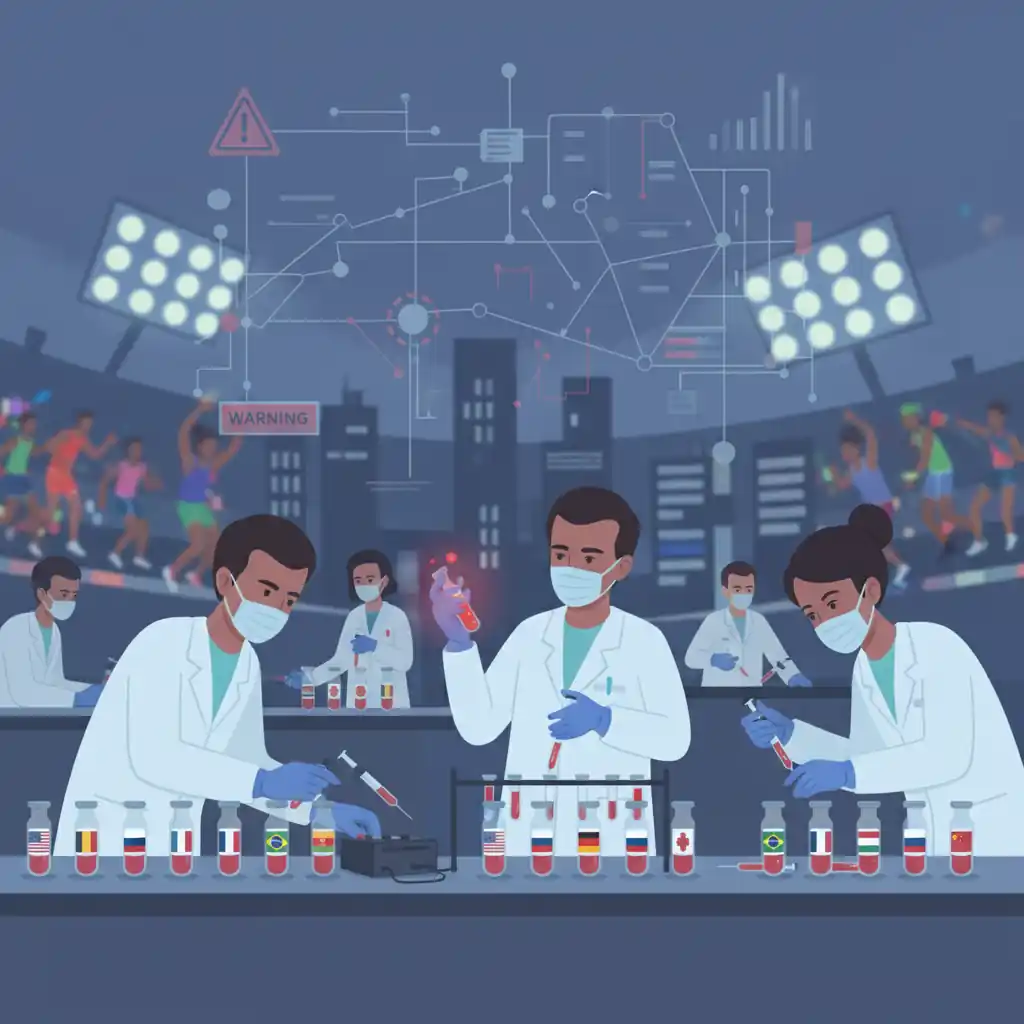
Cold War Doping Escalates
Historical reporting suggests state-sponsored doping was widespread during the Cold War, particularly in East Germany, setting a precedent for systematic manipulation in sports.
ARD Documentary Airs
German broadcaster ARD airs 'Top Secret Doping: How Russia Creates its Winners,' revealing extensive allegations of systemic doping and cover-ups within Russian athletics.
WADA Commission Report (Part 1)
The World Anti-Doping Agency's (WADA) Independent Commission releases its first report, concluding widespread, state-sponsored doping in Russian track and field and declaring RUSADA (Russia's anti-doping agency) non-compliant.
Rodchenkov's Revelations
The New York Times publishes an interview with Grigory Rodchenkov, former head of the Moscow Anti-Doping Laboratory, detailing an elaborate scheme to swap tainted urine samples at the 2014 Sochi Olympics.
McLaren Report (Part 1)
Richard McLaren's independent investigation, commissioned by WADA, releases its first report, confirming allegations of a state-directed, systematic doping system across multiple sports.
Rio Olympics Controversies
Despite calls for a blanket ban, the International Olympic Committee (IOC) allows individual sports federations to decide on Russian athlete participation, leading to a partial ban and significant controversy at the Rio Games.
McLaren Report (Part 2)
The second part of the McLaren Report is released, providing further forensic evidence of a 'disappearing positive methodology' affecting over 1,000 Russian athletes across 30 sports from 2011 to 2015.
PyeongChang Olympics Ban
The IOC bans Russia from the 2018 PyeongChang Winter Olympics, but allows 'clean' Russian athletes to compete under a neutral 'Olympic Athlete from Russia' (OAR) flag.
WADA Four-Year Ban
WADA imposes a four-year ban on Russia from major international sporting events, including the Olympics and World Championships, over manipulated laboratory data. The ban was later reduced to two years by the Court of Arbitration for Sport (CAS).
Tokyo Olympics Restrictions
Russian athletes compete at the delayed Tokyo 2020 Olympics under the 'ROC' (Russian Olympic Committee) designation, without national flags or anthems, due to ongoing sanctions.
PROLOGUE: THE STAGE AND THE SHADOWS
This story draws on historical investigations, journalism, and academic research. Some events described were the subject of public controversy or legal investigation. Allegations and interpretations are presented as reported claims rather than definitive conclusions.
The Olympic Games are designed as a global stage for human achievement, a celebration of talent, dedication, and the relentless pursuit of excellence. Yet, beneath the veneer of triumph and national pride, a darker narrative has often unfolded—a clandestine battle where the pursuit of victory transcends fair play, venturing into the murky world of illicit performance enhancement. The Russian State Doping Scandal stands as one of the most audacious and comprehensive assaults on sports integrity in modern history, a complex web of alleged deception, scientific manipulation, and geopolitical pressure.
Investigators later alleged that this was no mere collection of individual rogue athletes or coaches. Instead, they claimed to uncover a sophisticated, centrally controlled system, reportedly engineered at the highest levels to guarantee sporting supremacy. It was a narrative that would expose the fragile trust within international sports, leading to unprecedented sanctions and a global reckoning. This is the story of how the alleged quest for gold became a labyrinth of deceit, and the individuals who dared to pull back the curtain on a system designed to win at all costs.
ACT I: A LEGACY OF ILLICIT ADVANTAGE
To comprehend the scale of the Russian doping apparatus, one must first understand its historical roots. The pursuit of chemical advantage in sports is not new, but the Cold War era saw its elevation to a state-sponsored doctrine, particularly within the Soviet bloc. East Germany, for instance, became notorious for its systematic 'State Plan 14.25,' which reportedly administered performance-enhancing drugs to thousands of athletes, often without their knowledge, in a chilling pursuit of Olympic glory.
The Ghosts of Games Past: Echoes of East Germany
Historians have noted the parallels. The East German doping machine was a meticulously organized system, operating in secrecy, with medical professionals, coaches, and state security services allegedly working in concert. The primary goal was to project an image of communist superiority on the international stage. This historical precedent, according to sports ethicists, provided a chilling blueprint for how a nation could leverage its sporting federations for political ends.
The Post-Soviet Crucible: Pressure to Perform
Following the collapse of the Soviet Union, Russia inherited this sporting legacy, along with immense pressure to maintain its status as a global athletic powerhouse. The 1990s and early 2000s were a period of transition, but the desire for medals remained a powerful national imperative. Journalists and anti-doping officials began to observe a persistent pattern of positive tests among Russian athletes, particularly in track and field, which some considered disproportionate to other nations.
According to early WADA reports, there were increasing concerns about a culture of non-compliance within Russian anti-doping efforts. Whistleblowers, even then, were reportedly few and far between, silenced by fear or institutional loyalty. The foundation for a more elaborate system was, in the view of later investigators, already being laid—built upon a historical understanding that sports success could be manufactured, and that the stakes for national prestige were extraordinarily high.
Fun Fact: During the 1970s and 80s, East German athletes reportedly used a variety of substances, including anabolic steroids like Oral Turinabol. So effective and widespread was the program that many female athletes later suffered severe health consequences, including virilization and infertility, a tragic testament to the long-term human cost of state-sanctioned doping.
ACT II: THE ARCHITECTS AND THE WHISTLEBLOWERS
Every grand deception needs its architects, and for the alleged Russian doping system, the figure of Dr. Grigory Rodchenkov loomed large. As the director of the Moscow Anti-Doping Laboratory from 2005 to 2015, Rodchenkov was, according to later investigations, uniquely positioned at the heart of the alleged operation.
Dr. Rodchenkov's Realm: The Master of the Moscow Lab
Rodchenkov, a biochemist by training, was initially tasked with catching dopers. However, as he later told the New York Times, he was allegedly directed to facilitate doping and cover up positive tests. His laboratory, ironically, was accredited by WADA, giving it a veneer of legitimacy even as, investigators claimed, it became instrumental in manipulating test results.
His alleged methods, as described in subsequent reports, were disturbingly ingenious. He reportedly developed a 'Duchess Cocktail'—a blend of three anabolic steroids (oxandrolone, metenolone, and trenbolone) mixed with alcohol, designed for quicker absorption and excretion, making it harder to detect. Athletes allegedly swished the mixture in their mouths, absorbing it through their mucous membranes, rather than injecting it.
The Disappearing Positive Methodology
The ultimate alleged cover-up, however, was the 'disappearing positive methodology.' According to the McLaren Report, this involved a system where positive test results from Russian athletes were simply designated as 'negative' in the laboratory’s computer system. This manipulation was allegedly so pervasive that it affected hundreds of samples over several years, shielding known dopers from sanctions and allowing them to compete, often at the highest levels.
The Moral Break: Yuliya and Vitaly Stepanov
The elaborate system relied on silence, but that silence was ultimately broken. Yuliya Stepanova, an 800-meter runner who herself had doped under the alleged system, along with her husband Vitaly Stepanov, a former official at RUSADA, made the courageous decision to become whistleblowers. Beginning in 2010, they secretly recorded conversations and gathered evidence, eventually sharing their findings with German investigative journalist Hajo Seppelt.
Their revelations formed the backbone of the groundbreaking ARD documentary 'Top Secret Doping: How Russia Creates its Winners,' which aired in December 2014. This film, according to many observers, was the spark that ignited the wider scandal, bringing the allegations from whispers to the global media spotlight and prompting WADA to launch its own independent investigation. The Stepanovs, facing grave personal risks, later fled Russia, living in hiding and advocating for clean sport.
ACT III: THE WALL CRUMBLES: INVESTIGATIONS AND REVELATIONS
The ARD documentary of December 2014 was a seismic shock. It presented direct testimony and evidence, including from the Stepanovs, that implicated Russian coaches, athletes, and officials in a vast doping conspiracy. This immediate public outcry prompted a swift response from the World Anti-Doping Agency.
The WADA Independent Commission and its Initial Findings
WADA quickly established an Independent Commission, chaired by Richard Pound, a former WADA President and IOC member. Its mandate was to investigate the allegations of systemic doping, especially within Russian athletics. In November 2015, the Commission released its first report, a scathing indictment that concluded there was a 'deeply rooted culture of cheating' in Russian track and field.
The report, according to its findings, detailed widespread corruption, coercion, and bribery, alleging that Russian anti-doping authorities (RUSADA) and the Moscow laboratory were complicit in destroying samples and manipulating results. Crucially, it recommended that Russia be banned from international athletics competition, a recommendation later adopted by World Athletics (then IAAF), sidelining Russian track and field athletes from the 2016 Rio Olympics.