
Ho Chi Minh Declares Independence
After WWII, Ho Chi Minh declares the Democratic Republic of Vietnam, setting the stage for decades of conflict and U.S. involvement.
Fall of Dien Bien Phu
The French suffer a decisive defeat at Dien Bien Phu, leading to their withdrawal and solidifying American commitment to supporting South Vietnam.
Gulf of Tonkin Incident
Alleged attacks on U.S. destroyers lead to the Gulf of Tonkin Resolution, dramatically escalating direct U.S. military involvement in Vietnam.
McNamara Commissions Study
Secretary of Defense Robert McNamara commissions a top-secret study to document the history of U.S. involvement in Vietnam, later known as the Pentagon Papers.
Ellsberg Begins Copying
Daniel Ellsberg, a former Pentagon analyst and key contributor to the study, begins secretly copying the thousands of pages of classified documents.
Ellsberg Contacts The New York Times
After attempting to persuade members of Congress to release the study, Ellsberg provides portions of the classified report to 'The New York Times'.
NYT Publishes First Installment
'The New York Times' publishes the first installment of the Pentagon Papers, revealing widespread government deception to the American public.
Government Seeks Injunction
The U.S. government files a temporary restraining order against 'The New York Times', marking the first time in U.S. history the government successfully sought to restrain publication of news.
Supreme Court Rules for Press
In 'New York Times Co. v. United States', the Supreme Court rules 6-3 in favor of the newspapers, allowing publication to resume, citing the First Amendment.
Watergate Break-in
A break-in at the Democratic National Committee headquarters in the Watergate Hotel, later linked to the 'Plumbers' unit formed to stop leaks like the Pentagon Papers, sets off a chain of events leading to Nixon's resignation.
PROLOGUE: THE WEIGHT OF THE SECRET
This story draws on historical investigations, journalism, and academic research. Some events described were the subject of public controversy or legal investigation. Allegations and interpretations are presented as reported claims rather than definitive conclusions.
By 1967, the Vietnam War had become a quagmire, consuming American lives and treasure with no clear end in sight. Public trust in the government was eroding, yet the official narrative remained steadfast: victory was achievable, and U.S. intervention was vital to national security. But behind the polished press conferences and patriotic pronouncements, a darker truth, known only to a select few, was taking shape. This story explores how a deeply classified study, intended only for internal government eyes, became a seismic event that shook the foundations of American democracy, forever altering the relationship between the government, the press, and the people.
Imagine a vault, overflowing not with gold, but with secrets—decades of them, meticulously documented, detailing every clandestine operation, every political maneuver, every deceptive public statement regarding America’s longest and most divisive war. This was the 'History of U.S. Decision-making Process on Vietnam Policy,' a 7,000-page behemoth commissioned by the very architect of the war's escalation, Secretary of Defense Robert McNamara. It was never meant for public consumption. It was, as journalist Max Frankel later observed, 'the most important case involving the free press in history.'
ACT I: THE ARCHITECT'S DOUBT AND THE BIRTH OF THE STUDY
The Vietnam War, by the mid-1960s, was a conflict built on quicksand. While the Kennedy and Johnson administrations publicly assured Americans of progress and necessity, the reality, as documented in classified memos and reports, told a starkly different story. The 'credibility gap' was widening, a chasm between official statements and perceived truths. This gap was felt acutely by Robert S. McNamara, the Secretary of Defense—a man known for his analytical mind and his role in escalating U.S. involvement.
McNamara, a figure often described by historians as brilliant yet increasingly haunted, had begun to harbor deep doubts about the war he had helped prosecute. By 1967, he was reportedly grappling with the profound moral and strategic failures of the conflict. In a move some described as an attempt to create an institutional memory or perhaps even a personal reckoning, McNamara commissioned a 'very encyclopedic history of the whole Vietnam effort.' This study, he reportedly stipulated, was not to be a policy recommendation or a political statement, but an objective, comprehensive historical account of how the U.S. had become entangled in Vietnam.
The official title given to this project was the 'History of U.S. Decision-making Process on Vietnam Policy.' Its mandate was to examine the origins and evolution of American policy from World War II to May 1968. Overseen by Leslie Gelb, a Pentagon official, the team comprised 36 military officers, civilian analysts, and academics. They were granted access to an unprecedented trove of top-secret documents, including presidential directives, cables, internal memos, and intelligence assessments, many of which directly contradicted public pronouncements made at the time. The sheer volume and sensitivity of the material meant the study was instantly deemed 'Top Secret – Sensitive' and sequestered within the Pentagon.
As reported by journalists at the time, the study exposed a systematic pattern of deception. It documented how four administrations – Truman, Eisenhower, Kennedy, and Johnson – had reportedly misled the public about their intentions and actions in Southeast Asia. This included, as later reported by 'The New York Times,' a detailed account of deliberate escalation, covert operations, and the systematic underestimation of enemy strength and resilience, alongside the exaggeration of South Vietnamese capabilities. The internal findings contradicted years of public assurances, revealing that the U.S. government had, for instance, allegedly broadened the war's scope despite assurances of limited engagement and had reportedly prepared detailed military plans for invading North Vietnam months before the Gulf of Tonkin incident in 1964, which was presented to the American public as an unprovoked attack necessitating retaliation.
Fun Fact: McNamara's decision to commission the study was reportedly met with skepticism and even suspicion by some within the Pentagon. Defense Secretary Clark Clifford, McNamara's successor, reportedly dismissed the study as 'historical navel-gazing' and considered it largely irrelevant to ongoing policy. He later expressed surprise at the public impact of its revelations.
ACT II: THE SCHOLAR'S CRISIS OF CONSCIENCE
Into this labyrinth of classified information stepped Daniel Ellsberg, a former Marine, Harvard Ph.D., and a highly regarded defense analyst. Ellsberg was, by all accounts, an archetypal 'insider' – a hawk who had once passionately believed in the American mission in Vietnam, even serving two years in Vietnam for the State Department, where he witnessed the brutal realities firsthand. He was exactly the kind of intellectual the Pentagon sought for such a sensitive project.
Ellsberg joined the Pentagon Papers project in 1967, contributing to the section on the escalation of the war. However, his direct experiences in Vietnam, coupled with his deep dive into the historical record, began to corrode his faith. As later reported, the disjunction between the official rhetoric he had once helped craft and the documented truths within the study became unbearable. He reportedly saw a clear pattern: successive administrations had lied to Congress and the American people about the progress and purpose of the war, continually expanding the conflict while concealing the true costs and bleak prospects for victory. This realization, according to his own accounts, propelled him into a profound moral crisis.
By 1969, Ellsberg was working at the RAND Corporation, a government-funded think tank, and still had access to the completed 47-volume study. He reportedly decided that the American public had a right to know the truth. He claimed that the information contained within the study was crucial for a democratic society to make informed decisions about war and peace. He initially sought to leak the documents to prominent anti-war senators, hoping they would introduce the study into the Congressional Record. However, no senator proved willing to risk the political and legal fallout of such an act.
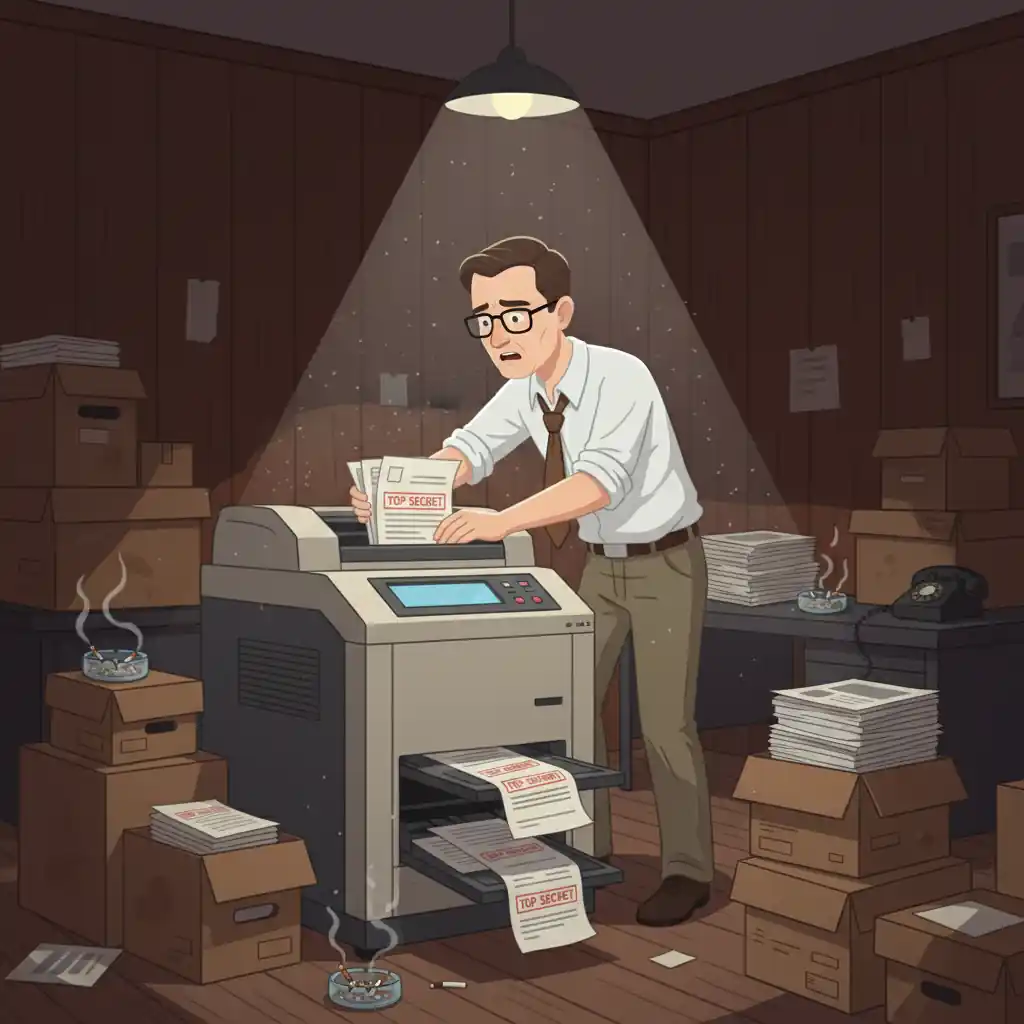
Frustrated by the inaction of Congress, Ellsberg, with the assistance of his RAND colleague Anthony Russo, began the arduous and clandestine process of copying the entire 7,000-page document. Using a Xerox machine in a friend's advertising agency office, often late at night, they painstakingly duplicated each page. This monumental effort reportedly took months, with stacks of classified documents secretly transported in shopping bags and suitcases, hidden in plain sight. This period, as later depicted, was filled with immense tension and secrecy, highlighting the extraordinary lengths Ellsberg felt compelled to go to fulfill his perceived duty to the public.
Fun Fact: The copying process was so extensive and took so long that Ellsberg's young children reportedly assisted, unknowingly, by helping to collate and sort pages, thinking it was just another of their father’s projects. This detail underscores the audacious nature of the leak and the domestic risks Ellsberg took.
ACT III: THE PRESS TAKES FIRE
After exhausting his avenues with Congress, Daniel Ellsberg reportedly turned to the press. In March 1971, he made contact with Neil Sheehan, a reporter for 'The New York Times'. Sheehan, a former Marine with his own deep-seated skepticism about the war, immediately recognized the monumental significance of the documents. Under extreme secrecy, Sheehan and a team of 'Times' reporters and editors, including managing editor A.M. Rosenthal, worked feverishly for weeks in a guarded hotel suite, analyzing and synthesizing the vast trove of information.
The internal debate at 'The New York Times' was reportedly intense. Publisher Arthur Ochs Sulzberger Jr. and his legal team were acutely aware of the potential legal ramifications, including prosecution under the Espionage Act. However, the journalistic imperative, the belief in the public’s right to know, ultimately prevailed. On Sunday, June 13, 1971, 'The New York Times' published the first installment of the Pentagon Papers under the banner headline: 'Vietnam Archive: Study Tells How U.S. Got Into War; Text of the Study's Introduction'.
The immediate government reaction was swift and aggressive. President Richard Nixon, through Attorney General John N. Mitchell, immediately demanded that 'The New York Times' cease publication, citing national security concerns. When the 'Times' refused, the Justice Department obtained a temporary restraining order on June 15, 1971, from a U.S. District Court judge, preventing further publication. This marked a historic moment: the first time in U.S. history that the federal government had successfully exercised prior restraint – stopping a newspaper from publishing news before it appeared.