
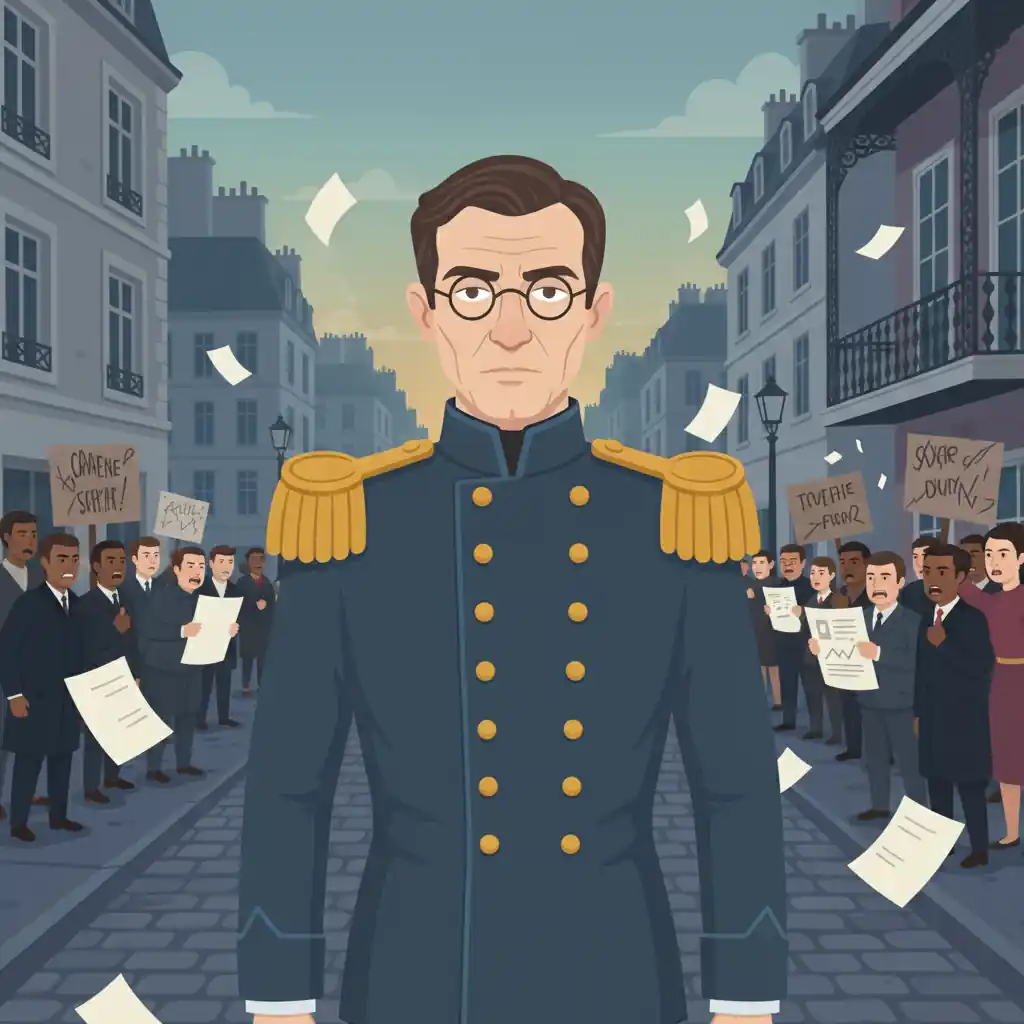
The Discovery of the Bordereau
French counterintelligence discovers a handwritten memo, the 'bordereau,' detailing secret military documents, leading to an immediate hunt for a traitor.
Dreyfus's Arrest and Interrogation
Captain Alfred Dreyfus, a Jewish artillery officer, is arrested on suspicion of treason, primarily due to perceived handwriting similarities to the bordereau.
Public Degradation Ceremony
Dreyfus is publicly stripped of his rank and sword in a humiliating ceremony in the courtyard of the École Militaire, before being deported to Devil's Island.
Colonel Picquart's Discovery
Colonel Georges Picquart, the new head of intelligence, uncovers evidence strongly suggesting Major Ferdinand Walsin Esterhazy, not Dreyfus, is the real traitor.
Émile Zola's 'J'Accuse!'
Famed writer Émile Zola publishes his open letter 'J'Accuse!' on the front page of 'L'Aurore,' directly accusing the military of a cover-up and injustice, sparking national and international outrage.
The Rennes Retrial
Dreyfus is brought back to France for a second court-martial in Rennes. Despite overwhelming evidence of his innocence, he is again convicted, though with 'extenuating circumstances.'
Presidential Pardon
President Émile Loubet grants Dreyfus a pardon, allowing him to be released from prison but not formally exonerating him, a decision that divides the nation.
Full Exoneration and Reinstatement
The French Supreme Court of Appeals finally annuls the Rennes verdict without ordering a third trial, fully exonerating Dreyfus, who is reinstated into the army and promoted.
PROLOGUE: THE SCARLET LETTER OF THE REPUBLIC
This story draws on historical investigations, journalism, and academic research. Some events described were the subject of public controversy or legal investigation. Allegations and interpretations are presented as reported claims rather than definitive conclusions. The Dreyfus Affair stands as a searing indictment of prejudice and a monumental struggle for justice, a scandal that ripped through the very fabric of the French Third Republic.
Imagine a nation on edge, still smarting from the Franco-Prussian War, consumed by a cocktail of nationalism, militarism, and virulent anti-Semitism. Into this volatile atmosphere steps a quiet, unassuming Jewish artillery captain named Alfred Dreyfus. His life, unremarkable until then, would become the unwilling pivot around which an entire republic nearly tore itself apart. It began with a scrap of paper, found in a German wastebasket, and spiraled into a decade-long saga of espionage, cover-ups, and a seismic battle for truth.
This wasn't merely a legal case; it was a psychological thriller played out on the grandest stage, a nation’s soul laid bare. It revealed the dark undercurrents of prejudice within the most revered institutions, and in its eventual, agonizing resolution, laid the groundwork for modern civil liberties and journalistic integrity. The affair became a crucible, forging the ideals of justice and individual rights against the fierce flames of state authority and collective hysteria.
ACT I: THE ANATOMY OF A FRAME-UP
The year is 1894. France, defeated by Prussia in 1870, is obsessed with national security and the threat of German espionage. Within the cloistered world of French military intelligence, a discovery shatters the fragile calm: a handwritten, undated memo, later dubbed the 'bordereau,' found by a cleaning woman in the wastebasket of the German military attaché in Paris. It itemized classified French military documents, clearly indicating a traitor within the General Staff.
The hunt for the spy was swift, and disturbingly unscientific. Investigators, under Colonel Jean Sandherr, immediately focused on officers with access to the listed documents. Alfred Dreyfus, an officer with a distinguished record, became a suspect due to two factors: his Jewish faith and his perceived ‘foreign’ Alsatian background, despite his French nationality. In a climate rife with anti-Semitism, his identity alone made him a convenient target. Journalists of the era, notably those from the anti-Semitic newspaper La Libre Parole, began publishing inflammatory articles, creating a public frenzy and pre-judging Dreyfus long before a trial.
The evidence against Dreyfus was flimsy, to say the least. The primary proof was the supposed similarity of his handwriting to that on the bordereau. While some experts expressed doubts, others, swayed by the prevailing sentiment, confirmed the match. A crucial piece of the puzzle, later dubbed the 'secret dossier,' was compiled by military intelligence. This dossier, never shown to Dreyfus or his defense, allegedly contained further evidence of his guilt, including documents historians would later claim were largely irrelevant or even outright forged. Its existence and concealment from the defense were a profound violation of due process.
Dreyfus was brought before a secret court-martial. Denied the right to review the secret dossier or confront his accusers with full knowledge of the evidence, his conviction was all but assured. On December 22, 1894, he was found guilty of treason. The sentence: military degradation and life imprisonment on Devil's Island, a remote penal colony off the coast of French Guiana. The public degradation ceremony on January 5, 1895, was a meticulously orchestrated humiliation. Before a crowd baying for his blood, Dreyfus was stripped of his uniform insignia, his sword was broken, and he was marched through the streets, maintaining his innocence with a desperate cry: 'You will tell the whole of France that I am innocent!'
The spectacle was designed to close the book on the affair, to demonstrate the Republic’s resolve against traitors. Instead, it was just the beginning. Historians and legal scholars have since meticulously documented the chain of events, revealing how, according to later investigations, the pressure to find a culprit, coupled with deep-seated anti-Semitism within the military and parts of society, led to a gross miscarriage of justice. This early phase of the affair, critics argued, showcased a military establishment more concerned with its own honor than with truth.
ACT II: THE WHISPER OF TRUTH AND THE WALL OF SILENCE
While Dreyfus endured the brutal solitude of Devil's Island, where he was chained to his bed and his sanity tested by the tropical heat and isolation, the wheels of justice, however slowly, began to turn. The first crack in the military's seemingly impenetrable facade of certainty appeared in 1896, with the arrival of a new chief of military intelligence: Colonel Georges Picquart.
Picquart, a career officer with no particular sympathy for Dreyfus, began a routine review of files. His methodical approach led him to a startling discovery: a new telegram, the 'petit bleu,' intercepted from the German embassy, was addressed to a French officer named Major Ferdinand Walsin Esterhazy. Further investigation by Picquart, including an examination of Esterhazy's handwriting, strongly suggested that Esterhazy, not Dreyfus, was the true author of the infamous bordereau. The physical resemblance of Esterhazy's script to the original document was, according to Picquart’s later testimony, 'striking.'
Picquart reported his findings to his superiors. His reward was not commendation but obstruction and hostility. The military high command, led by General Auguste Mercier, General Charles-Arthur Gonse, and General Raoul de Boisdeffre, faced an agonizing dilemma. To admit Dreyfus's innocence would be to concede a catastrophic error, to invalidate a court-martial, and to expose the deeply ingrained anti-Semitism and potential cover-up within their ranks. This, they feared, would shatter public trust in the army, an institution held sacrosanct after the Franco-Prussian War. The mantra became: 'The honor of the army is at stake.'
In a move that historians later characterized as a deliberate act to protect the military's reputation, Picquart was discreetly sidelined, then transferred to hazardous duty in Tunisia, effectively silencing him. Meanwhile, another intelligence officer, Major Hubert-Joseph Henry, took desperate measures. To further incriminate Dreyfus and reinforce the official narrative, Henry confessed to forging a document that explicitly named Dreyfus as a traitor, a piece of evidence later dubbed the 'faux Henry.' This forgery was then secretly added to the existing 'secret dossier,' strengthening the false case against Dreyfus and further complicating any future review.
Despite the military's efforts to suppress the truth, whispers began to escape. Dreyfus's family, particularly his brother Mathieu, tirelessly worked behind the scenes, engaging lawyers and influential figures. Bernard Lazare, a Jewish intellectual, published a pamphlet arguing for Dreyfus's innocence, and the story began to gain traction in intellectual and political circles. The military, however, remained resolute in its defense of the original verdict, dismissing all counter-evidence as slander or conspiracy. This period marked the hardening of a 'conspiracy of silence' within the upper echelons of the army, according to later investigative journalists, aiming to bury the truth for the sake of institutional prestige.
ACT III: 'J'ACCUSE!' – THE REPUBLIC TORN ASUNDER
The simmering controversy exploded onto the national stage in January 1898 with a single, audacious headline. On January 13, the literary titan Émile Zola published an open letter on the front page of the newspaper L'Aurore, titled 'J'Accuse!'. In a blistering 4,500-word essay, Zola directly accused the highest echelons of the French military and government of a monstrous miscarriage of justice, of obstructing the truth, and of knowingly condemning an innocent man. He named names: General Auguste Mercier, General Charles-Arthur Gonse, Major Henry, and others, charging them with unlawful arrest, judicial error, and the deliberate suppression of evidence.