
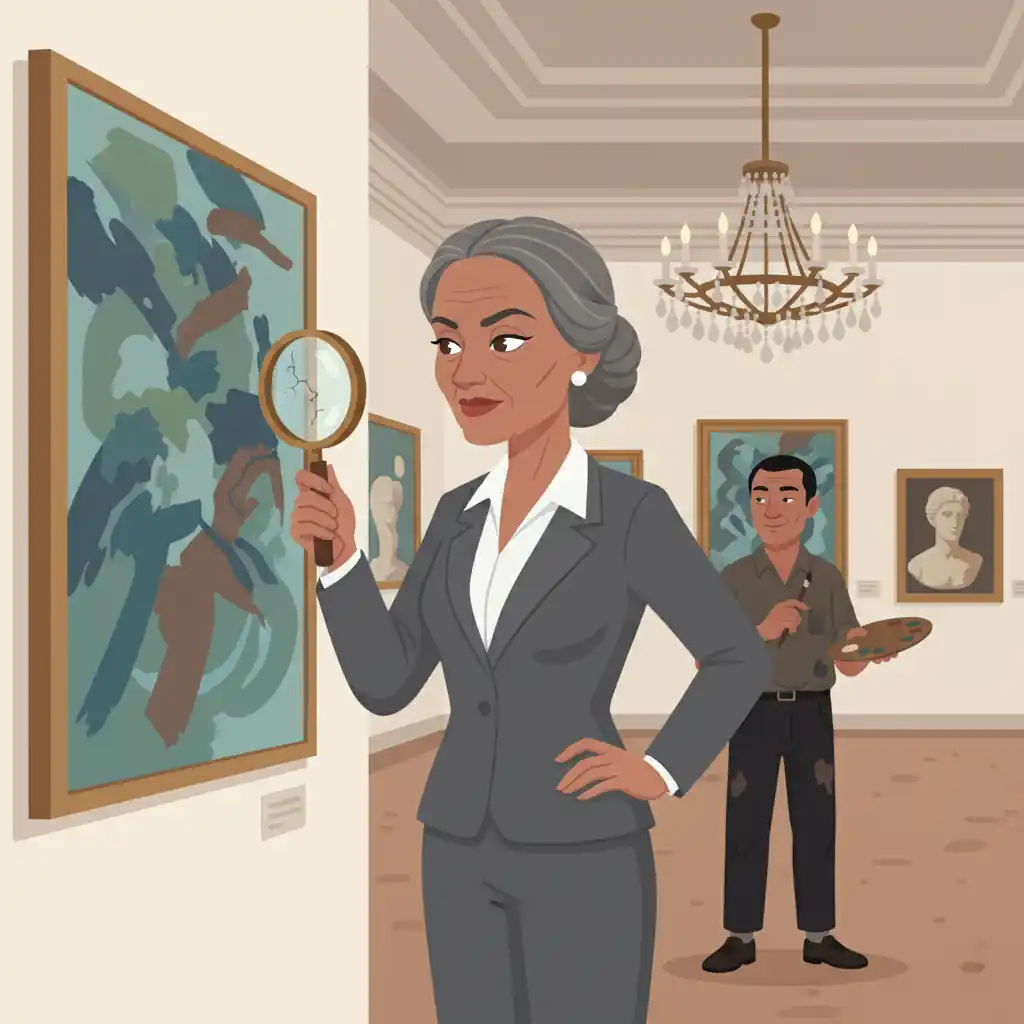
Knoedler Gallery Founded
M. Knoedler & Co., one of New York City's oldest and most prestigious art galleries, is established. It would operate for 165 years.
Glafira Rosales Enters the Scene
Art dealer Glafira Rosales allegedly begins selling previously unknown Abstract Expressionist works to Knoedler Gallery, claiming they came from a mysterious private collector.
Ann Freedman Takes the Helm
Ann Freedman becomes president of Knoedler. Under her leadership, the gallery significantly ramps up sales of Rosales's 'discoveries'.
First Major Sale Questioned
A 'Jackson Pollock' painting from Rosales's cache is sold to collector Jack Levy for $2 million. Doubts about its authenticity emerge years later.
Forensic Doubts Begin
Scientific analysis conducted on a 'Robert Motherwell' painting from Rosales’s supply suggests inconsistencies with known pigments of the period.
Legal Action Initiated
Collector Pierre Lagrange files the first lawsuit against Knoedler and Ann Freedman, alleging fraud over a 'Jackson Pollock' he purchased.
Knoedler Gallery Closes
Amid mounting lawsuits and a tarnished reputation, Knoedler Gallery announces its permanent closure after 165 years in business.
FBI Investigation Intensifies
The FBI launches a full-scale investigation into the Knoedler forgery ring, leading to criminal charges against Glafira Rosales.
Rosales Pleads Guilty
Glafira Rosales pleads guilty to nine counts of fraud, money laundering, and tax evasion, confessing to orchestrating the decade-long forgery scheme.
The Forger Identified
Pei-Shen Qian, a Chinese immigrant living in Queens, New York, is identified by federal prosecutors as the alleged painter of the forgeries. He flees to China.
Final Civil Cases Settled
The last of the civil lawsuits against Knoedler and its former director are settled out of court, bringing an end to the protracted legal battles.
PROLOGUE: THE UNDOING OF A DYNASTY
This story draws on historical investigations, journalism, and academic research. Some events described were the subject of public controversy or legal investigation. Allegations and interpretations are presented as reported claims rather than definitive conclusions.
For 165 years, M. Knoedler & Co. stood as a titan of the American art world. Founded in 1846, it was more than just a gallery; it was an institution, a gatekeeper of taste, and a trusted arbiter of authenticity. From its elegant Fifth Avenue address, Knoedler had supplied masterpieces to industrialists, presidents, and museums, shaping some of the nation's most iconic collections. It was a beacon of old-world prestige in a city constantly reinventing itself. Yet, beneath its polished façade, a dark secret festered, threatening to unravel not just a venerable business but the very fabric of trust upon which the entire art market operates.
Imagine a gallery that sold works by Jackson Pollock, Mark Rothko, Robert Motherwell, Barnett Newman, and Willem de Kooning—all artists whose works command millions—but every single one of them was a fake. Not just a misattribution, but a deliberate forgery painted in a garage, then laundered through a sophisticated network of deception. This wasn't a minor slip-up; it was, according to prosecutors, a massive criminal enterprise that swindled collectors out of an estimated $80 million and ultimately destroyed one of New York's most storied art institutions. This is the story of the Knoedler Gallery scandal, a tale of ambition, credulity, and the shadowy underbelly of the high-stakes art market.
How did a reputable gallery, advised by experts and serving a clientele of sophisticated buyers, fall victim to such a scheme? And what does it reveal about the subjective nature of 'authenticity' when vast sums of money are on the line?
ACT I: THE MYSTERIOUS 'MR. X'
The seeds of the scandal were allegedly sown in 1994 when a relatively unknown art dealer named Glafira Rosales walked into the Knoedler Gallery. She reportedly presented a stunning collection of never-before-seen Abstract Expressionist paintings, claiming they belonged to an anonymous 'Mr. X'—an elderly, reclusive European collector whose father had allegedly acquired the works directly from the artists during the 1940s and 50s. This mysterious provenance, while vague, initially intrigued Knoedler's president at the time, Richard L. Feigen.
The allure was undeniable: a trove of undiscovered masterpieces from a golden age of American art. Works by Pollock, Rothko, Motherwell, and others, supposedly hidden from public view for decades. According to court documents, Rosales spun an elaborate narrative: Mr. X was a fastidious man who demanded discretion, anonymity, and cash payments. He allegedly wanted no paper trail, no public exhibition, and no direct contact with the gallery or buyers. This tale, which would later be revealed by investigators as entirely fabricated, provided the perfect cover for a systematic laundering of forgeries.
Between 1994 and 2011, Rosales reportedly supplied Knoedler with approximately 60 artworks. The gallery, under the leadership of Ann Freedman (who became president in 2000), eagerly embraced these 'discoveries.' Freedman, a respected figure in the art world, became the primary champion of the 'Mr. X' collection. She allegedly described the works as 'missing links' in the oeuvres of these masters, pieces that filled gaps in their known stylistic evolution. She exhibited them, authored catalogue essays, and reportedly convinced her discerning clientele of their authenticity, selling paintings for prices ranging from several hundred thousand dollars to more than $17 million.
To bolster the credibility of the 'Mr. X' narrative, Rosales reportedly concocted details about the collector's family and his connection to the artists. She claimed he often preferred to deal in cash, explaining the lack of bank records, and that his identity had to be protected for privacy reasons. Journalists later reported that Freedman herself visited Rosales's supposed home for Mr. X, though it was later revealed to be an empty apartment staged for the purpose. This dedication to upholding the narrative, even in the face of red flags, would become a central point of debate and legal contention.
Among the most compelling stories Rosales reportedly created for 'Mr. X' was that he was a Swiss émigré who befriended Abstract Expressionist artists in New York and kept their paintings in his private, climate-controlled collection, hidden from the public eye for half a century. The truth, as revealed by the FBI, was that 'Mr. X' did not exist, and the 'masterpieces' were painted in a garage studio in Queens.
ACT II: THE GHOST PAINTER OF QUEENS
While Rosales was the face of the operation, the true artistic engine behind the scam was a ghost: Pei-Shen Qian, an elderly Chinese immigrant and former mathematics professor living a humble life in a garage apartment in Queens, New York. According to federal prosecutors, Qian was the alleged forger, a skilled but struggling artist who was reportedly paid a pittance—often just a few thousand dollars—for each 'masterpiece' he painstakingly created.
Qian's alleged studio was a stark contrast to Knoedler's elegant salon. Described by investigators as a cluttered garage, it was a world away from the hallowed halls of art history. Yet, within those unassuming walls, Qian reportedly replicated the distinctive styles and techniques of some of the 20th century's most iconic artists with uncanny precision. He allegedly studied their brushstrokes, color palettes, and compositional structures, sometimes referencing art books or catalogs provided by Rosales’s associates.
Investigators claimed Qian's process was meticulous. He allegedly used period-appropriate materials where possible, distressing canvases to appear aged and even applying tea stains to mimic the yellowing effects of time. Experts later noted that he had a remarkable ability to capture the 'spirit' of the artists he mimicked, even if subtle anomalies in pigment or technique would eventually betray him. According to reports from the FBI, Qian was allegedly introduced to Rosales through her boyfriend, Jose Carlos Bergantiños Diaz, and his brother, Jesus Angel Bergantiños Diaz, who were involved in sourcing and distributing the forgeries.
The motivation for Qian, as painted by federal authorities, was not grand ambition or artistic recognition, but financial necessity. He was reportedly paid by the Bergantiños brothers for his work, often receiving as little as $5,000 for a painting that would later sell for millions. He was, in the eyes of prosecutors, a skilled artisan caught in a criminal web, churning out 'masterpieces' that fed the insatiable appetite of the high-end art market for new discoveries. Qian fled the United States for China in 2011 before charges were filed against him and has remained beyond the reach of U.S. law enforcement.
According to court documents and FBI reports, Pei-Shen Qian allegedly painted the forgeries on canvases and boards purchased from discount art supply stores, then meticulously aged them. He would often use household items, such as a hair dryer to speed up drying paint or even baking a canvas in an oven to achieve a desired aged effect, a detail uncovered during forensic analysis.