
Klaus the Worrier
In a small village nestled by the Black Forest lived Klaus, a master carpenter. His hands crafted the finest timbers, but his mind crafted the darkest fears.
Klaus was a man of meticulous skill. If a beam needed cutting, he measured it ten times. If a roof needed tiling, he checked every single tile. His work was flawless.
But with every hammer stroke, a sigh escaped him. He worried about splinters. He worried about rust. He worried about the woodworms he hadn't seen yet, but knew were surely coming.
“This roof will hold,” he'd declare, wiping sweat from his brow, “unless, of course, a great storm hits. A storm like the one in '78, perhaps even worse. Then, who knows?”
The villagers respected his craft but grew weary of his constant predictions of doom. It was exhausting to build a house with Klaus. It was like building a ruin.
The Bridge Over Troubled Waters
The village relied on an old wooden bridge over the fast-flowing Neckar River. Each spring, the floods battered its ancient posts. One year, it simply gave way.
The village elders immediately called for Klaus. He was the only man skilled enough to build a new one. A strong one. A lasting one.
Klaus accepted the task. He sketched designs with fervent precision. He selected the sturdiest oaks. His hands moved with purpose.
But his mouth moved with even greater purpose. “The supports must be deeper,” he insisted, “or the current will tear them out. Imagine the logs, crashing against the pilings!”
He described the collapse in vivid detail. He spoke of splintered wood, swirling eddies, and the inevitable cries for help. Each day, he built the bridge and tore it down in his mind.
The other workers started to avoid him. “Just build it, Klaus,” they'd say. “Don't tempt fate.” But Klaus believed he was simply being prepared.
A Stroke of Dread
As the bridge neared completion, Klaus's anxieties peaked. It was beautiful. It was sturdy. But what if he had missed something? What if an unseen flaw lay waiting?
He spent sleepless nights pacing. The river gurgled below, a constant whisper of potential disaster. He felt a terrible weight on his shoulders.
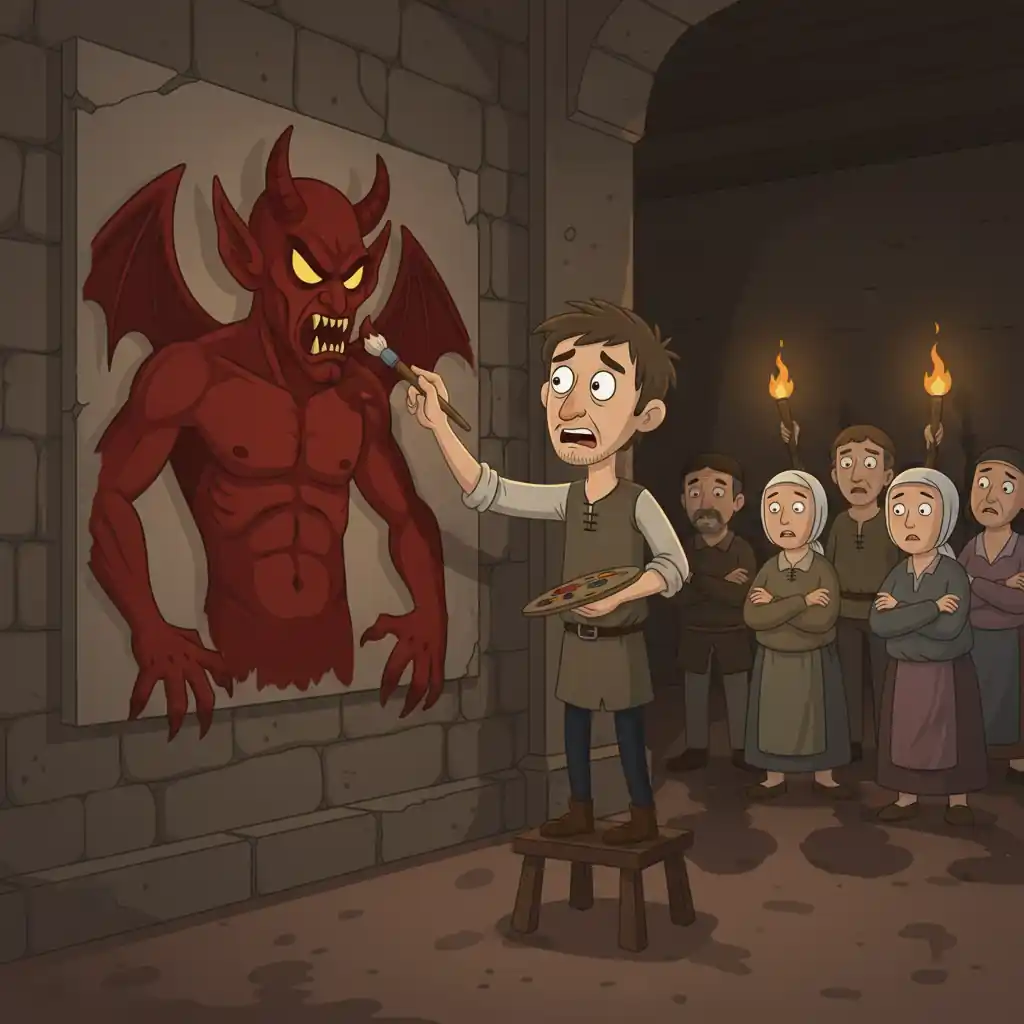
One evening, under the cloak of twilight, Klaus brought his paints to the bridge. Not the bright colors for frescoes, but dark, earthy tones he usually reserved for sealing wood.
He chose a large, smooth stone on the underside of the main arch, hidden from casual view. Here, he began to paint.
He didn't paint the river. He didn't paint the sturdy timbers. He painted his fear. A grotesque, horned figure. A demon of destruction, with cruel eyes and jagged teeth, tearing at the bridge's foundation.