
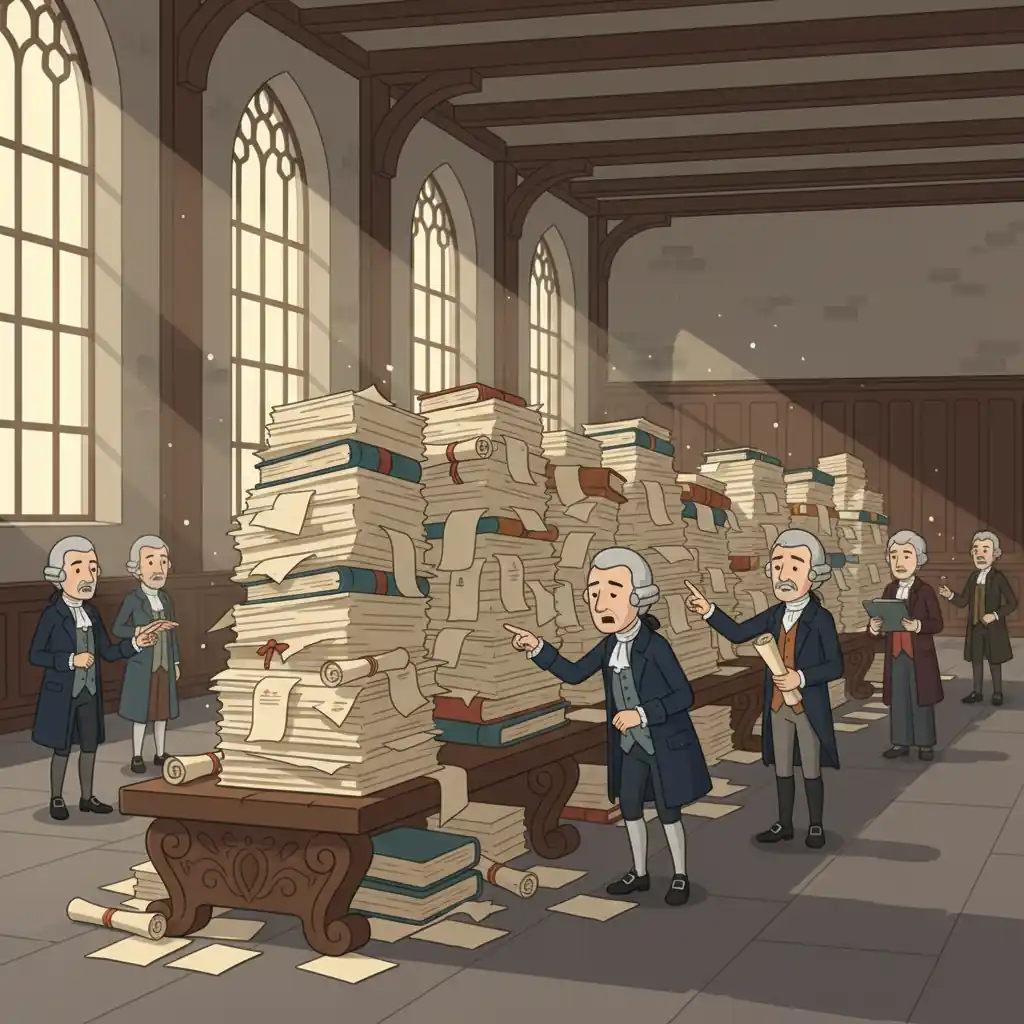
The Drowning Man of Papers
Centuries ago, in a grand old town hall in Bremen, lived a man named Herr Richter. He was not a judge, but the chief clerk. His world was made of paper.
Every day, new documents arrived. Petitions from merchants, requests from farmers, legal disputes, tax forms, building permits. The stacks grew taller than small children.
Herr Richter was a meticulous man. He loved order. But even his sharp mind and tireless hands could not keep pace with the endless flow.
His desk became a paper mountain. His assistants’ desks were equally buried. The entire office felt like it was drowning in ink and parchment.
Important matters screamed for attention. Urgent matters demanded immediate action. But many documents were not urgent. They were merely important. Or sometimes, just routine.
These less pressing papers still needed processing. Still needed decisions. But there was simply no room for them, no time for them, amidst the daily chaos.
Herr Richter often stood in his office, hands on his hips, looking at the overwhelming piles. He needed a system. A place for the 'later' tasks. A way to clear the immediate path.
One day, he had an idea. It seemed brilliant at the time. A simple solution to a complex problem.
The Invention of the 'Long Bench'
In a rarely used corridor, just outside Herr Richter's main office, stood a very long, very sturdy wooden bench. It had been there for generations, used mostly by weary messengers waiting for a signature.
Herr Richter pointed to it. “This,” he announced to his assistants, “will be our new system. The ‘Lange Bank’.”
He explained his plan. “Urgent matters, we handle immediately. Everything else – those documents that need careful thought but not immediate action – we place here. On the long bench.”
He motioned for a stack of property deeds and a few minor inheritance claims. “When the rush dies down,” he declared, “we will come to the bench. We will address these items. In due course.”
The assistants, young Klaus among them, nodded. It made sense. It cleared their desks. It offered a promise of future action.
The first few documents were placed neatly on the bench. Then a few more. For a short while, the office did feel a little less cluttered.
The long bench, once a waiting place for people, became a waiting place for papers. A silent repository for postponed intentions.
The Gravity of Dust
But the rush never truly died down. New papers arrived every morning, fresh waves crashing against the clerks' desks. The 'immediate storm' became the permanent weather.