
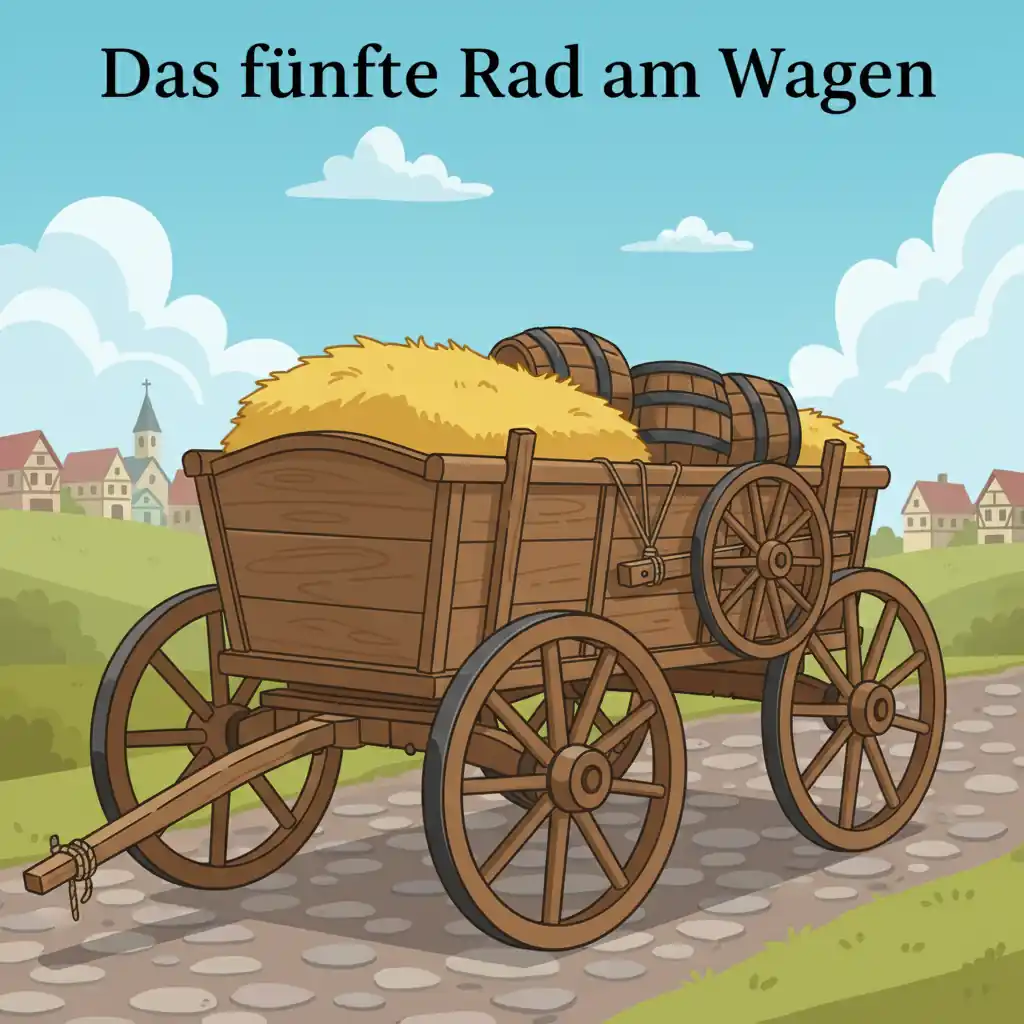
The Four Perfect Wheels
Centuries ago, life in Germany's villages depended on sturdy carts. These weren't fancy carriages. They were hardworking, simple wagons pulled by horses or oxen, essential for everything from hauling grain to bringing goods to market.
A good cart had four wheels. No more, no less. Two at the front, two at the back. They worked together, distributing weight, rolling smoothly over cobbled paths and dirt tracks.
Four wheels meant balance. Four wheels meant efficiency. Everyone understood this.
In one such village lived Old Klaus. He was a meticulous farmer, proud of his harvest and even prouder of his cart. His wagon was built strong, its wooden wheels bound with iron, ready for any journey.
But Klaus was also a worrier. What if a wheel broke on a long trip? What if he was stranded miles from home, his precious produce rotting? The thought kept him up at night.
Klaus's 'Brilliant' Idea
One crisp autumn morning, Klaus had what he considered a stroke of genius. He would add a spare wheel. Not just store it in the cart, taking up space, but attach it underneath, ready to assist or replace any ailing wheel at a moment's notice.
He found an old, sturdy wheel that fit the axle. With ropes and some clever engineering, he secured it in the middle, slightly off the ground, hoping it would act as a backup, a floating guardian against disaster.
The villagers watched, scratching their heads. "What's that, Klaus?" asked his neighbor, young Greta, pointing at the odd attachment.
"It's for safety, child!" Klaus declared, beaming. "A fifth wheel! Always prepared!"
Most just nodded politely. Klaus was old, and sometimes old men had strange ideas. But a fifth wheel? It looked... wrong.
The Burden of the Extra Wheel
Klaus's first trip with his 'improved' cart was not a triumph. The cart lumbered down the lane, slower than usual. The extra weight was noticeable.
Then came the ruts. The road was uneven, full of dips and grooves. The four main wheels managed, but the fifth wheel, suspended just an inch or two above the ground, kept catching.
It scraped, it dragged. It jolted the entire wagon, making Klaus spill his morning ale. When a wheel hit a particularly deep rut, the fifth wheel would crash down, making the whole cart swerve violently.
His horses strained harder, confused by the erratic movement. Klaus himself had to wrestle the reins to keep the wagon straight. It was less safe, not more.