
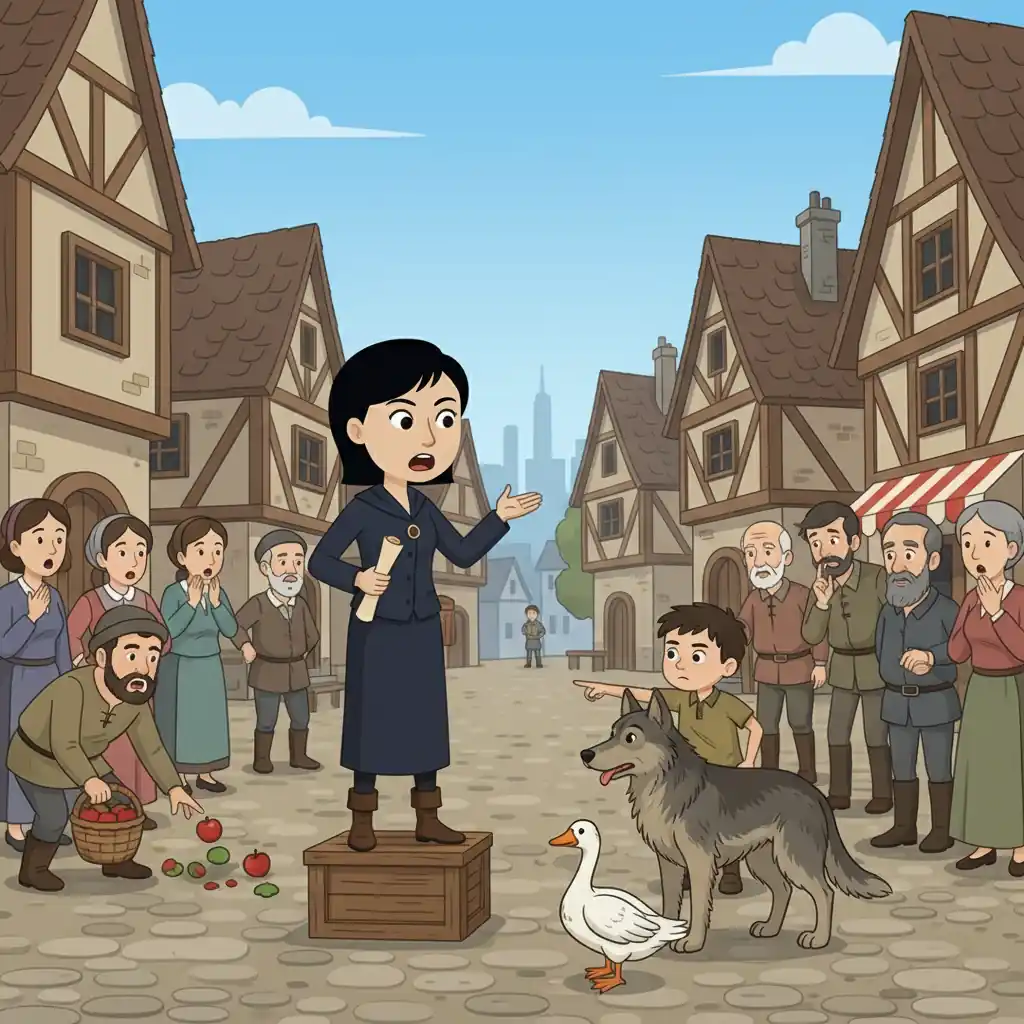
The Village of Gentle Avoidance
Long ago, nestled in a quiet valley, lay the village of Wiesengrund. It was a place known for its polite manners and its carefully chosen words. Conflict was unwelcome. Disagreement was smoothed over. Direct confrontation was simply not done.
The village Burgermeister, Herr Schmidt, embodied this spirit. He was a man of peace. Too much peace, some might say. He believed every sharp edge could be rounded, every harsh truth softened with kind words.
Wiesengrund had a problem. Not a new problem, but a stubborn one. It concerned der Schattenacker – the Shadow Field. This particular piece of land, vital for the village's wheat supply, consistently yielded poor harvests.
Every year, during the harvest festival, complaints would arise. “The soil on the Schattenacker is a bit… weary,” one farmer would sigh. “Perhaps the sun doesn't quite favor that corner,” another would suggest, nodding gravely.
“Indeed, indeed,” Herr Schmidt would chime in, stroking his chin. “We must consider rotating the crops, or perhaps a new type of fertilizer. The earth has its own will, after all.”
But everyone in Wiesengrund knew the real issue. The Schattenacker was tended by old Klaus. Klaus was a distant cousin of the Burgermeister. He was also, frankly, lazy. He woke late. He plowed shallow. He weeded rarely. His tools rusted more than they worked.
Yet, no one mentioned Klaus. No one ever said, “Klaus is not doing his job.” To do so would be impolite. It would cause an unpleasantness. It would ‘rock the boat,’ as the saying goes.
So, the villagers suffered through smaller harvests. They ate more potatoes and less bread. They hoped the Schattenacker would miraculously improve, all while knowing exactly why it would not.
Grete's Plain Truth
One autumn, the harvest from the Schattenacker was the worst yet. The granaries looked emptier than usual. The laughter at the market felt a little forced.
During the next village council meeting, the discussion began its familiar dance. “The air currents seem to behave differently around the Schattenacker,” theorized one elder. “The moon phase perhaps wasn't optimal,” offered another.
Herr Schmidt nodded sagely, preparing to suggest another costly, complex solution that avoided the obvious. Old Klaus sat in the back, picking his teeth, looking entirely unconcerned.
Then, Grete, the baker's wife, stood up. Grete was a woman of sturdy build and even sturdier opinions. Her hands were usually covered in flour, her words rarely minced.
A hush fell over the room. Grete rarely spoke at council meetings. When she did, it was usually to complain about the price of yeast.
“Burgermeister,” Grete said, her voice cutting through the polite murmur. “And good folk of Wiesengrund.”
She paused, looking around at the earnest, worried faces. Then she looked directly at Klaus, who stopped picking his teeth and fidgeted.
“We talk of air currents and moon phases. We speak of weary soil and stubborn weeds. But we all know what the problem is, don't we?”