
PROLOGUE: THE BASEMENT'S SECRET
The year is 1971. The location: the seemingly innocuous basement of Jordan Hall, Stanford University's psychology department. Here, an audacious, unprecedented experiment was about to unfold, designed to probe the very core of human behavior. What happens when ordinary men are thrust into extraordinary roles? What happens when the lines between identity and persona blur under the harsh glare of institutional power?
The Stanford Prison Experiment (SPE) wasn't just a study; it was a psychological pressure cooker, a grim theatrical performance where the actors forgot they were acting. In just six days, a group of well-adjusted, middle-class college students would transform: some into sadistic oppressors, others into broken, dehumanized victims. It was a descent into a self-created hell, demonstrating with chilling clarity how quickly 'normal' people could succumb to the corrupting influence of power and the crushing weight of systemic dehumanization.
This wasn't a historical reenactment of a famous prison break, but rather the live construction of a human cage, built brick by psychological brick. The question wasn't if the experiment would reveal something about prison life, but how much it would reveal about the darkness lurking within the human psyche itself. And the answers it provided, even decades later, remain as controversial as they are unsettling.
The SPE would become a landmark, albeit infamous, study in social psychology, forever etched into textbooks as a cautionary tale. Its implications sparked fierce debate about research ethics, human nature, and the malleability of identity. It forced academia to confront uncomfortable truths about the power of situational forces, a power that could eclipse individual morality with terrifying speed. This is the story of a prison that wasn't, yet became more real than any of its participants could have imagined.
ACT I: THE MAN BEHIND THE WALL
At the helm of this ambitious undertaking was Dr. Philip Zimbardo, a professor of psychology at Stanford. Zimbardo wasn't just an academic; he was a showman, a provocateur driven by a profound curiosity about human behavior, particularly how social roles and environmental contexts could shape individual actions. His fascination lay in understanding the deindividuation process – the psychological state where individuals lose their sense of personal identity and responsibility when immersed in a group or a specific role.
In the late 1960s and early 1970s, America was grappling with widespread social unrest. Prison reform was a hot-button issue, fueled by revelations of brutality and dehumanization within correctional facilities. Zimbardo, along with his team, wanted to understand whether the inherent brutality in prisons was due to the 'bad apples'—the violent guards and prisoners—or if the system itself was corrupting, forcing good people into evil roles and strong individuals into submission.
The Call for 'Normal' Men
To answer this, Zimbardo placed an advertisement in local newspapers, seeking male college students for a 'psychological study of prison life' for two weeks, offering a handsome sum of $15 a day (equivalent to over $100 today). The aim was to recruit psychologically stable, 'normal' young men who could serve as a blank slate, ensuring that any subsequent behavioral changes couldn't be attributed to pre-existing personality flaws.
Over 70 volunteers responded. A rigorous selection process, involving diagnostic interviews and personality questionnaires, whittled them down to 24 of the most 'normal, healthy, intelligent, middle-class' young men. These were not delinquents or career criminals; they were ordinary students, eager for some extra cash and a unique summer experience. They were randomly assigned to two groups: 'guards' and 'prisoners.'
The Improvised Institution
The stage was set in the basement of Stanford's psychology building, transformed into a makeshift prison. Three small cells were constructed, each barely large enough for three men, complete with steel-bar doors. There was a solitary confinement room known as 'The Hole,' a guards' quarters, and, crucially, an observation room with hidden cameras and microphones. Zimbardo himself took on the role of the 'Superintendent,' blurring the lines between researcher and participant.
The intent was to create a realistic, yet controlled, environment where the raw dynamics of power and confinement could play out. They knew it would be intense, but none could have predicted the speed and ferocity with which the simulated reality would consume everyone involved. The stage was small, the actors unwitting, and the script unwritten, but the drama was about to unfold with devastating authenticity.
ACT II: THE COSTUMES OF OPPRESSION AND SUBMISSION
On Sunday, August 15, 1971, the experiment began not with a university memo, but with a shock. The 'prisoners' were subjected to surprise arrests at their homes by real Palo Alto police officers, who collaborated with Zimbardo’s team. They were handcuffed, read their rights, searched, and bundled into patrol cars, sirens wailing. This jarring, public humiliation was the first step in stripping them of their civilian identities and plunging them into their new roles.
Upon arrival at the 'Stanford County Jail,' they were systematically dehumanized. They were stripped, deloused, and subjected to a 'strip search.' Their personal belongings were confiscated. Each man was given an identification number, which would be their sole identifier from then on; guards were instructed never to use their names. This process, designed to induce deindividuation and powerlessness, was disturbingly effective.
The Uniforms: Symbols of Power and Degradation
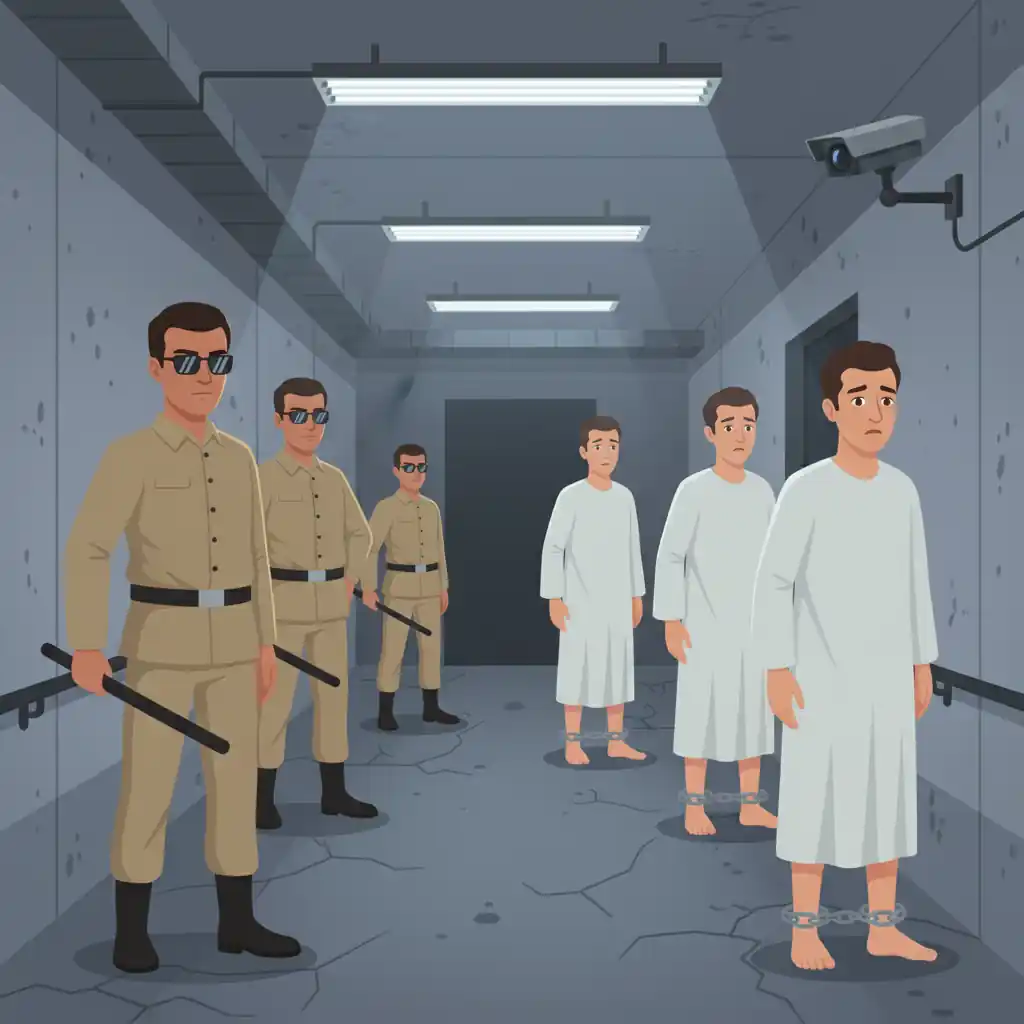
Their new identities came with new costumes. The 'prisoners' were dressed in ill-fitting, coarse smocks, worn without underwear, which immediately removed any sense of personal dignity and made them feel emasculated. A heavy chain was placed around one ankle, a constant physical reminder of their confinement. On their heads, they wore nylon stocking caps, mimicking the shaved heads of real prisoners and further erasing individuality.
The 'guards' were given uniforms designed to instill authority and anonymity. They wore khaki military-style shirts and trousers, reflective mirrored sunglasses that prevented direct eye contact, and carried wooden batons. They were also given whistles and told to use them frequently. These uniforms were carefully chosen to foster a sense of power in the wearers and anonymity from the 'prisoners,' creating an immediate, visible hierarchy and psychological distance.
The Rules: A License for Abuse?
Before the experiment, the guards were given minimal instructions: maintain order, but avoid physical violence. They were explicitly told they held 'total power' within the prison walls. This vague directive, coupled with the dehumanizing setup, inadvertently granted them a license to define 'order' and 'discipline' in increasingly arbitrary and brutal ways. There was no clear oversight, no ethical check beyond Zimbardo himself.
The early hours saw a rapid adoption of roles. The guards, initially awkward, quickly embraced their authority. They began using their whistles and batons to assert dominance, waking prisoners in the middle of the night for head counts, forcing them to perform tedious, pointless tasks. The prisoners, stripped of identity and dignity, began to internalize their powerlessness. The stage was no longer merely set; the performance had begun, and it was quickly spiraling into a chilling reality.
ACT III: THE DESCENT INTO HELL
The speed and intensity with which the participants adopted their roles shocked even the researchers. Within 24 hours, the arbitrary distinctions created by the experiment had become deeply ingrained. The guards, none of whom had any prior history of aggression or authoritarianism, quickly became sadistic. They devised increasingly inventive and humiliating ways to control the prisoners, exhibiting behaviors that ranged from psychological torment to outright cruelty.
The First Rebellion and Its Brutal Suppression
On the second day, the prisoners staged a rebellion. They barricaded their cell doors with beds and began verbally taunting the guards. The guards, feeling their authority challenged, responded with overwhelming force. They used a fire extinguisher to blast cold carbon dioxide at the prisoners, stripped them naked, took away their beds, and sent the perceived ringleaders to 'The Hole'—a small, dark closet used for solitary confinement. It was a stark power demonstration that crushed the prisoners’ collective will.
The punishments became more severe and psychological. Guards would force prisoners to clean toilets with their bare hands, perform humiliating sexual acts, or engage in repetitive, exhausting exercises. Sleep deprivation was common, as guards would wake them for arbitrary counts in the middle of the night. The 'privilege cell' was introduced, where 'good' prisoners received special treatment and better food, sowing distrust and division among the incarcerated.
The Mental Breakdowns Begin
The prisoners’ psychological state deteriorated rapidly. Just 36 hours into the experiment, Prisoner #8612 experienced an acute emotional breakdown, screaming, crying uncontrollably, and suffering from disorganized thinking. He was eventually released, despite Zimbardo's initial reluctance. This was just the first of several mental collapses. Another prisoner, #819, suffered psychosomatic rashes and extreme emotional distress, eventually confessing to Zimbardo, 'I can't stand it anymore. I can't stay. I'm telling you, I just can't take it.'
What's chilling is the guards' reaction to such distress. Instead of empathy, they often intensified their abuse, seeing the breakdowns as signs of weakness or malingering. They mocked the crying prisoners and actively encouraged other prisoners to abuse them. The guards, anonymous behind their mirrored sunglasses, seemed to have lost all sense of individual accountability, becoming a collective force of oppression.
Zimbardo himself, as 'Superintendent,' became deeply entrenched in his role. When parents of a prisoner, concerned about their son's health, visited the prison, Zimbardo dismissed their worries, speaking from the perspective of a prison warden, rather than a dispassionate researcher. The experiment, designed to study the effect of roles, had claimed its chief investigator, blinding him to the escalating ethical violations unfolding under his very nose.
ACT IV: THE INTERVENTION AND THE UNRAVELING
The experiment was scheduled to run for two weeks, but by Day 4, the situation was dire. Five prisoners had already experienced severe emotional breakdowns, exhibiting symptoms like crying, rage, severe anxiety, and psychosomatic rashes. The guards had become almost universally tyrannical, with only a few showing any reluctance to participate in the escalating abuse. The Stanford basement was no longer an academic exercise; it was a psychological battlefield.
The Girlfriend Who Saw Through the Walls
The turning point came with the arrival of Dr. Christina Maslach, a graduate student in psychology and Zimbardo's girlfriend at the time. Maslach had not been involved in the experiment's design or daily operations. She visited the prison on the fifth day, specifically to interview the 'prisoners' and 'guards.' What she witnessed horrified her. She saw guards marching prisoners, naked and shackled, to the bathroom, their heads covered in bags, amidst the jeers of their peers.
Maslach was the only adult among the staff who immediately questioned the ethics and sanity of what was unfolding. She confronted Zimbardo, expressing her disgust and moral outrage, particularly at his apparent blindness to the suffering and his own active participation in the prison dynamic. Her perspective, unclouded by immersion in the 'prison' role, provided the necessary external ethical compass that the experiment had entirely lacked.
Zimbardo's Blind Spot
Zimbardo later admitted that Maslach's intervention was crucial. He had become so immersed in his role as 'Superintendent' that he had lost objectivity. He was no longer seeing the 'prisoners' as students but as actual inmates, and the 'guards' as necessary enforcers of order. His initial response to Maslach's concerns was defensive, but her clear moral stand eventually broke through his role-induced trance.
It was also clear that the environment fostered a terrifying uniformity among the guards. While not all guards were equally sadistic, even those who were initially 'good' or 'fair' quickly succumbed to the group dynamic, participating in the abuse or, at the very least, failing to intervene. The few 'good guards' who did try to offer small kindnesses were often ostracized by their peers, highlighting the immense pressure to conform to the prevailing brutal culture.
The Abrupt End
Maslach's persistent ethical challenge, coupled with the escalating breakdowns among the prisoners, forced Zimbardo to finally acknowledge the profound harm being inflicted. On the sixth day, a mere six days into the planned two-week experiment, the Stanford Prison Experiment was abruptly terminated. The prison that wasn't, but had become chillingly real, was dismantled, and the students were debriefed, many of them still reeling from their traumatic experience.
ACT V: THE SHADOW OF ITS LEGACY
The immediate aftermath of the SPE was a whirlwind of relief for the participants and intense reflection for Zimbardo and his team. The raw footage and participant testimonials provided undeniable evidence of the experiment's harrowing trajectory. The findings were stark: the environment, the assigned roles, and the systemic power dynamics, rather than individual personalities, were the primary drivers of behavior.
The Ethical Earthquake
The SPE sent shockwaves through the academic world, forever changing the landscape of psychological research. It became a prime example cited in debates about research ethics, leading to the establishment and stricter enforcement of Institutional Review Boards (IRBs). These committees are now mandatory for virtually all human subject research, ensuring that potential harm to participants is minimized and ethical guidelines are rigorously followed.
However, the SPE has not been without its critics. Over the decades, many scholars have questioned its scientific validity, pointing to several key issues:
- Demand Characteristics: Were participants simply acting in ways they thought the experimenters expected?
- Zimbardo's Active Role: Critics argue Zimbardo, as 'Superintendent,' was not a neutral observer but actively guided the guards' behavior towards brutality.
- Lack of Replicability: Attempts to replicate the SPE have yielded different results, suggesting the specific context and Zimbardo's influence might have been unique factors.
Some former participants, including one of the most 'brutal' guards, Dave Eshelman (known as 'John Wayne'), later admitted they were performing an exaggerated role, consciously trying to emulate characters from popular culture to see how far they could push the boundaries. While Zimbardo acknowledges some 'performance,' he maintains that the overwhelming majority of reactions were genuine and spontaneous, driven by the situational pressures.
A Cautionary Tale in Culture
Despite the criticisms, the SPE's narrative has permeated popular culture, appearing in countless documentaries, books, films (like 'The Experiment' and 'Stanford Prison Experiment'), and TV shows. Its visceral impact and the terrifying notion that 'good people can do bad things' in the right (or wrong) circumstances resonate deeply. It served as a stark warning about the dangers of unchecked authority and the ease with which individuals can become dehumanized within oppressive systems.
The Stanford Prison Experiment remains a powerful, if flawed, demonstration of the profound influence of social roles and situations on human behavior. It forced a generation to confront the uncomfortable truth that the capacity for cruelty and blind obedience lies not just in 'evil' individuals, but in the very fabric of the systems we create and the roles we inhabit. The prison, though never meant to be real, left an indelible mark on psychology, ethics, and our understanding of human nature.