
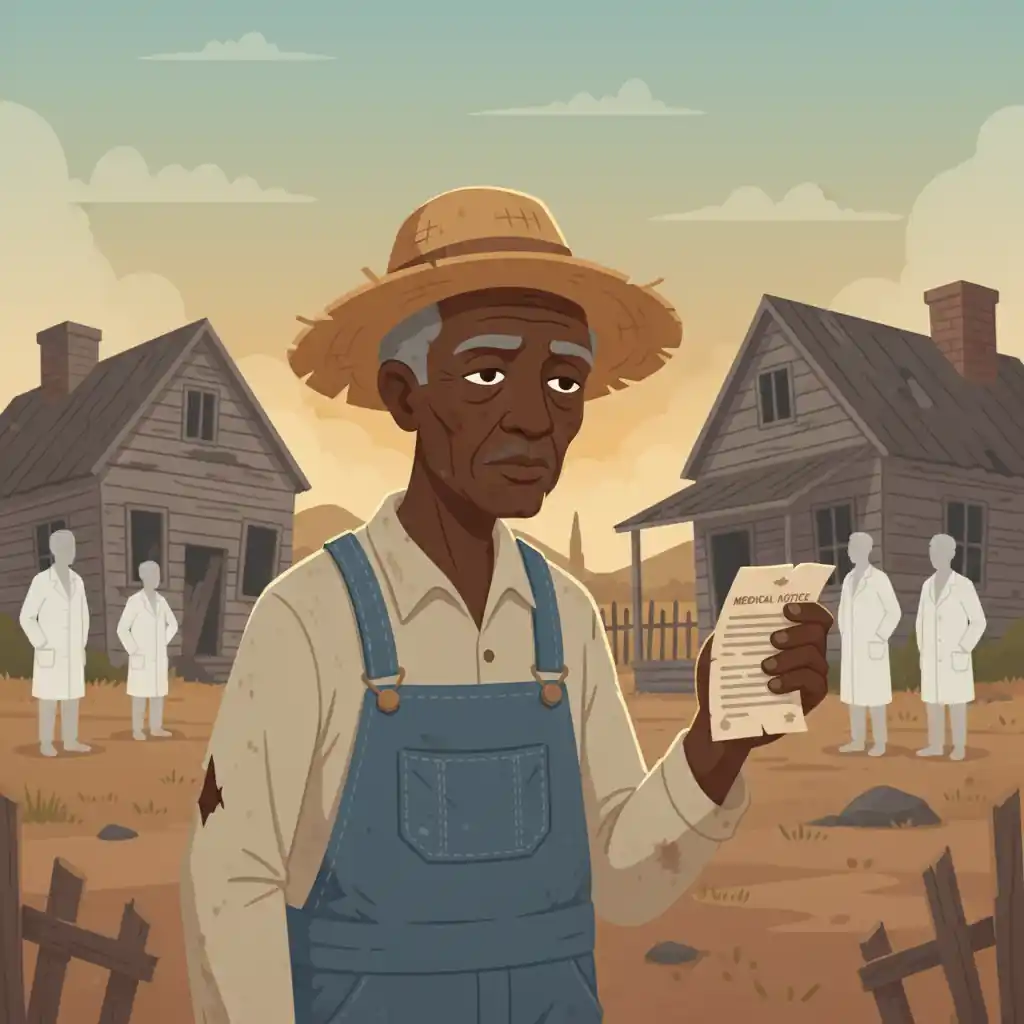
PROLOGUE: THE SILENT KILLER'S SHADOW
The year is 1932. The place is Macon County, Alabama. Nestled deep within the Jim Crow South, it’s a landscape of grinding poverty, sharecropping, and stark racial inequality. Here, the 'invisible enemy' was not just economic hardship or social injustice; it was also a silent, insidious disease known as syphilis.
For centuries, syphilis had ravaged humanity. Its grotesque progression—from skin lesions to organ failure, blindness, insanity, and ultimately, death—earned it fearsome nicknames like 'the Great Pox' and 'the French Disease.' In rural Black communities, where medical care was a luxury and education often denied, myths and misinformation about 'bad blood' often obscured the true nature of the illness.
It was into this vulnerable demographic that a team of government doctors from the U.S. Public Health Service (PHS) arrived, promising hope. They offered free medical care, free meals, and even burial stipends to hundreds of impoverished Black men. To these men, who rarely saw a doctor and often suffered from multiple ailments, it sounded like a blessing, a benevolent intervention from a world that had largely ignored them. But behind the facade of philanthropy lay a chilling secret.
What began as a six-month study of untreated syphilis in Black men, intended to be followed by treatment, morphed into a forty-year human experiment. These men, trusting in the white coats and the government seal, became unwitting subjects in one of the darkest chapters of American medical history. They were not just observed; they were deliberately left to suffer, their agony meticulously documented for 'science,' even as effective treatments became readily available. This is the story of The Tuskegee Deception, a betrayal that poisoned the well of trust for generations.
ACT I: EUGENICS, 'BAD BLOOD,' AND THE ROOTS OF BETRAYAL
To understand how such an atrocity could unfold, we must first contextualize the era. The early 20th century in America was steeped in pseudo-scientific racism and the insidious doctrines of eugenics. This 'science' promoted the idea of improving the human race through selective breeding, and in practice, it often meant demonizing and controlling marginalized groups, especially African Americans.
Medical literature of the time frequently depicted Black people as inherently less intelligent, more promiscuous, and more prone to disease, often attributing these traits to biological inferiority. It was believed that Black bodies reacted differently to disease, requiring different medical approaches—or, in the case of syphilis, that their symptoms were somehow less severe or that their unique 'racial constitution' meant they couldn't tolerate standard treatments.
The specific genesis of the Tuskegee Study traces back to a previous, ostensibly humanitarian effort. In 1929, the Julius Rosenwald Fund launched a program to control syphilis among rural Black communities in the South, primarily in five counties in Georgia and one in Alabama (Macon County, home of the Tuskegee Institute). When the Great Depression hit, the Rosenwald Fund withdrew its support, leaving thousands of diagnosed individuals without treatment.
The PHS, which had been a partner in the Rosenwald effort, was left with a dilemma: what to do with the untreated syphilitic men in Macon County? Instead of seeking funds to continue treatment, a shocking proposal emerged: why not simply observe them? The prevailing medical belief was that syphilis in Black men had a 'benign' course, rarely affecting the central nervous system. This unfounded theory provided a twisted rationale. Researchers wanted to understand the 'natural history' of the disease, effectively using living human beings as biological specimens.
Dr. Thomas Parran, Jr., then head of the PHS Venereal Disease Division, famously stated, 'The Negro is not going to have his syphilis treated anyway.' This sentiment, pervasive among white medical professionals, laid the groundwork for the ultimate deception. The study was not about finding a cure, or even testing a treatment. It was about observation, documentation, and a perverse form of 'scientific curiosity' that utterly disregarded human dignity. The stage was set for a four-decade experiment in medical racism, cloaked in the guise of public health.
ACT II: THE PROMISE OF 'FREE TREATMENT' AND THE SHIFT TO BETRAYAL
The Tuskegee Study of Untreated Syphilis in the Negro Male began in 1932. Its initial stated goal, deceptively, was to track the disease and then offer treatment. This façade was crucial for gaining the trust of a deeply impoverished and medically underserved population. The PHS collaborated with the Tuskegee Institute, a historically Black college renowned for its commitment to education and health in the Black community. This partnership lent an air of legitimacy and comfort to the rural Black men who would become the study’s subjects.
Approximately 600 Black men were recruited: 399 who had latent syphilis and 201 who were syphilis-free and served as a control group. The men were enticed with promises of 'free treatment' for 'bad blood'—a local euphemism for various ailments, including syphilis, anemia, and fatigue. They were also offered free transportation to clinics, free hot meals, and, most crucially, free burial insurance for their families upon their death, a significant incentive in a community where funerals were often financially devastating.
Crucially, the men were never informed they had syphilis. Instead, they were told they had 'bad blood' and were undergoing 'special free treatment.' The actual 'treatment' consisted of painful spinal taps, presented as diagnostic tests necessary for their condition, but which in reality offered no therapeutic benefit. These invasive procedures were conducted primarily to observe the neurological effects of syphilis, not to cure it.
As the study progressed, a horrifying decision was made: to indefinitely withhold effective treatment. Even when penicillin, a miraculous cure for syphilis, became widely available in the 1940s, it was explicitly denied to the men in the Tuskegee Study. PHS doctors actively prevented these men from accessing penicillin, even intercepting draft notices to prevent them from being treated by military doctors, and advising local physicians not to treat them. This was not a passive omission; it was an active, deliberate policy of non-intervention.
The moral compass of the medical professionals involved was shattered. They prioritized the observation of the disease's natural progression over the lives and well-being of their human subjects. The original six-month observational study had mutated into a multi-decade ethical nightmare, fueled by racial prejudice and a chilling indifference to human suffering. The men of Macon County were no longer patients; they were data points in a horrifying experiment.
ACT III: THE DECADES OF SUFFERING AND INSTITUTIONAL COMPLICITY
For four long decades, from 1932 to 1972, the Tuskegee Study continued its grim work. The lives of the 399 men with syphilis were systematically documented as the disease slowly, inexorably, ravaged their bodies. Researchers observed as their subjects developed heart problems, neurological damage, blindness, mental illness, and other debilitating conditions, ultimately leading to agonizing deaths. The wives of many subjects also contracted syphilis, and some of their children were born with congenital syphilis, suffering the consequences of a disease that could have been easily cured.
The study was not a clandestine operation. Its findings were published in leading medical journals for decades, reviewed by countless medical professionals, and supported by various government agencies. These included the Centers for Disease Control and Prevention (CDC), the Alabama State Board of Health, and even elements within the Tuskegee Institute itself, particularly its hospital and nursing staff who facilitated the examinations.
One central figure in the study was Nurse Eunice Rivers, a Black public health nurse from the Tuskegee Institute. She was instrumental in maintaining the trust of the men, acting as a liaison between them and the PHS doctors. While her role is complex, seen by some as a compassionate caregiver and by others as a facilitator of the deception, her presence undeniably helped to perpetuate the study. Her intimate knowledge of the community and her rapport with the men ensured their continued participation, even as they suffered.