
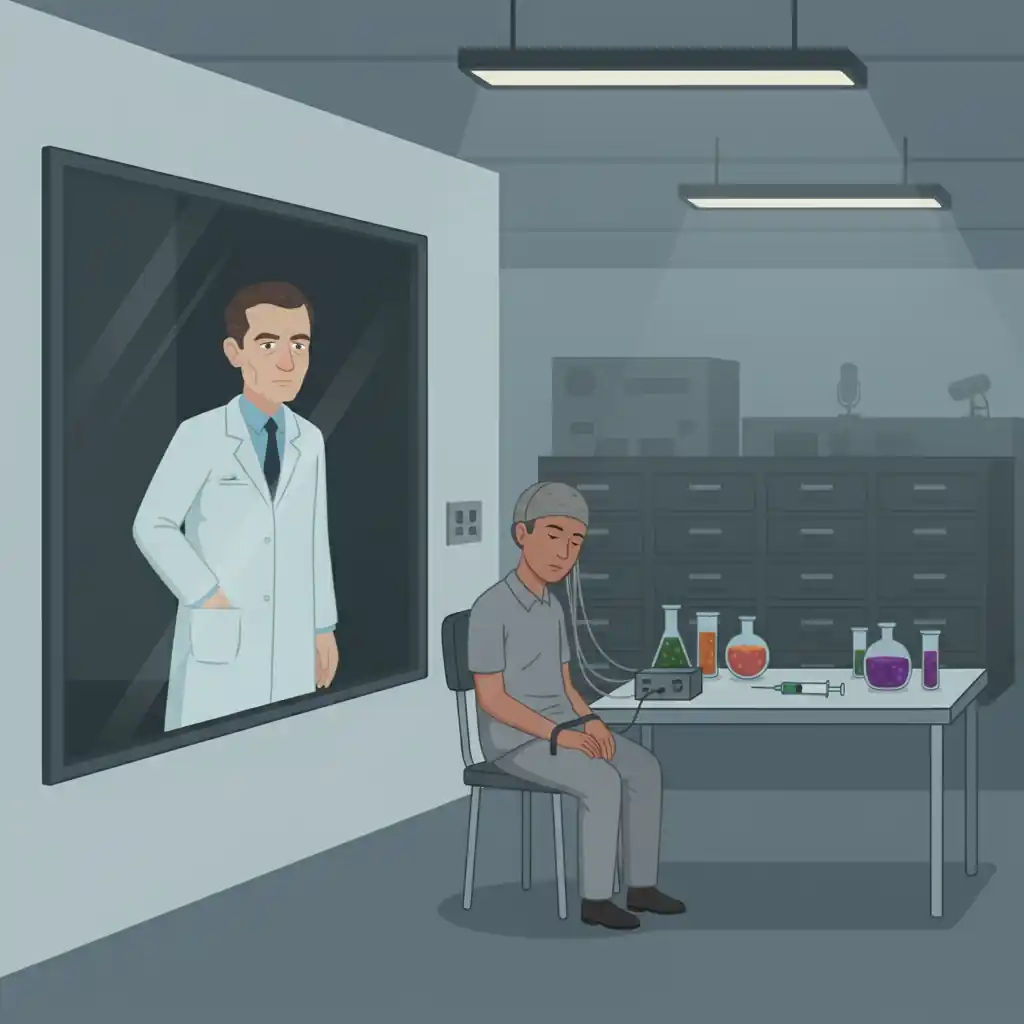
PROLOGUE: THE SHADOW WARRIORS' NEW FRONTIER
The year is 1951. The Cold War is a silent, simmering cauldron of paranoia and suspicion. The specter of a new kind of war—a war for the very minds of men—haunted the halls of Washington. The Korean War had just introduced the terrifying concept of 'brainwashing,' and suddenly, the unthinkable became the imperative: if the enemy could control minds, so too must the United States. This desperate fear forged the chilling directive that birthed Project ARTICHOKE.
The idea wasn't a super soldier in the comic book sense, enhanced with bionics or gamma radiation. No, this was far more insidious: a 'super asset' or a 'controllable operative.' Imagine an agent who could withstand any interrogation, or better yet, one who could be programmed to carry out a mission and then forget it, or even self-destruct. The concept was as seductive as it was terrifying, and the CIA, newly formed and eager to prove its mettle, was ready to delve into the darkest corners of human psychology to achieve it.
This wasn’t merely about extracting information; it was about the ultimate manipulation: altering personalities, creating amnesia, inserting false memories, or compelling individuals to act against their conscious will. The stakes were nothing less than national security, and in this shadow war, ethics were often considered a dangerous luxury.
The journey into Project ARTICHOKE was a descent into a moral abyss, fueled by fear, unbridled ambition, and a chillingly detached scientific curiosity. It was a secret chapter in history where the human mind itself became the ultimate battleground.
ACT I: THE BIRTH OF ARTICHOKE - WEAPONIZING THE MIND
Project ARTICHOKE formally kicked off in 1951, approved by none other than then-CIA Director Allen Dulles. It wasn't born in a vacuum; it evolved from earlier, smaller-scale CIA endeavors like Project CHATTER (1947-1953) and Project BLUEBIRD (1950-1951), both of which explored the use of drugs and hypnosis for interrogation.
The initial objective of ARTICHOKE was breathtakingly ambitious: to create a method by which a person could be controlled to perform actions involuntarily, to be a 'human robot' in essence. This included the ability to force confessions, erase memories, implant new identities, or even induce suicide without the subject's conscious awareness or memory.
Early research focused heavily on hypnosis, often combined with what they called 'narco-hypnosis' – using 'truth serums' like sodium amytal or pentothal to make subjects more susceptible. The idea was that under this combined influence, an individual's will could be bypassed, their defenses lowered, and their secrets extracted or new commands implanted. The belief in the almost magical power of hypnosis to utterly control a person, like a puppet on a string, was surprisingly strong among these early operatives.
The subjects for these initial experiments were often individuals considered 'expendable' or 'easily controlled.' This included captured foreign agents, suspected spies, and, more disturbingly, unwitting American citizens. Some sources suggest that terminally ill patients in hospitals and inmates in prisons were also used, all without informed consent, their vulnerabilities exploited in the name of national defense.
The operations were designed to be utterly deniable. The CIA established a front organization, the Society for the Investigation of Human Ecology, to funnel funds and provide a veneer of academic legitimacy to the truly black-ops research. This allowed them to tap into universities and hospitals, drawing in researchers who were often unaware of the true nature or ultimate purpose of their work.
One of the bizarre early hypotheses of Project ARTICHOKE was that a subject could be induced to commit assassination under hypnosis, only to have no memory of the act afterwards. They were essentially trying to create 'sleeper agents' or 'Manchurian candidates' decades before the popular novel and film even existed.
ACT II: THE PHARMACEUTICAL FRONTIER - DRUGS AND DECEPTION
As the initial probes into hypnosis yielded limited, inconsistent results for full mind control, ARTICHOKE's focus rapidly shifted towards the potent allure of psychotropic drugs. The CIA became particularly enamored with LSD, a newly discovered compound with unprecedented mind-altering properties, and believed it might hold the key to unlocking or even breaking the human psyche.
The agency began stockpiling massive quantities of LSD from Swiss pharmaceutical companies. Their goal wasn't just to use it as a truth serum, but to explore its potential for 'depatterning' the mind—shattering an individual's sense of self and reality, leaving them vulnerable to new programming. Beyond LSD, the program experimented with a frightening pharmacopeia: mescaline, psilocybin, scopolamine, heroin, marijuana, and various barbiturates and amphetamines, often in dangerous combinations.
The experiments were disturbingly unscientific and often reckless. Subjects were dosed without their knowledge or consent, in what the CIA chillingly called 'black bag' operations. Agents would spike drinks in bars or at parties, then observe the effects. The infamous Operation Midnight Climax was a series of safe houses set up in San Francisco and New York, disguised as brothels, where unwitting men were lured, given LSD, and then secretly observed behind one-way mirrors as they interacted with prostitutes. The goal was to study the effects of LSD on sexual behavior and confession under duress, all while gathering 'dirty data' for potential blackmail.
The consequences for these unwitting subjects were often catastrophic. Many experienced prolonged psychosis, severe psychological trauma, and long-term personality changes. Some even died. The agency simply observed, documented, and moved on, driven by the perceived urgency of the Cold War and a shocking lack of moral accountability. The overriding fear of the Soviets developing similar techniques seemed to justify any means necessary.
These drug experiments weren't just about truth extraction; they were about exploring the limits of human resilience under chemical assault. Can memories be erased? Can loyalty be reversed? Can a person be made to forget their own identity? ARTICHOKE sought to answer these questions, regardless of the human cost.
One bizarre ARTICHOKE test involved administering LSD to two men and then having them play chess. The observation notes meticulously detailed their deteriorating cognitive abilities and increasingly irrational behavior, a grim 'fun fact' highlighting the program's detached, experimental nature.
ACT III: THE SCIENCE OF SUFFERING - TORTURE AND TRAUMA
As ARTICHOKE progressed, the experimentation moved beyond chemical manipulation alone. Researchers began to combine drugs with extreme forms of psychological and physical torture, creating a truly chilling arsenal of mind-breaking techniques. The goal was to utterly dismantle a person's established identity and then, theoretically, rebuild it to suit agency objectives.