
PROLOGUE: THE SUMMER CAMP OF SECRETS
Imagine a sweltering July in 1954, deep within the rugged, pine-studded hills of Robbers Cave State Park, Oklahoma. Twenty-two bright-eyed, seemingly ordinary eleven-year-old boys arrived, ready for what they believed would be an idyllic summer camp experience. They looked forward to swimming, hiking, and the simple joys of childhood freedom. But this was no ordinary summer camp. It was a meticulously crafted psychological stage, a human terrarium designed to expose the raw, tribal heart of humanity. Unbeknownst to these innocent participants, they were about to become unwitting actors in one of social psychology's most controversial and groundbreaking experiments.
The man behind this audacious undertaking was Muzafer Sherif, a Turkish-American psychologist haunted by the specter of global conflict and the rise of fascism. Sherif was convinced that prejudice and intergroup hostility weren't inherent flaws in human nature but rather products of specific social conditions. He sought to prove this by deliberately creating conflict among well-adjusted children, and then, if possible, resolving it.
The very premise was audacious, even chilling: to take healthy, stable boys, engineer their separation, foster group loyalty, and then, with surgical precision, introduce a rival group to ignite a firestorm of animosity. The ethical tightrope Sherif walked was fraught with peril, raising questions that still echo today about the lengths to which science should go in pursuit of profound truth. This wasn't just observation; it was active, calculated manipulation of young minds, all to understand how quickly 'us' could become 'them,' and how deeply ingrained that division could become.
The Robbers Cave Experiment wasn't merely a study of boys at camp; it was a microcosm of a world struggling with war, racial tension, and ideological divides. Its findings would shake the foundations of sociological thought, revealing both the terrifying ease with which prejudice can be manufactured and the hopeful, albeit challenging, pathways to peace. The boys would leave Robbers Cave, but the lessons learned there would reverberate through the halls of academia, influence civil rights movements, and inform countless strategies for conflict resolution. The quiet Oklahoma park would forever be etched into history as 'The Cave of Conflict.'
ACT I: THE ARCHITECTS OF ANTAGONISM
The mastermind, Muzafer Sherif, was a figure forged in the crucible of turbulent geopolitics. Born in Turkey in 1906, he witnessed firsthand the collapse of the Ottoman Empire, the rise of nationalism, and the ensuing conflicts. These experiences instilled in him a profound desire to understand the psychological roots of intergroup conflict and cooperation. He earned his Ph.D. from Harvard but was heavily influenced by the German Gestalt school of psychology, which emphasized understanding phenomena in their entirety rather than as isolated parts.
Sherif's prior work, notably his autokinetic effect studies, had already demonstrated how quickly individuals conform to group norms, even when those norms are entirely arbitrary. Now, he wanted to push the boundaries further, to create group identity and intergroup conflict from scratch in a controlled, naturalistic setting. This wasn't just about observation; it was an experiment in social engineering, a bold attempt to reverse-engineer prejudice.
The Chosen Twenty-Two: Innocence on the Altar of Science
The participants were crucial. Sherif and his team meticulously selected 22 eleven-year-old boys, all from stable, middle-class Protestant families in Oklahoma City. They were chosen specifically because they were well-adjusted, of similar intelligence, and had no history of behavioral problems or disciplinary issues. There were no 'troublemakers' or 'outsiders'; these were 'good boys,' handpicked to ensure any resulting conflict wasn't due to pre-existing individual pathologies but rather the experimental conditions themselves. The boys were, in essence, psychological blank slates, ripe for the inscription of group identity and antagonism.
The Stage is Set: Robbers Cave State Park
Robbers Cave, with its rugged terrain and relative isolation, was the perfect natural laboratory. The boys arrived in two separate groups, kept deliberately ignorant of the other's existence. The research staff, comprised of trained psychologists and graduate students, posed as camp counselors, blending seamlessly into the background, observing every interaction, and taking meticulous notes. These 'counselors' were, in fact, the chief manipulators, subtly guiding the experiment's progression. Their role was a delicate dance, allowing conflict to develop naturally while ensuring it never spiraled into genuine physical harm.
The first phase of the experiment was dedicated to in-group formation. Each group of boys spent roughly a week independently, bonding over typical camp activities like swimming, hiking, and cooking out. They developed their own distinct cultures: choosing group names, designing flags, composing group songs, and establishing internal hierarchies. One group named themselves the 'Rattlers,' embracing the rugged image of their namesake with a fierce, almost militaristic pride. The other group, equally enthusiastic, chose the name 'Eagles,' symbolizing aspiration and dominance.
During this initial bonding phase, the boys were allowed to vote on their group names. The names 'Rattlers' and 'Eagles' weren't imposed; they emerged organically from the boys' discussions, unknowingly aligning perfectly with the researchers' need for distinct, identifiable groups.
ACT II: THE SEEDING OF SEPARATION
The initial days at camp were idyllic within each group. The Rattlers, a boisterous bunch, quickly established themselves, building a diving board and working together to improve their campsite. The Eagles, more reserved but equally competitive, set up their own distinct camp and fostered a strong sense of unity. Both groups developed internal norms, leaders, and even their own slang. They truly became cohesive units, each with a burgeoning sense of collective identity and pride.
But the true experiment began when the researchers subtly introduced the notion of an 'other.' Initial hints were dropped: 'You know, we think there might be another group of boys somewhere else in the park.' The staff, posing as counselors, would casually mention findings – a dropped lunch sack, a stray softball – suggesting the presence of another group. The seeds of curiosity, then rivalry, were meticulously sown.
The Discovery: From Curiosity to Contempt
The moment of 'discovery' was carefully orchestrated. The Rattlers, while on a hike, stumbled upon the Eagles' campsite. The initial reaction was a mixture of surprise and territoriality. This wasn't just another group of kids; these were outsiders intruding on their space. The counselors recorded a palpable shift in demeanor, a newfound defensiveness.
Sherif then moved to the second, most critical phase: the friction phase. He introduced a series of competitive events designed to bring the two groups into direct conflict. These weren't friendly competitions; they were zero-sum games with highly desirable prizes – medals, knives, and trophies – awarded only to the winners. The losers received nothing. The setup was engineered to foster a sense of 'us vs. them,' where one group's gain was explicitly the other's loss.
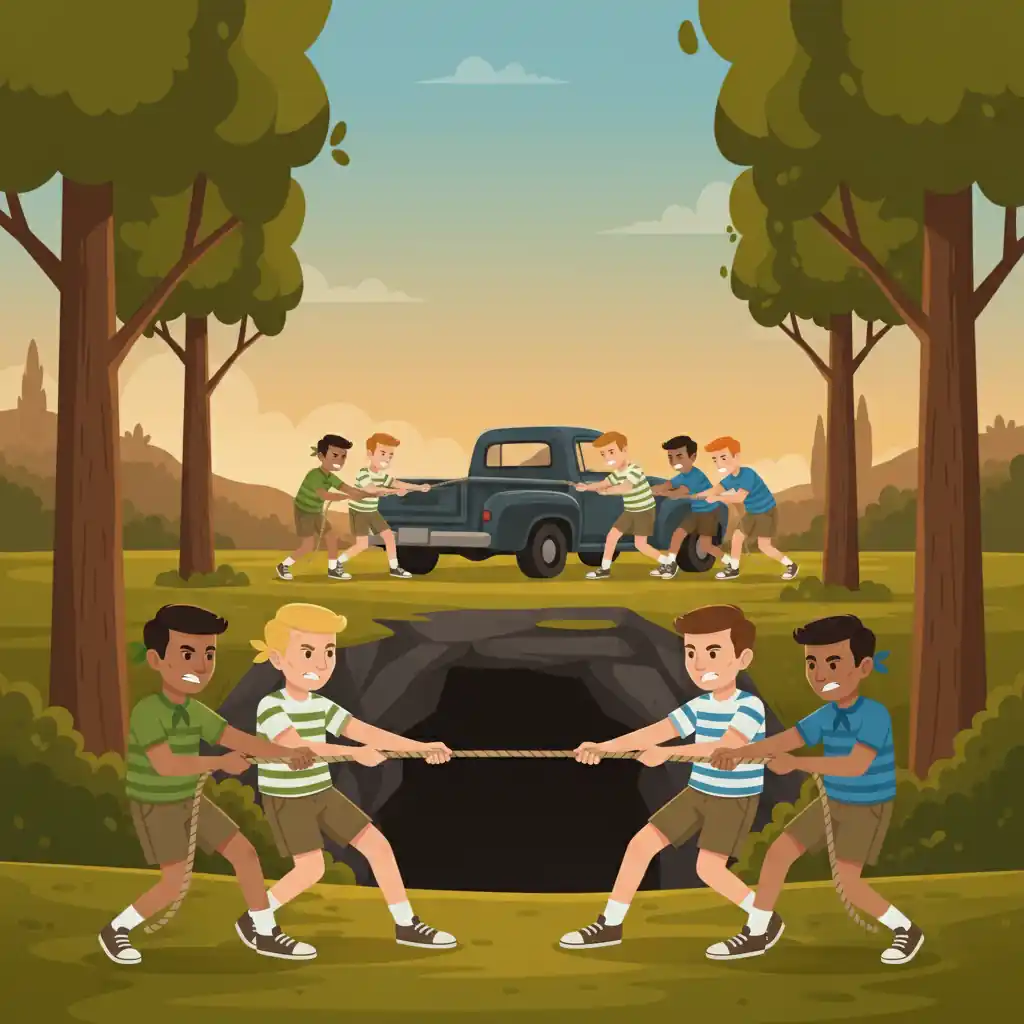
The first competition was baseball, followed by tug-of-war, a treasure hunt, and a competitive tent pitching contest. As the games progressed, the atmosphere soured. What began as spirited rivalry quickly devolved into overt hostility. The groups started to hurl insults at each other: 'Stinkers!' 'Braggarts!' 'Sissies!' The Eagles proudly chanted, 'We're the Eagles, we're the best, we're the ones to beat the rest!' The Rattlers responded with equal fervor, 'Snakes! Snakes! Snakes! We're gonna beat you up, snakes!'
The 'counselors' subtly fanned the flames. For example, if one group excelled, the 'counselors' would praise them, reinforcing their sense of superiority over the other. If one group made a mistake, the 'counselors' would note it, feeding into the other group's perception of their rivals' incompetence. Every interaction, every comment, was a deliberate data point, observing how quickly perceived threats and competition could morph into ingrained prejudice.
The researchers initially proposed a series of friendly interactions, like sharing meals and watching movies together, as a way to *introduce* the groups. However, Sherif's intuition, based on his theory, correctly predicted that without a superordinate goal, these interactions would only provide more opportunities for friction. He scrapped the 'friendly introduction' phase, moving directly into competition to accelerate the conflict.
ACT III: THE BATTLE FOR THE CAVE
The carefully constructed friction phase quickly escalated beyond mere verbal taunts. The competitive games fueled an intense us-vs-them mentality. When the Eagles won the baseball game, the Rattlers refused to shake hands, calling them 'cheaters.' The lines were drawn, and the 'other' group was no longer just a rival; they were an enemy. This was the raw, unvarnished display of intergroup conflict Sherif had sought, and it was playing out in real-time among innocent eleven-year-olds.