
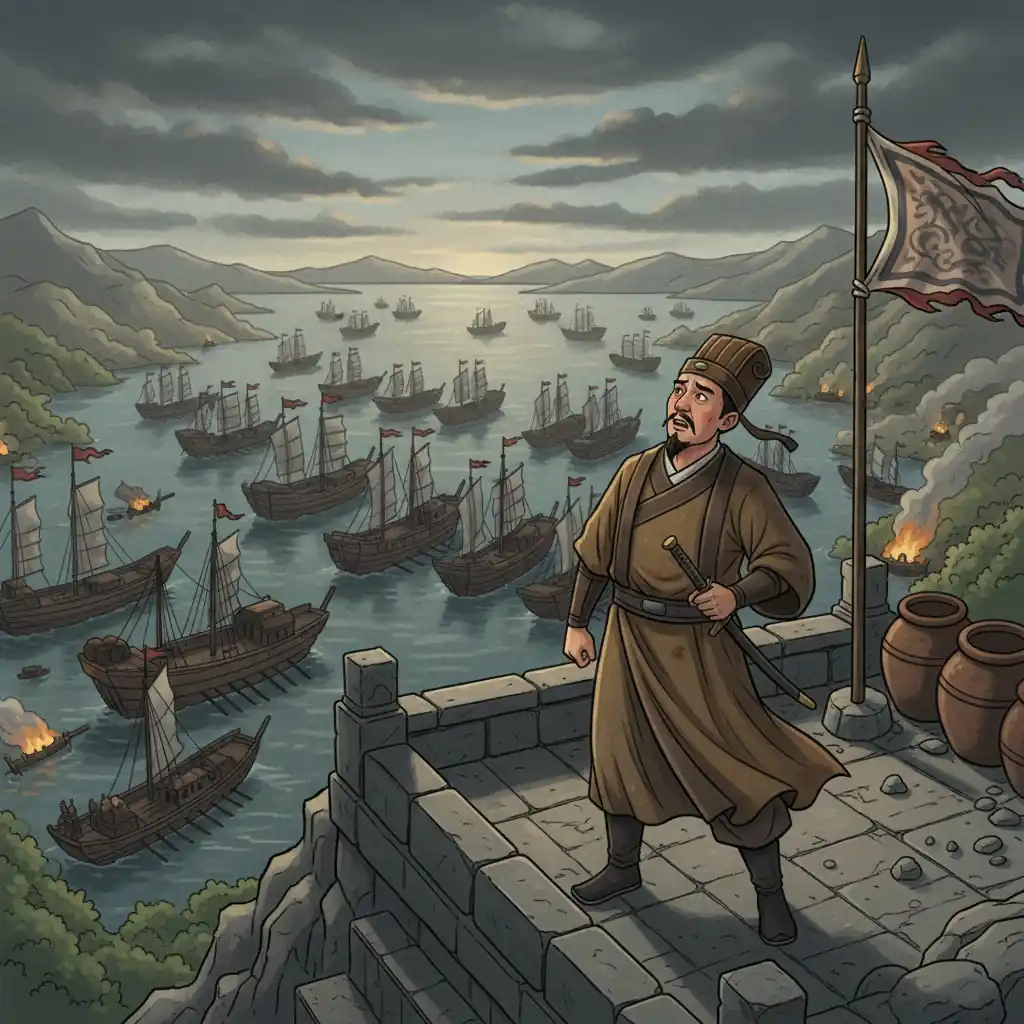
The Looming Storm
The year was 208 AD. China was a fractured land, scarred by war. In the north, the powerful warlord Cao Cao had consolidated his power. He now looked south, hungry for total dominion. His ambition was vast, his army even vaster. He commanded an army of hundreds of thousands, a seemingly endless tide of soldiers and a fleet of over two thousand war junks.
Against this colossal force stood the allied armies of Sun Quan, the 'Tiger of Jiangdong,' and Liu Bei, a descendant of the Han imperial family. Their combined forces were a fraction of Cao Cao's — perhaps fifty thousand men and a few hundred ships. They were outnumbered, outgunned, and cornered on the Yangtze River near a place called Red Cliffs.
Defeat seemed inevitable. Cao Cao's ships, many of them requisitioned from the northern provinces, were filled with soldiers unaccustomed to naval warfare. To combat their seasickness and maintain formation, Cao Cao made a crucial decision: he ordered his ships to be chained together, bow to stern, deck to deck. A truly massive, floating fortress. He thought it a stroke of genius.
For the allied strategists, Zhou Yu of Sun Quan's forces and Zhuge Liang of Liu Bei's, this seemingly invincible formation was both a nightmare and a glimmer of hope. Direct confrontation was suicide. They needed a plan that defied logic, a strategy that turned Cao Cao’s strength into his greatest weakness.
The Fire Plan
Zhou Yu, Sun Quan's brilliant chief commander, conceived a daring plan: a fire attack. If they could set just a few of Cao Cao’s chained ships ablaze, the fire would spread like wildfire through the entire fleet. The chains, meant to secure, would become conduits of destruction, trapping Cao Cao’s army in an inferno.
The preparations began. They prepared small, swift boats packed with kindling, bundles of dry reeds soaked in oil, and potent sulfur. Fighters were ready, disguised as defectors, ready to ignite the traps. Everything was meticulously arranged. The soldiers were briefed, the ships were provisioned, and the attack time was set.
Zhou Yu surveyed his fleet, then looked across the river at the immense, unsuspecting enemy. He had accounted for every detail: the currents, the timing, the enemy’s complacency. Victory, he felt, was within their grasp. All the pieces were in place. The trap was perfectly sprung.
The Missing Breeze
But as the day of the attack approached, a cold dread settled over Zhou Yu. He stood on the deck of his flagship, watching the flags ripple in the persistent, unforgiving wind. It blew, steadily and strongly, from the northwest. Day after day, the wind pushed from Cao Cao's position towards their own.
A fire attack required the wind to carry the flames toward the enemy. If they launched their burning ships now, the wind would blow the fire right back at their own fleet, their own shore, their own men. It would be an act of self-immolation, a catastrophic blunder that would doom their armies.