
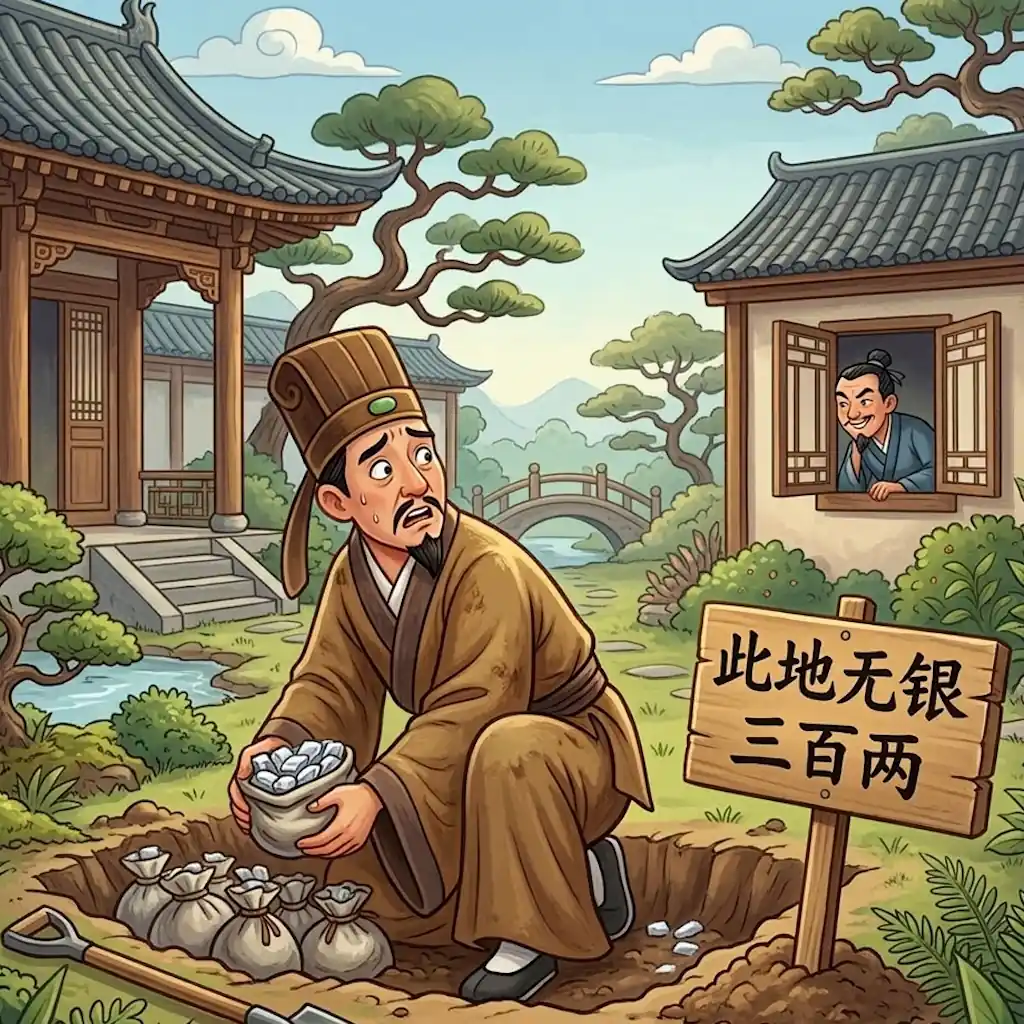
The Midnight Digging
Two thousand years ago, in a village where the mud stayed wet long after the rain stopped, a man named Zhang San lived in a state of perpetual vibration. He wasn't a criminal, and he wasn't a king. He was something much more stressed: a man who had suddenly come into possession of three hundred taels of silver.
In a village where everyone knew the color of their neighbor’s tea, 300 pieces of silver was a loud, heavy secret. To Zhang San, every floorboard in his house sounded like a warning. Every gust of wind against his door sounded like a thief’s fingers. He spent three nights staring at his hoard, watching the moonlight glint off the metal, realizing that wealth isn't just power—it’s a target.
He couldn't keep it in the house. He needed the earth to hold it.
Under the cover of a cloud-veiled moon, Zhang San carried his heavy wooden box to the furthest corner of his backyard. He dug. The soil was thick and resistant, but his paranoia gave him strength. He lowered the silver into the dark maw of the earth and covered it back up. He stepped back, panting, and looked at the patch of ground.
It looked exactly like a place where someone had just buried something valuable.
Zhang San paced the perimeter of his yard. 'If I walk past this, I know it's there,' he reasoned. 'And if I know it's there, surely anyone walking past will see the disturbed dirt and know it's there too.'
His mind began to spin a web of 'what-ifs.' He needed a way to tell people not to look there. He needed to provide a reason for them to keep walking. He went back into his hut, grabbed a wide wooden plank and a brush, and with trembling hands, he painted seven bold characters:
此地无银三百两 (Cǐ dì wú yín sān bǎi liǎng) — 'There are not 300 taels of silver buried here.'
He stood back, admired his handiwork, and finally felt a sense of peace. He had addressed the problem head-on. He believed that if the sign said there is no silver there, the rest of the world would just take his word for it. He had told the truth—or rather, a very specific version of a lie—and now he could sleep.
The Neighbor’s Shadow
Zhang San’s neighbor was a man named Wang Er. Wang Er was not a professional thief; he was simply a man who happened to be outside looking for his escaped goat in the early hours of the morning. He saw the sign. He stopped. He read it once, then twice.
He looked at the sign, then at the fresh dirt, then back at the sign. A man who buries nothing does not need a sign to tell the world he has buried nothing. Wang Er didn't even need to think. He went home, fetched his own shovel, and within twenty minutes, Zhang San’s nightmare had come true. The silver was gone.
But the heavy silence of the empty hole began to gnaw at him. He knew Zhang San would wake up, see the theft, and look directly at the house next door. Panicked by the coming suspicion, Wang Er flipped the wooden plank over and wrote:
隔壁王二不曾偷 (Gébì Wáng Èr bùcéng tōu) — 'Your neighbor Wang Er did not steal this.'
He believed that by putting the denial in writing, Zhang San would not figure that he took the money. He hammered the sign back into the hole, convinced he had successfully cleared his name before the investigation even began.
When Zhang San woke up and saw the empty hole and the new sign, he knew immediately who took his silver. The irony is clear. Two men had tried to cover the truth by explaining more, and in doing so, they had both signed their names to their own foolishness.
The Lesson
When Zhang San woke up and saw the empty hole and the new sign, he knew immediately who took his silver. The irony is clear. Two men had tried to cover the truth by explaining more, and in doing so, they had both signed their names to their own foolishness.
If Zhang San had never put up the sign, Wang Er would likely have never thought to dig in that random patch of dirt. And if Wang Er hadn't felt the need to leave a 'denial' behind, Zhang San would have had no proof of who took it. In their rush to protect themselves with words, they both created the very evidence they were trying to hide.
In modern Chinese culture, this proverb is the ultimate 'gotcha.' It describes the act of Explaining Too Much—trying so hard to hide the truth with words that the words themselves become the evidence. It is the linguistic equivalent of a guilty conscience shouting in a quiet room.
- 此地 (Cǐ dì): This place.
- 无 (Wú): Does not have.
- 银 (Yín): Silver.
- 三百两 (Sān bǎi liǎng): Three hundred taels.
The tragedy of Zhang San wasn't his lack of security; it was his lack of silence.
The more energy you spend denying something, the more weight you give to the suspicion. The most effective way to keep a secret is to act as if there is **nothing to keep**.