
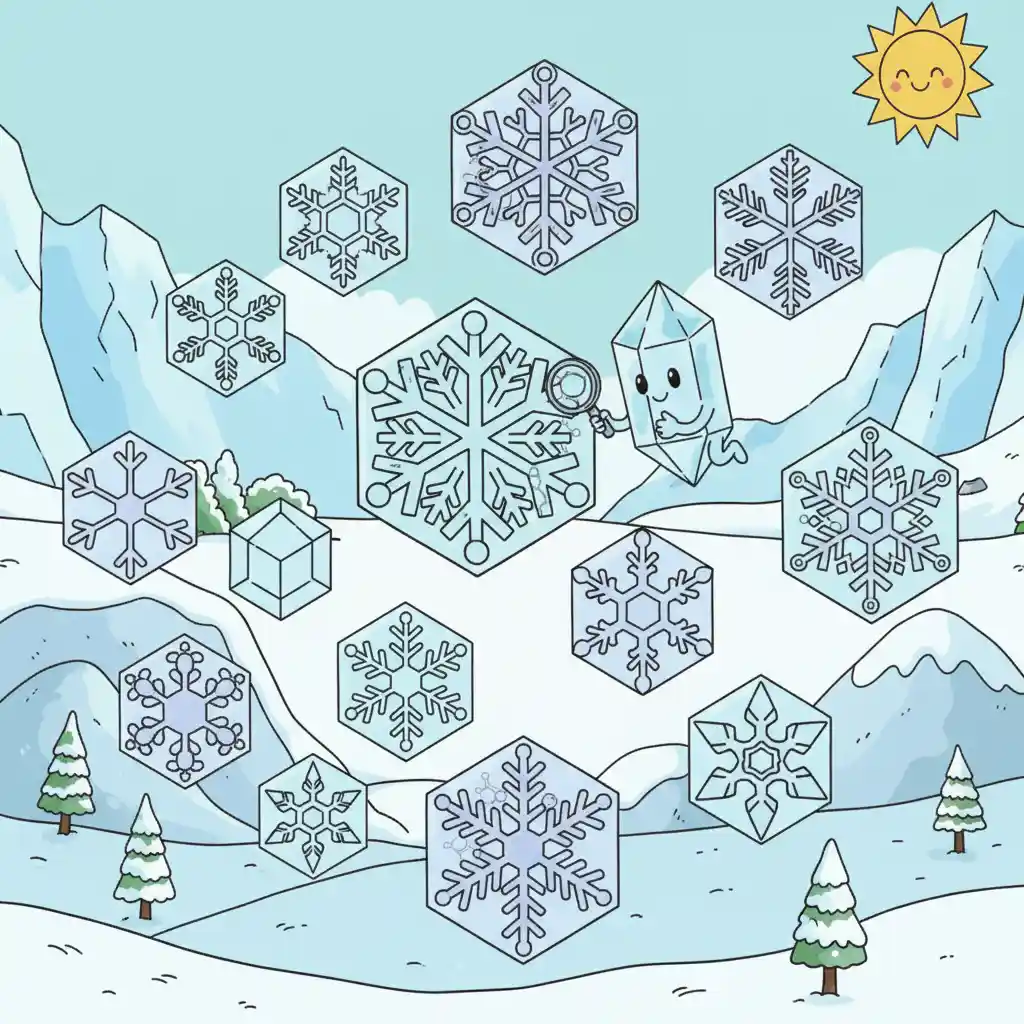
The Six-Sided Rule
Every snowflake begins its life as a tiny hexagonal crystal. This isn't a coincidence; it’s a law of chemistry. When water molecules ($H_2O$) freeze, they prefer to 'hold hands' in a very specific way, forming a ring with six sides. Because the foundation is a hexagon, the entire structure must follow that pattern. This is why you will never find a natural snowflake with five or eight sides—they are always hexagonal.
The Birth of a Flake
A snowflake doesn't just appear out of thin air; it needs a 'seed.' This is usually a microscopic speck of dust or a grain of pollen floating high in a cloud. When the temperature drops, water vapor begins to stick to this speck, freezing instantly. As the speck travels through the cloud, more water vapor attaches to the corners of the original hexagon, causing the 'arms' of the snowflake to grow outward.
A Unique Journey
You’ve likely heard that no two snowflakes are exactly alike. This is because every single flake takes a different path from the cloud to the ground. One flake might pass through a patch of extra-wet air, making its arms grow thick, while another hits a cold, dry gust that makes its branches thin and sharp. Since no two flakes experience the exact same sequence of wind and temperature, their final shapes are all unique.