
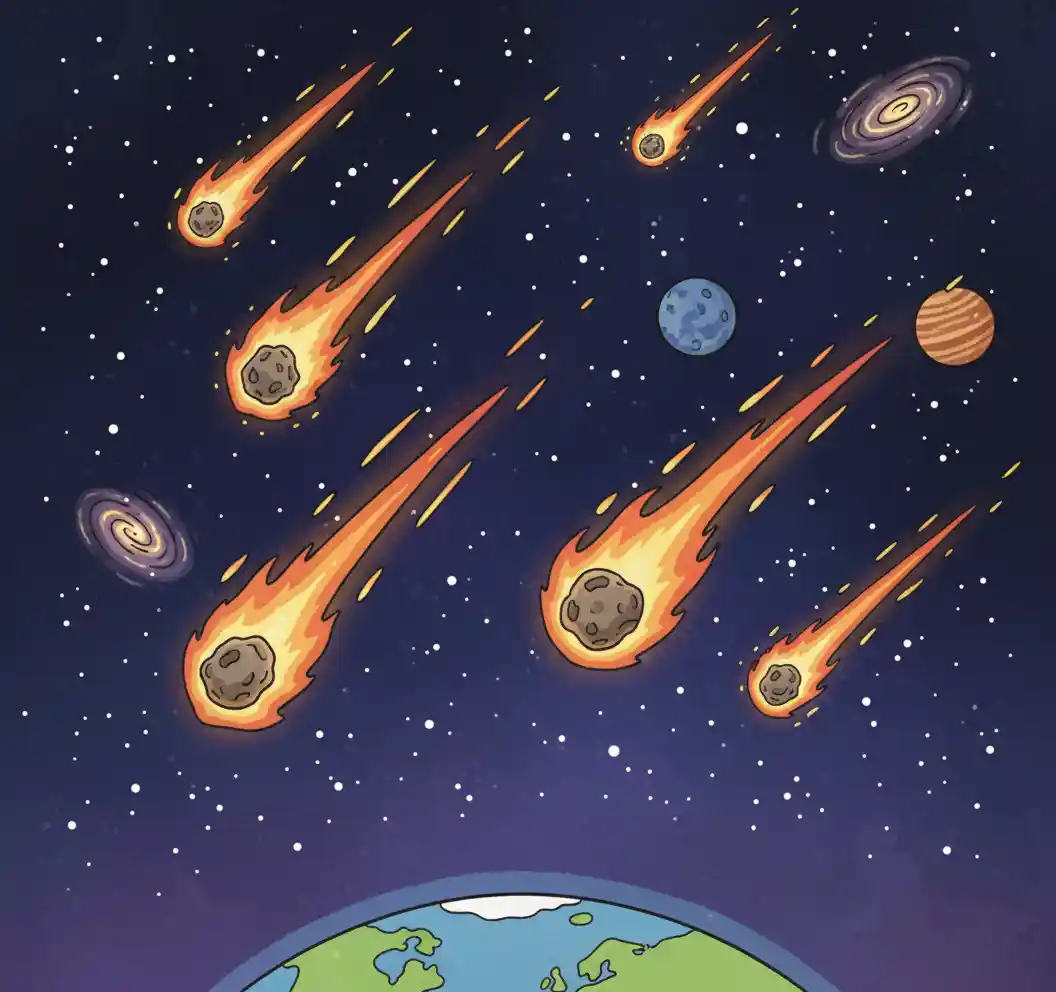
The Great Imposter
When you see a bright flash of light zip across the night sky, it’s easy to think a star is falling. But stars are massive balls of burning gas trillions of miles away. If a real star fell toward Earth, the whole solar system would be in big trouble!
What you are actually seeing is a 'meteor.' These are tiny pieces of rock or dust floating in space. Most of them are no bigger than a pebble or even a grain of sand, but when they meet Earth's atmosphere, they become the brightest things in the sky.
Hitting the Air Wall
Space is a vacuum, so there's nothing to slow these rocks down. They zoom toward Earth at speeds up to 45 miles per second! When they hit our atmosphere, they aren't hitting empty space—they are hitting a 'wall' of air molecules.
Even though air feels light to us, hitting it at 160,000 miles per hour creates an incredible amount of friction. This friction generates intense heat, reaching temperatures of over 3,000 degrees Fahrenheit in a split second.
The Glowing Trail
As the space rock (called a meteoroid) heats up, it begins to vaporize or burn away. The glowing streak you see isn't necessarily the rock itself, but the air around it glowing white-hot.
It’s like a cosmic eraser mark. The rock is moving so fast that it leaves a trail of 'plasma'—super-heated gas—behind it. This is the beautiful tail that you see when you make a wish.