
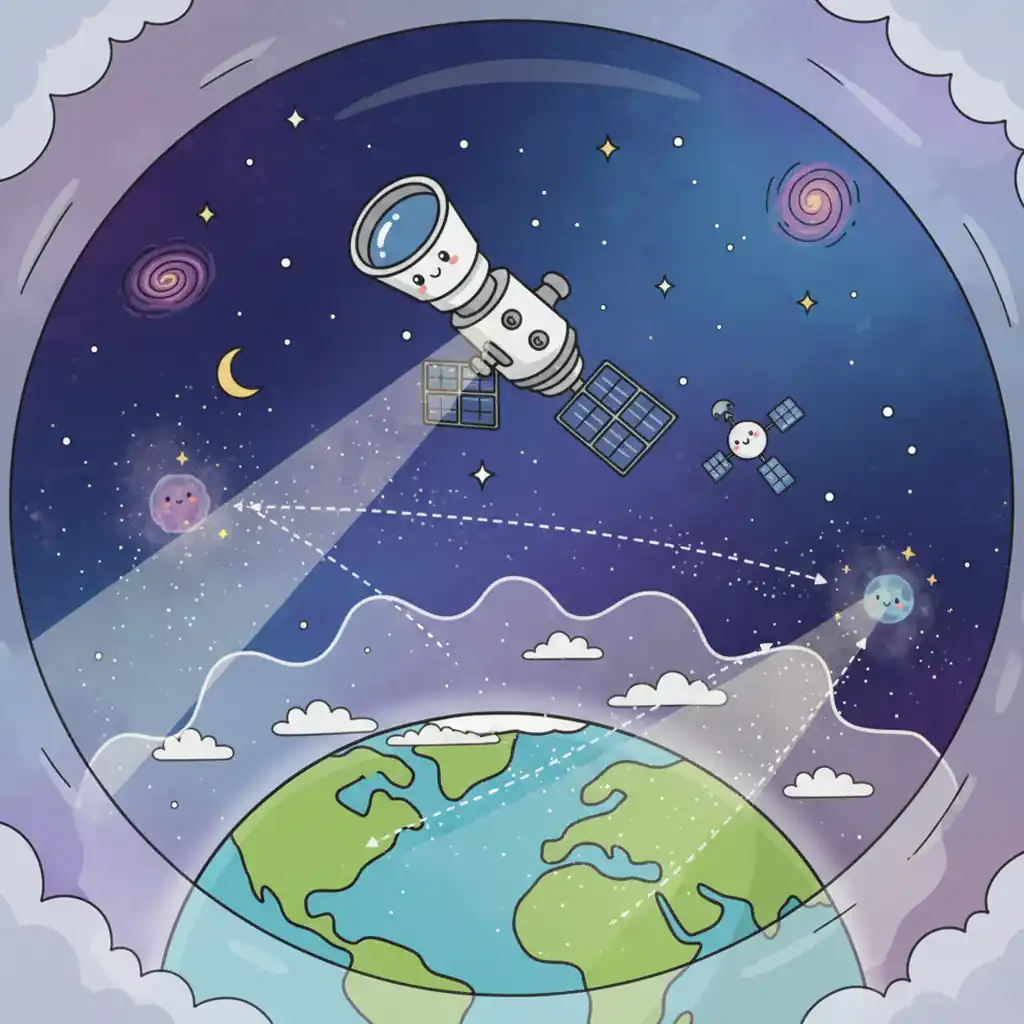
Stargazing: A Peek at the Universe
Have you ever looked up at the night sky and wondered about the twinkling stars, the glowing Moon, or the distant planets? For thousands of years, humans have been fascinated by the cosmos, trying to understand what's out there. Our eyes are amazing, but the universe is so vast and full of faint, far-off wonders that we need special tools to truly see it. That's where telescopes come in!
A telescope is like a giant, super-powered eye that helps us gather more light from distant objects than our own eyes ever could. It makes faraway stars and galaxies appear brighter and closer, allowing us to explore incredible sights like swirling nebulae, distant planets with rings, and galaxies shaped like spirals or footballs. But sometimes, even with the biggest telescopes on Earth, our view is still blurry or incomplete. Why is that?
The Blurry Blanket: Earth's Atmosphere Problem
Imagine trying to read a book from across a swimming pool that's full of wavy, moving water. The words would look blurry and distorted, right? That's a bit like what happens when we try to look at space from Earth. Our planet is wrapped in a thick blanket of air called the atmosphere. This atmosphere is fantastic because it gives us air to breathe and protects us from harmful radiation, but it's not so great for stargazing.
The air in our atmosphere is always moving, swirling, and has different temperatures. When light from a distant star travels millions of miles to reach us, it has to pass through this turbulent air. Each time the light hits a pocket of warm or cool air, or dust particles, it gets bent and scattered a little bit. This is why stars seem to 'twinkle' in the night sky – it's not the star changing, but our atmosphere wiggling its light around!
All this bending and scattering makes images blurry. Even the biggest telescopes on mountains can't escape this 'wavy water' effect completely, making it hard to see fine details on planets or study faint, distant galaxies with perfect clarity. It's like trying to take a super sharp photo through a constantly shimmering window.
Light's Secret Superpowers: Beyond What We See
Did you know that the light we see with our eyes – the colors of the rainbow – is only a tiny fraction of all the light in the universe? Scientists call all the different types of light the 'electromagnetic spectrum.' Besides visible light, there's radio waves, microwaves, infrared light (which feels like heat), ultraviolet light (which gives you a sunburn), X-rays, and even super-powerful gamma rays!
Each of these types of light carries different information about objects in space. For example, hot, energetic explosions might give off X-rays and gamma rays, while cooler dust clouds might glow in infrared. Imagine if you could only see the color blue; you'd miss out on so much of the world's beauty! Our atmosphere acts like a pair of special sunglasses that only lets visible light (and some radio waves) through to the ground.
It completely blocks most of the infrared, ultraviolet, X-rays, and gamma rays from space. This is great for protecting us from harmful radiation, but it means Earth-based telescopes can't 'see' the universe in these other important 'colors.' To get a complete picture of the cosmos, we need to observe all these different kinds of light.
Eyes in the Sky: Why Go to Space?
So, if the atmosphere is the problem, what's the solution? Simple! Get above it! This is why scientists launch telescopes into space. When a telescope is orbiting Earth, high above the atmosphere, it has a perfectly clear and stable view of the universe. There's no air to bend or scatter the starlight, so the images it captures are incredibly sharp and detailed.