
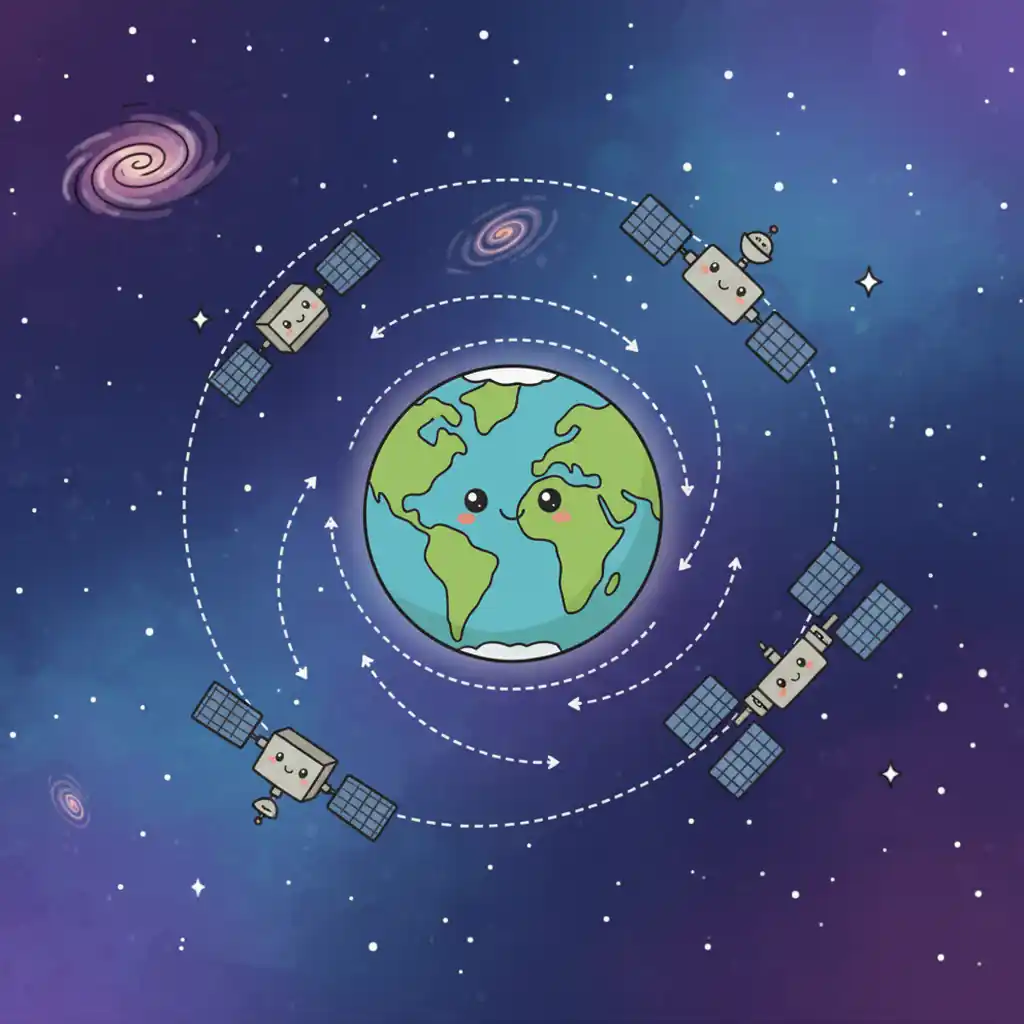
The Great Space Somersault: Falling Without Landing
Imagine playing catch with a friend. You throw the ball up, and gravity pulls it back down. Simple, right? But what if you could throw that ball so incredibly hard and fast that it went all the way around the Earth instead of hitting the ground? That’s exactly what satellites do!
It sounds a bit like magic, but it’s pure science. A satellite isn't floating aimlessly in space; it's actually in a continuous state of 'falling.' But here's the clever trick: it's also moving sideways at such an astonishing speed that as it falls, the curved surface of the Earth constantly drops away beneath it. So, it keeps falling around the Earth, forever missing the ground! This amazing cosmic dance is called an orbit, and it’s how everything from the International Space Station to the satellites that bring you TV stays up in the sky.
Gravity's Invisible Tug-of-War
To understand orbits, we first need to remember gravity. Gravity is the invisible force that pulls everything with mass towards everything else with mass. Earth has a lot of mass, so its gravity pulls hard on everything, including you, an apple falling from a tree, and yes, even far-off satellites.
So, if gravity is always pulling, why doesn't a satellite just crash down? The secret is a delicate but powerful balancing act. Gravity is constantly trying to pull the satellite inward towards the Earth. But the satellite’s incredible speed creates a force that tries to make it fly outward into deep space. When these two forces—gravity's pull and the satellite's outward push (due to its momentum or inertia)—are perfectly matched, the satellite stays in a stable orbit, circling our planet without falling or flying away. It’s a constant tug-of-war, and the satellite is the rope!
Speed is the Superpower: The Need for Incredible Velocity
Just how fast does a satellite need to go to keep from crashing? We're talking mind-boggling speeds! For example, the International Space Station (ISS), where astronauts live and work, zooms around Earth at approximately 17,500 miles per hour (about 28,000 kilometers per hour)! To give you an idea, a commercial airplane flies around 500 mph. The ISS is moving over 35 times faster!
This extreme speed is crucial. If a satellite were to slow down too much, gravity would quickly win the tug-of-war, and the satellite would start spiraling down into the atmosphere, eventually burning up or crashing. On the other hand, if a satellite went too fast, it could overcome Earth's gravitational pull entirely and shoot off into space, becoming lost forever among the stars. There’s a very specific 'orbital velocity' needed for each altitude to keep that perfect balance.
Not All Orbits Are Alike: Different Paths for Different Jobs
Just like there are different types of roads for different vehicles, there are many different types of orbits for different satellites, depending on their mission.
Low Earth Orbit (LEO): These are the 'express lanes' closest to Earth, typically a few hundred miles (200-1,200 miles / 320-1,900 km) up. Satellites here travel super fast, completing an orbit in about 90 minutes. The ISS is in LEO, as are many weather and Earth-observing satellites that need to take detailed pictures or collect data close-up. Because they are lower, they experience a tiny bit of atmospheric drag, which means they might need a little push from small thrusters every now and then to stay in orbit.
Geosynchronous Orbit (GEO): These are the 'stationary lookout' orbits, much higher up, at about 22,236 miles (35,786 kilometers) above the equator. The incredible thing about GEO satellites is that they travel at the exact same speed that the Earth rotates! This makes them appear to hover over the exact same spot on Earth all the time. This is perfect for communication satellites (like those for TV, radio, or internet) because ground antennas don't have to constantly move to track them.
Polar Orbits: These satellites travel from pole to pole, crossing over the North and South Poles. As the Earth spins beneath them, they can 'see' almost every inch of the planet's surface over several orbits. These are fantastic for mapping, climate monitoring, and reconnaissance.